
Ex-Formula 1 engineers built Britain’s new cheap cruise missile
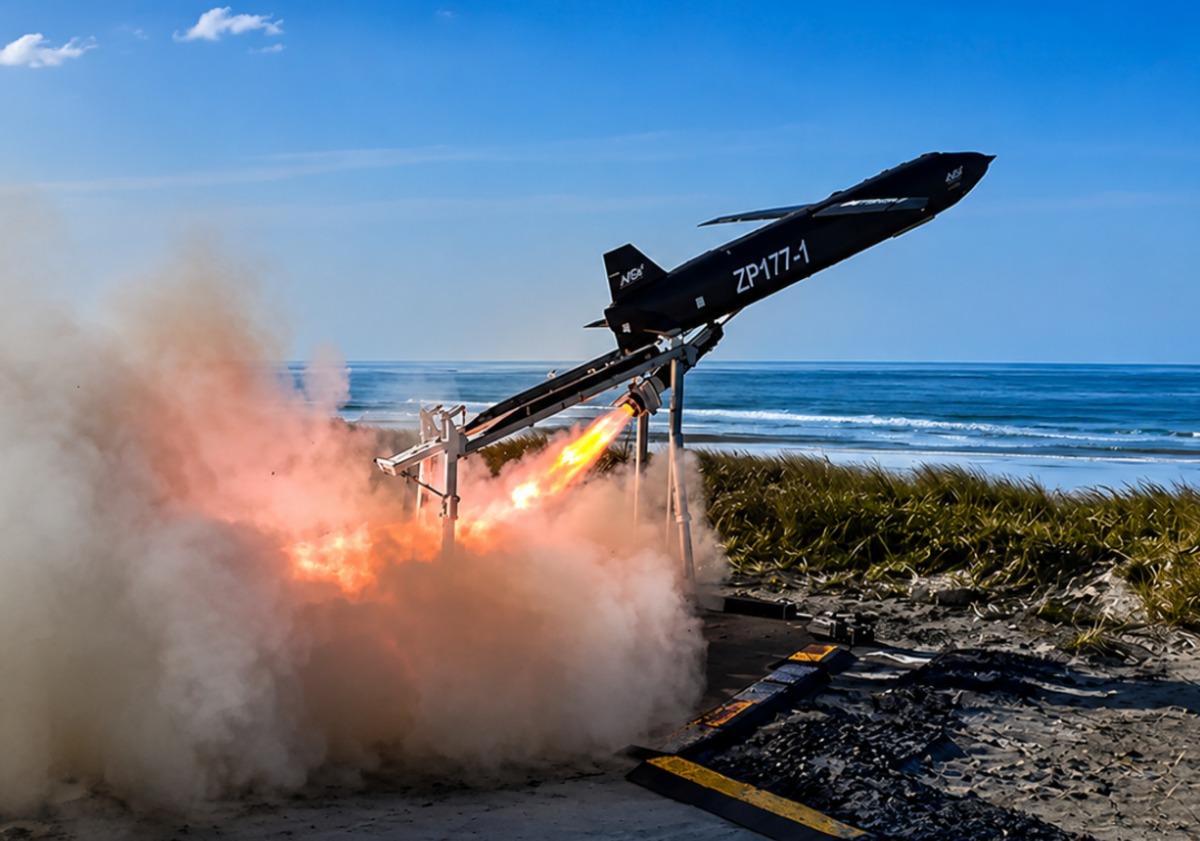
A British engineering company that spent decades building Formula 1 race cars has announced it will start delivering a weapon that flies faster than 460 mph, carries a 300-kilogram (661-pound) payload, and never comes back from its mission.
MGI Engineering, a defense firm based in Witney, Oxfordshire, announced that its TigerShark autonomous strike drone is coming soon, describing the system as a high-speed, one-way effector built for deep-strike missions against defended or distant targets. A one-way effector is the defense industry’s term for a weapon that flies to its target, strikes it, and is never recovered or reused, placing TigerShark in a category that functions much like a cruise missile while costing a fraction of what traditional missiles like Storm Shadow or Tomahawk run per unit.
According to the specifications MGI released, TigerShark can reach a maximum speed of 750 kilometers per hour (466 mph) and cover a range of 900 kilometers (559 miles) at cruise speed, carrying a modular 300-kilogram payload that can be configured for either high-explosive strikes or electronic warfare missions designed to jam or disrupt enemy sensors and communications rather than physically destroy a target. The drone is built to operate fully autonomously in GPS-denied environments, meaning it can navigate and strike its target even when an adversary jams or spoofs the satellite signals most modern weapons depend on for guidance, a growing concern for Western militaries as electronic warfare has become a defining feature of the war in Ukraine.
“TigerShark enables defence forces to engage defended or distant targets with speed, precision, and autonomy, without relying on satellite navigation or real-time control. Its guidance suite combines inertial navigation with GPS-free terrain mapping for reliable operation in GPS-denied and spoofed environments,” MGI said.
That guidance approach relies on two complementary technologies working together rather than a single navigation method. Inertial navigation tracks a vehicle’s position by continuously measuring its own acceleration and movement from a known starting point, a technique that works without any external signal but can drift off course over long distances if left uncorrected, while the terrain-mapping component compares what TigerShark’s sensors see below it against pre-loaded maps of the landscape to continuously verify and correct its position. Combining both systems lets the drone maintain accurate targeting even in contested airspace where an enemy has knocked out or corrupted GPS signals entirely, a capability MGI has developed in partnership with Auterion, a software company that supplies the autonomy core running TigerShark’s flight and navigation systems.
MGI first unveiled TigerShark publicly at the DSEI defense exhibition in London in September 2025, positioning it as a lower-cost, sovereign British alternative to established cruise missile systems at a moment when Western militaries have grown increasingly concerned about how quickly they can replenish expensive munitions stockpiles during a prolonged conflict. The drone completed its first flight tests in April 2026, a milestone Auterion’s founder and CEO described at the time as the first successful European test of a system in this weight and range class in more than a decade, placing TigerShark in what the industry classifies as a Group 4 unmanned aircraft system, the heaviest weight category typically reserved for large, long-range platforms rather than small tactical drones.
“Built for coordinated launch and rapid deployment, TigerShark can be fired as a salvo from a land-based vehicle launcher to overwhelm or degrade enemy defences. Its modular payload bay supports a wide range of mission types, from warhead delivery to electronic disruption,” MGI said.
Firing weapons in a coordinated salvo, launching multiple munitions in rapid succession from the same platform, matters because modern air defense systems can typically only track and intercept a limited number of incoming threats at once, meaning a swarm of simultaneously launched drones stands a better chance of overwhelming those defenses than a single missile fired alone. TigerShark launches from a ground-based vehicle using rocket-assisted takeoff, a system that provides the initial thrust needed to get the drone airborne before its twin turbojet engines take over for sustained flight, allowing the weapon to be fired from mobile launchers rather than requiring a fixed launch site that would be vulnerable to enemy targeting.
TigerShark’s development sits within a broader British government effort called Project Brakestop, a Ministry of Defence initiative designed to accelerate development of long-range autonomous strike systems through closer collaboration between the government and private industry. MGI has received a development contract under that program and showcased TigerShark at a Project Brakestop industry event in June 2026 alongside the UK’s Secretary of State for Defence, competing for the program’s eventual production contract against at least two rival systems, MBDA UK’s Crossbow One-Way Effector and Rotron Aerospace’s propeller-driven SkyLance, both of which offer broadly similar payload capacities but rely on different propulsion approaches to reach their target speeds and ranges.
MGI has said it intends to scale up TigerShark production during the fourth quarter of 2026 and continuing into 2027, and the company’s latest announcement specifically listed the drone as available starting in October 2026, manufactured entirely within the United Kingdom and licensed for export to allied nations. That export focus reflects how MGI has positioned TigerShark from the outset, framing it as a capability British allies can acquire and iterate on faster than they could with a traditional cruise missile program, while paying substantially less per unit for a weapon that shares much of the same operational logic as far more expensive systems currently in Western arsenals.
Content preview only. Full article available at source. View Full Article
MGI Engineering announced the upcoming delivery of the TigerShark autonomous strike drone, designed for deep-strike missions, with capabilities including speeds over 460 mph and a range of 900 km. The drone can carry a 300 kg payload for various mission types and operates autonomously in GPS-denied environments. Production is expected to scale up in late 2026, with the drone available for export to allied nations.
- MGI Engineering is developing the TigerShark drone, capable of speeds over 460 mph and a range of 900 km.
- The drone can carry a 300 kg payload for high-explosive or electronic warfare missions.
- TigerShark operates autonomously in GPS-denied environments, using inertial navigation and terrain mapping.
- The drone is part of Project Brakestop, aimed at accelerating the development of long-range autonomous strike systems.
- Production of TigerShark is set to scale up in late 2026, with availability for export to allied nations.