
Expanded dining options popular among soldiers, US Army officials say

The U.S. Army is continuing to roll out pilot programs aimed at improving soldiers’ diets, including expanded, campus-like dining hall options and partnerships with restaurant franchises — and reporting high soldier satisfaction with the changes.
“Chow halls operated on decades-old schedules that clashed with modern soldier work shifts,” Jason Condrey, acting deputy chief of staff of Army Materiel Command, said Wednesday at the Association of the United States Army annual meeting in Washington, D.C.
Changing how, when and where service members can eat is an ongoing process, with new programs, such as flexible eating and extended dining (FEED) and campus-style dining venues (CSDV), available at select Army installations in the continental U.S.
CSDVs launched in September 2025 and are currently available at five different Army installations: Fort Bragg, North Carolina; Fort Stewart, Georgia; ort. Carson, Colorado; Fort Hood, Texas; and Fort Drum, New York. They are operated by private contractors, unlike traditional garrison dining halls that are operated by the base and staffed by soldiers.
The panel of Army officials on Wednesday touted the popularity of the new dining facilities.
“[At] Fort Carson alone ... we’re looking at about 67% utilization from the soldiers that live in the barracks, and another 56% for the soldiers that live at Fort Hood,” Sgt. Maj. Damarco Wyatt of Army Materiel Command said.
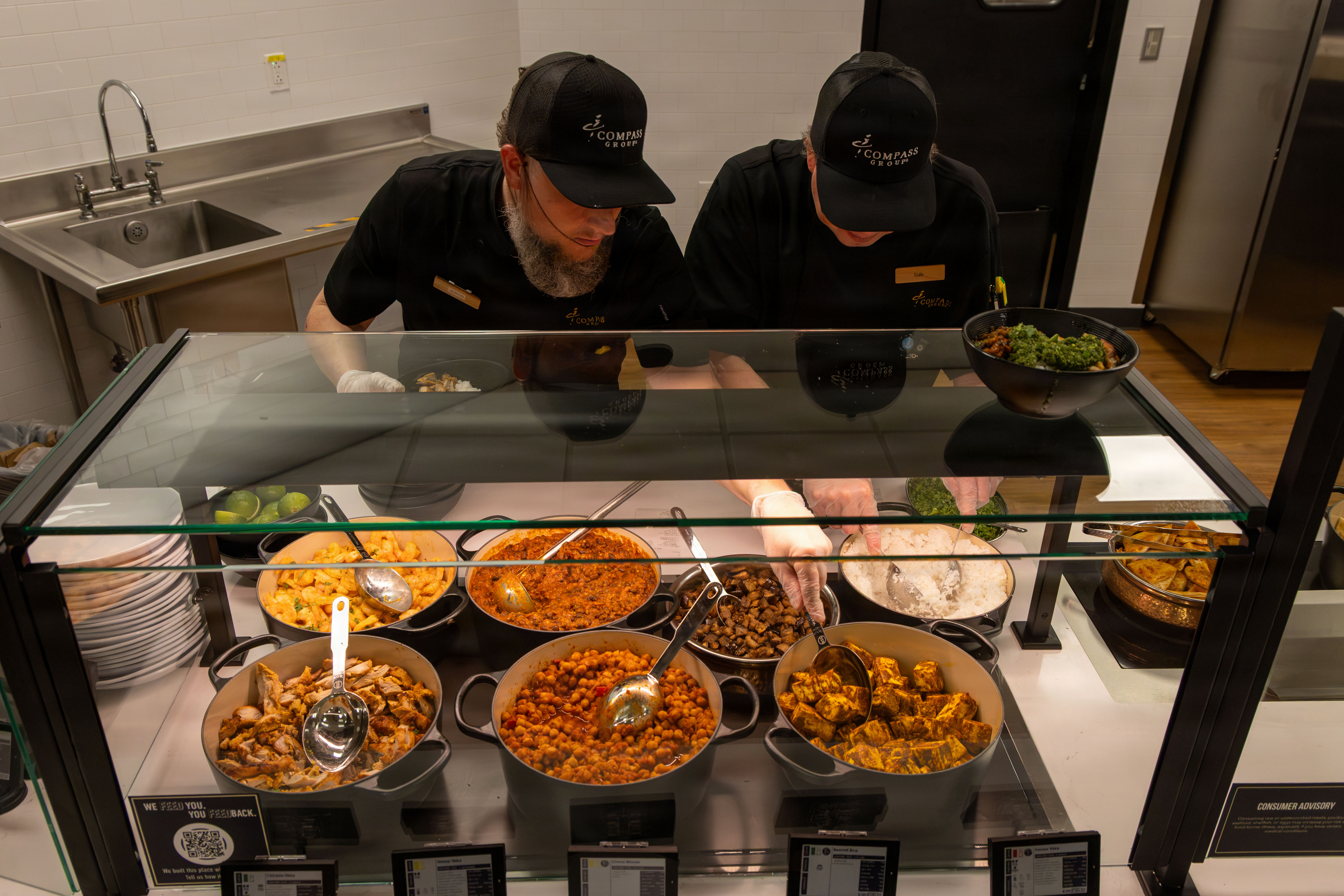
Dependents can dine with their soldiers at CSDVs, Wyatt added, though they still must pay for their meals. Traditional garrison dining halls typically allow dependents only under specific circumstances, like holidays.
“If we look at the two that have been open the longest — at Hood and at Carson — Hood’s a very large installation, and yet the Army is serving about 55% of its meals from the CSDV,” said Sydney Smith, director of materiel management at the Office of the Deputy Chief of Staff. “At Carson, about 85% of meals are being served out of that one CSDV.”
Soldiers who are of legal drinking age can purchase wine, beer, cider and hard seltzer during specific hours at Fort Hood’s CSDV, though it’s unclear whether other installations will offer alcohol. The decision is being left to each installation’s senior commander, the commanding general of Army Materiel Command said in February.
The Army’s commercial partners are responsible for outfitting the dining facilities for service.
“The contractors are willing to pay for that themselves, so that they can be successful,” said Scott Kindberg, executive director for support operations at the Army Sustainment Command.
Some critics have questioned the decision to hand over food production to commercial entities, citing past problems with commercially built military housing. Still, the Army plans to expand the CSDV program beyond the five current installations.
The service’s efforts are part of a broader quality-of-life initiative across the military to offer troops better dining experiences. Earlier this month, Camp Pendleton, California, opened a chow hall drive-thru to better serve Marines and sailors.
The U.S. Army is rolling out pilot programs to enhance soldiers' dining experiences with campus-style dining venues at five installations, including Fort Bragg and Fort Hood, starting in September 2025. These facilities, operated by private contractors, have reported high utilization rates among soldiers, with Fort Carson seeing 67% usage. The Army aims to expand this initiative as part of a broader quality-of-life improvement effort for service members.
- The U.S. Army is implementing pilot programs for improved dining options.
- Campus-style dining venues (CSDVs) are operational at five installations.
- CSDVs allow dependents to dine with soldiers, which is a change from traditional policies.
- Fort Carson has a 67% utilization rate for the new dining facilities.
- The Army plans to expand the CSDV program beyond the initial five installations.