
Experts call for halt of AI chip exports to China after White House distillation warning
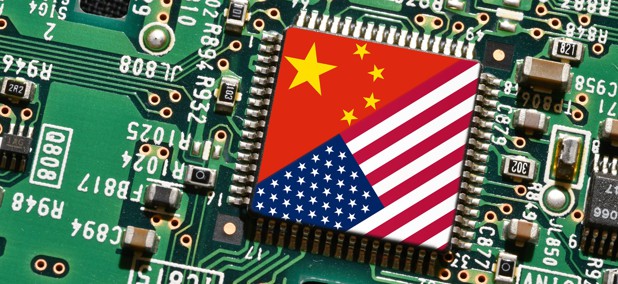
The Trump administration is facing new calls to halt U.S. exports of advanced AI chips to China after the White House warned last week that Beijing is attempting to copy components of American AI systems to build similar models of its own.
Americans for Responsible Innovation, an AI policy advocacy group, told White House Office of Science and Technology Policy Director Michael Kratsios that the administration should bar exports of advanced chips that could help China use U.S. AI systems to develop similar capabilities, according to a letter sent Monday that was first seen by Nextgov/FCW.
It comes after OSTP last Thursday accused China and other foreign nations of engaging in “deliberate, industrial-scale campaigns to distill U.S. frontier AI systems,” and said the Trump administration will be taking steps to safeguard domestic AI systems. Distillation campaigns involve sending large volumes of queries to an AI model to train a competing version.
The push comes as exports of advanced chips, such as Nvidia’s H200, remain in limbo. The Trump administration approved limited H200 sales earlier this year, but none have reached China. Commerce Secretary Howard Lutnick said last week that “we have not sold them chips as of yet” and that Beijing has not allowed domestic firms to purchase the hardware.
The letter argues that China cannot effectively replicate capabilities derived from U.S. AI tools if it doesn’t have access to cutting-edge chips.
“If we are serious about preventing adversaries from appropriating the capabilities of U.S. frontier models, we must be equally serious about restricting their access to the computational infrastructure that enables adversarial distillation, as well as the training and deployment of models built on data obtained through such malicious activity,” said the letter, which is signed by ARI executive director Eric Gastfriend.
Nextgov/FCW has asked OSTP and the Commerce Department for comment.
Hardware like Nvidia’s H200 underpins the computing power needed to train and run powerful AI models, including the large-scale querying required for distillation campaigns. Limiting access to those chips could slow China’s ability to develop and deploy competing models, though it likely wouldn’t halt those efforts altogether.
“Nation-state level AI competition is very, very real, and has been going on for some time, and it continues to increase in its intensity and sophistication,” Peter Kant, CEO of Enabled Intelligence, said in an interview. Distillation efforts are “a whole new attack vector and domain that will only increase over time. I don’t see this [White House memo] as a one-off at all,” he added.
Anthropic in February accused three Chinese-based AI companies — DeepSeek, Moonshot AI and MiniMax — of overwhelming its Claude model with 16 million exchanges from roughly 24,000 fraudulent accounts.
The same month, OpenAI sent a letter to members of the House China Select Committee that said it had seen evidence “indicative of ongoing attempts by DeepSeek to distill frontier models of OpenAI and other US frontier labs, including through new, obfuscated methods.”
Last week’s White House warning about China-based distillation campaigns marks the latest escalation in the U.S.-China race for AI dominance. It comes as major American firms are deploying increasingly advanced models with cybersecurity capabilities that could pose national security risks if they fall into the wrong hands.
A small group of unauthorized users has accessed Anthropic’s new Mythos AI model, which the company previously said has identified thousands of vulnerabilities and is powerful enough to enable dangerous cyberattacks, Bloomberg News reported last week.
“This is just the early days,” Lonny Anderson, president of BlueVoyant Government Solutions and former chief technology officer of the NSA, told Nextgov/FCW. “This is only gonna get faster and it’s gonna get more dramatic.”
The U.S. government faces pressure to halt AI chip exports to China following warnings about China's efforts to replicate American AI systems. Americans for Responsible Innovation urged the administration to restrict access to advanced chips like Nvidia's H200, citing national security risks. The White House has accused China of conducting industrial-scale campaigns to distill U.S. AI technologies, raising concerns about the implications for AI competition.
- The Trump administration is urged to stop AI chip exports to China.
- The White House warned about China's attempts to replicate U.S. AI systems.
- Americans for Responsible Innovation sent a letter advocating for export restrictions.
- Nvidia's H200 chips are central to the discussion on AI capabilities.
- Distillation campaigns by China are a concern for U.S. national security.