
Falcon shot down for the first time over Ukraine, revealing the weakness of the Russian anti-drone layer in 2026
 Dmitri Volkov
The Falcon Shot Down for the First Time Over Ukraine Shows the Weakness of the Russian Counter-Drone Layer in 2026
About a month passed between the public demonstration of the new Russian UAV "Falcon" and its first confirmed destruction by a Ukrainian interceptor. For military equipment, this is not a testing period, but almost an instant combat check. That is why the report from the 57th Separate Motorized Infantry Brigade named after the Cossack Ataman Kostya Hordiienko, transmitted to Ukrinform on June 29, deserves more attention than a typical news story about a downed drone. This is not about a rare trophy, but about the fate of an entire class of solutions that the Russian army is trying to use to close the most painful gap in the front — the protection of troops from Ukrainian strike and reconnaissance drones.
What is Known About the "Falcon"
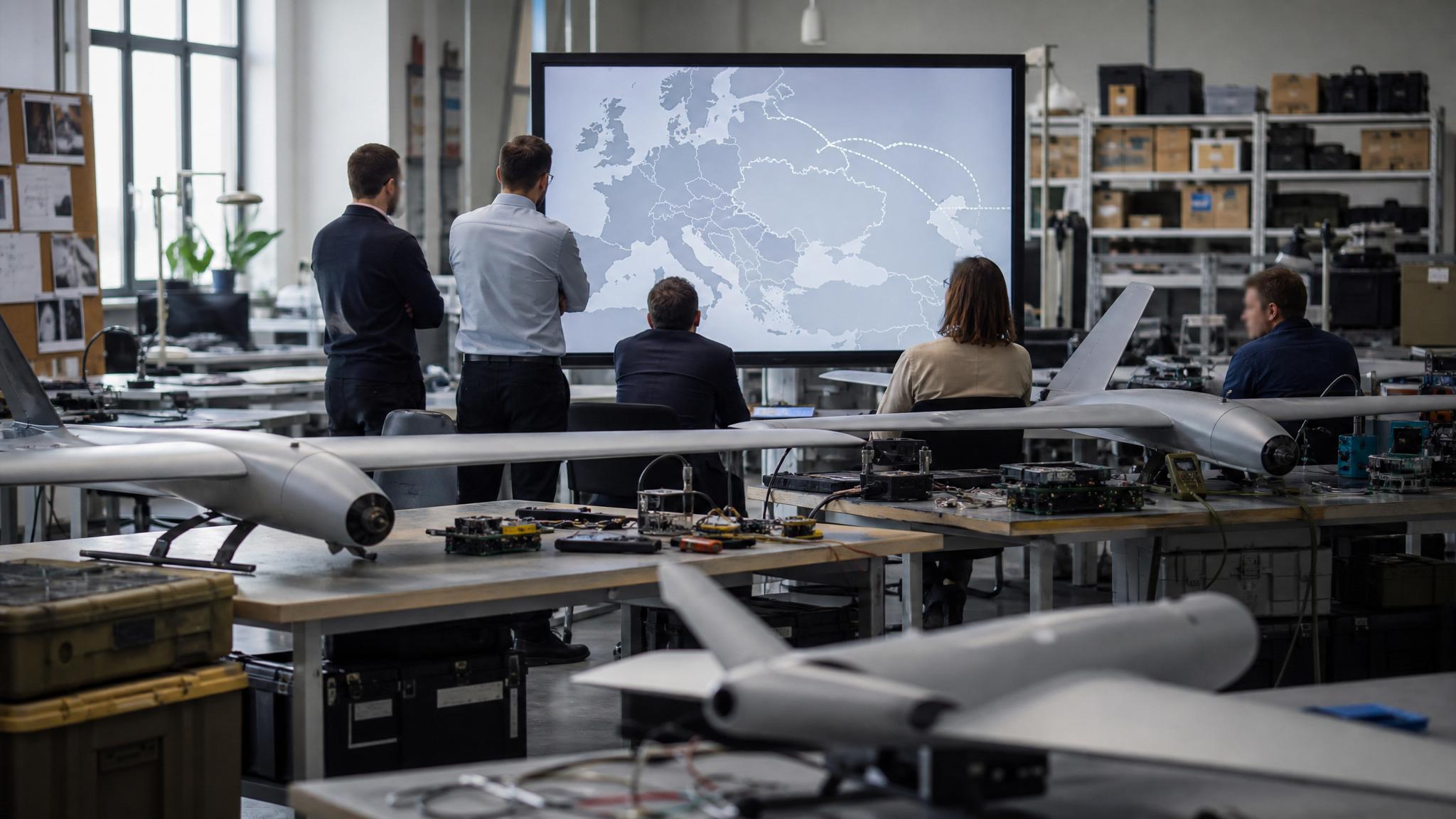
According to the Ukrainian report, operators of the 57th Brigade shot down the Russian "Falcon" using the General Cherry AIR interceptor. The Russian side presented the "Falcon" as a counter-drone system: it was supposed to target Ukrainian reconnaissance and strike devices, acting not as a classic air defense missile, but as a small aerial hunter. The claimed Russian specifications appear moderately ambitious: a speed of up to 150 km/h, an operational altitude of up to 5,000 meters, a foam material body, and target engagement either by remote detonation or kinetic ramming. All these figures require cautious consideration, as they come from a party interested in demonstrating success. But even if taken as an upper limit, the picture is indicative.
150 km/h is a speed sufficient to intercept some slow reconnaissance quadcopters, loitering munitions, and improvised strike platforms, but insufficient to turn the "Falcon" into a universal counter-UAV tool. An altitude of 5,000 meters expands the theoretical operational zone; however, in real frontline air, it is not the passport ceiling that matters, but the ability to detect a target, receive a guidance command, maintain communication under electronic suppression, and not be intercepted itself. The Russian engineering school knows how to create simple and crude solutions. The problem is that the war of 2026 requires not only crudeness but also network discipline.
Why One Downed Device is More Important Than Its Cost
In a normal army, the emergence of a counter-drone UAV would be an element of a layered system: sensors, electronic warfare, small radars, automated target distribution, standby interceptors, repair, and reuse. In recent years of Russian practice, a different order often arises: first, a product is showcased, then it is sent to the front, and only after a combat failure does the search for tactics begin. This resembles the late Soviet habit of closing systemic deficits with a separate "product," but without the Soviet industrial depth and with a much clearer battlefield.
According to Ukrinform, the same day provided a broader context: on June 29, the Ukrainian General Staff recorded 227 combat engagements, 78 Russian airstrikes, 237 guided aerial bombs, 9,618 uses of kamikaze drones, and 2,835 artillery shellings. These numbers are important not as daily arithmetic but as a description of the density of war. The Russian army is simultaneously trying to pressure with mass infantry, aerial bombs, and cheap drones. In such an environment, the counter-drone "Falcon" must not only fly but operate serially, cheaply, and daily. The first confirmed episode shows the opposite: the Ukrainian side has already found a way to defeat the new Russian hunter with means of the same class.
The Lyman Direction and the Cost of Air Defense
The Lyman direction makes this story particularly significant. A representative of the Joint Forces of Ukraine, Viktor Trehubov, stated to Ukrainian Radio that Russian forces are trying to expand the bulge north of Lyman and establish themselves on its eastern outskirts; according to him, the number of clashes in the area has increased by about one and a half times, as have Russian losses — up to 250–300 people per day in the area of responsibility, mainly around Lyman. If this assessment is taken as Ukrainian rather than neutral statistics, it still points to a familiar Russian scheme: increasing pressure on an operationally important node amid rising losses and supply problems.
Here, counter-drone means become not a luxury but a condition for an offensive. Infantry moving towards Yampol or the eastern outskirts of Lyman without a stable umbrella from Ukrainian reconnaissance UAVs quickly turns into a visible target for artillery, FPV, and mortars. A Russian commander may demand pace, but a Ukrainian drone adjusts the economics of that pace. Therefore, the "Falcon" should be viewed as an attempt to restore at least some tactical stealth to Russian units. Its loss in the very first month after its public appearance does not indicate that the program is useless, but rather that it enters combat in an extremely unfavorable environment.
Industrial Logic and Its Limits
The "Falcon" has a rational kernel. The foam material reduces costs and simplifies production; kinetic ramming or a small remote charge is cheaper than a missile; the device can be produced in small batches at distributed sites. This is precisely the logic that the Russian defense industry is now forced to master under sanctions: not an elegant complex, but a disposable module that can be quickly replaced. The question is whether Russia has enough electronics, control channels, operators, and training cycles for such modules to become a mass system rather than another showcase batch.
Ukraine has an unpleasant advantage for Moscow in this area: it fights as a laboratory where the feedback loop between the front, the manufacturer, and a small team of developers is often shorter than the bureaucratic cycle. General Cherry AIR in the Ukrainian report appears not as a wonder weapon but as a sign of the maturity of the interceptor market. If one Ukrainian interceptor can destroy the new Russian counter-drone UAV shortly after its appearance, then each new Russian model will face not an empty sky but an already existing ecosystem of countermeasures. In Soviet terminology, this would be called a competition of means of attack and defense. In 2026, it is more a competition of supply chains and the speed of firmware updates.
Forecast
The first destruction of the "Falcon" does not mean that the Russian army will abandon counter-drone UAVs. On the contrary, it will expand this layer because it has no other cheap protection for advancing units. But the episode shows the limits of Russian adaptation: Moscow can quickly present a new device, but it is not always able to integrate it into a stable system of application faster than the opponent. If in the coming months the "Falcon" remains a rare product, it will become yet another symbol of Russian frontline improvisation. If it starts to be lost in series, it will no longer be a symbol but accounting — that same boring military accounting that is usually more honest than press releases.
The main conclusion is simple: in the drone war, it is not the one who first showcases a new device that wins, but the one who more quickly turns its loss into the next modification.
Sources: Ukrinform, June 29–30, 2026; report from the 57th Separate Motorized Infantry Brigade; summary from the General Staff of the Armed Forces of Ukraine; comment from Viktor Trehubov to Ukrainian Radio; Kyiv Independent, June 30, 2026.
Ukrainian forces shot down a Russian Sokol drone using a General Cherry AIR interceptor on June 29, 2026, marking the first confirmed destruction of this drone type. The incident highlights weaknesses in Russian drone defense capabilities and the challenges faced by their military in the ongoing conflict. The Ukrainian military reported a high level of combat activity on the same day, indicating an intense operational environment.
- The Sokol drone was shot down by Ukrainian forces using a General Cherry AIR interceptor.
- This incident marks the first confirmed destruction of the Sokol drone over Ukraine.
- The Sokol was intended as a counter-drone system by Russia.
- The report indicates a significant operational challenge for Russian forces in drone warfare.
- Ukrainian military reported a high number of combat engagements on the same day.