
Former military pilot explains why Poland let a Russian missile fly on
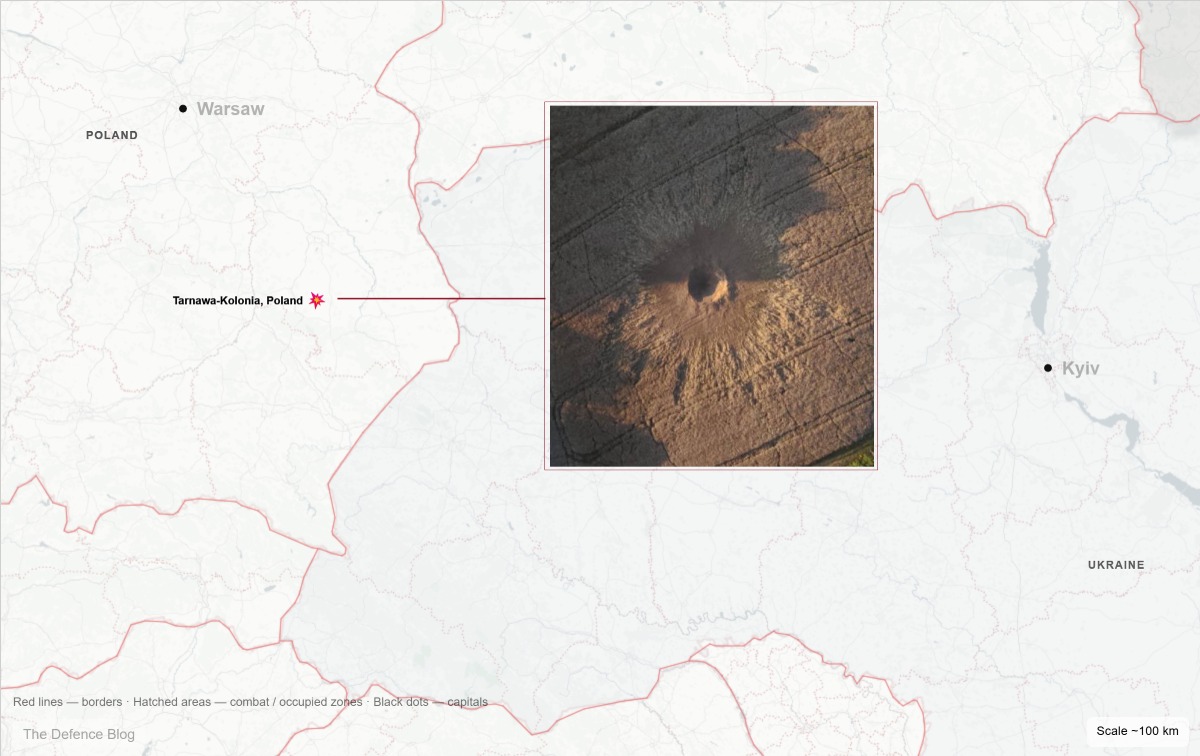
The Polish military had a fighter jet tracking a Russian cruise missile for six full minutes as it crossed Polish airspace early Thursday morning, yet no one pulled the trigger, and according to retired Polish military pilot Michał Fiszer, that was not a failure of the Polish Armed Forces but the predictable result of peacetime rules that never anticipated a missile flying straight through NATO territory.
The missile in question was almost certainly a Russian Kh-101, an air-launched cruise missile that crashed into a farm field near the village of Tarnawa-Kolonia in Poland’s Lublin Voivodeship on July 30, 2026, roughly 100 kilometers (62 miles) from the Ukrainian border, leaving a crater described by TechTimes as roughly 10 meters (33 feet) wide and 5 meters (16 feet) deep. Polish Prime Minister Donald Tusk confirmed at a press conference in Lublin that everything indicated the object was a Kh-101 and stated that Polish forces had been prepared to shoot it down had it continued flying deeper into Polish territory. No injuries were reported, since the missile came down in open, undeveloped ground rather than a populated area.
Writing on social media in the hours after the crash, Fiszer moved quickly to correct a mistake he said was spreading across Polish television coverage of the incident.
“The most important thing from our point of view are the cruise missiles, which, it’s worth emphasizing, are not ballistic, as television reports horrifyingly claim, that’s a different category. These are small automatically guided aircraft with their own small jet engines and folding wings that let them fly,” Fiszer said.
Fiszer detailed that Russia launched 61 cruise missiles as part of the broader overnight strike, with most identified as Kh-101 missiles launched from Tu-95MS and Tu-160 strategic bombers, typically released over the Caspian Sea from a distance safe enough that even if the missile’s engine failed to ignite after release, it would simply fall into the water rather than causing damage on land. A second missile type involved in the barrage, the 3M14 Kalibr, launches from both surface ships and submarines of Russia’s Black Sea Fleet and shares a broadly similar design concept with the Kh-101, both of which Fiszer compared functionally to the American BGM-109 Tomahawk cruise missile. These missiles cruise at speeds around 900 to 950 kilometers per hour (559 to 590 mph) and fly at altitudes of just 50 to 200 meters (164 to 656 feet), deliberately low enough to complicate both radar detection and any attempt to shoot them down.
That low-altitude flight profile directly explains why ground-based radar struggles against this kind of target, Fiszer wrote, since radar detection range depends heavily on how high above the ground the incoming object is flying, a relationship rooted in the curvature of the earth itself. According to his analysis, a missile flying at 100 meters (328 feet) can typically be detected from about 35 kilometers (21.7 miles) away, while one flying at 500 meters (1,640 feet) becomes visible from roughly 85 kilometers (52.8 miles), climbing to about 130 kilometers (80.8 miles) of detection range at 1,000 meters (3,281 feet) altitude and around 230 kilometers (142.9 miles) at 3,000 meters (9,843 feet).
The missile that eventually crashed in Poland had actually been tracked well before it crossed the border, according to Fiszer, after Ukrainian forces spotted it and attempted an unsuccessful intercept using a fighter jet over their own territory, then passed that tracking information to Polish authorities. The Ukrainian pilot broke off the pursuit just 20 seconds before he would have crossed into Polish airspace himself, a decision Fiszer described as involving genuine risk, since firing toward the missile’s flight path so close to the border risked the Ukrainian aircraft itself becoming the accidental target of any Polish response rather than the missile.
Poland’s response mobilized a substantial portion of its regional air defense network. The 32nd Tactical Air Base at Łask scrambled a pair of armed F-16C fighters toward the border region, while the 22nd Tactical Air Base at Malbork launched a pair of MiG-29s to cover the northern approach, according to Fiszer’s account. A pair of German Eurofighters from Tactical Air Wing 31 “Boelcke,” also armed, reportedly operated in the area, flying out of their home base in Nörvenich, Germany, and refueling from a single NATO Multinational Multi Role Tanker Transport Fleet Airbus A330 based in Eindhoven, Netherlands, which had launched from a forward base in Cologne. The Dutch 802 Air Defense Missile Squadron, operating Patriot batteries stationed near Rzeszów-Jasionka airport, also reached full combat readiness with missiles loaded on launchers.
Poland’s operational commander, Lieutenant General Ireneusz Nowak, indicated additional Polish air defense units had reached readiness as well, which Fiszer suggested likely included the 18th Anti-Aircraft Regiment at Zamość-Sitaniec, equipped with the Mała Narew short-range air defense system, and the 37th Sochaczew Air Defense Missile Squadron, operating Patriot PAC-3 MSE batteries and standing combat duty at Warsaw’s Bemowo airfield. Fiszer also noted that a Polish SAAB 340 airborne early warning aircraft, operating from the 44th Naval Aviation Base at Siemirowice and already active in prior operational missions dating back to at least September 2025, helped coordinate the fighter response throughout the incident.
Despite that substantial mobilization, no shot was fired at the missile before it crashed, and Fiszer argued that outcome reflected sound judgment rather than any operational failure. A decision to shoot down a cruise missile carries real risk, he explained, since a missile with this kind of warhead striking a populated village rather than open farmland would likely have caused fatalities given its destructive power, meaning commanders had to weigh the certain risk of debris from an intercepted missile against the uncertain risk of letting an unengaged missile continue on an unpredictable path. Because the missile’s trajectory never pointed toward a city or large population center, no shoot-down order was ultimately issued, and Fiszer credited the Polish military and its allies with handling the incident well precisely because the outcome was a crater in Lublin farmland rather than civilian casualties from falling debris.
Fiszer’s technical analysis of the crash itself supports the Kh-101 identification independent of official statements. The missile traveled through Polish territory for six minutes while covering 93 kilometers (57.8 miles), yielding a calculated speed of roughly 930 kilometers per hour (578 mph), squarely consistent with both the Kh-101 and 3M14 Kalibr’s typical cruise speed and notably slower than Ukraine’s own FP-5 Flamingo cruise missile, which Fiszer said uses a more powerful AI-25 engine derived from the L-39 Albatros trainer aircraft and normally flies closer to 940 to 960 kilometers per hour (584 to 596 mph), though production of that particular missile remains limited due to a scarcity of the discontinued engines needed to build it. The size of the crater, Fiszer wrote, roughly matches the destructive footprint of a 500-kilogram (1,102-pound) aerial bomb carrying about 210 kilograms (463 pounds) of explosive, consistent with the 450-kilogram (992-pound) warhead both the Kh-101 and Kalibr carry, of which slightly more than 200 kilograms (441 pounds) is typically composed of a modern plastic explosive compound more powerful than older RDX-based formulations.
Fiszer explicitly ruled out GPS or GLONASS jamming as the cause of the missile straying so far off course, noting that satellite navigation interference typically produces deviations of only 50 to 100 meters (164 to 328 feet), nowhere near the roughly 150 kilometers (93 miles) the missile apparently drifted from its intended path over Ukraine. He assessed a navigation system malfunction as the most probable explanation, while considering a deliberate Russian warning strike intended to raise tensions unlikely, though not entirely impossible.
Content preview only. Full article available at source. View Full Article
The Polish military tracked a Russian Kh-101 cruise missile for six minutes before it crashed in Tarnawa-Kolonia, Lublin Voivodeship, on July 30, 2026. Polish forces were prepared to intercept but did not fire, as the missile's trajectory posed no immediate threat to populated areas. The incident prompted a significant mobilization of Poland's air defense units, including F-16C and MiG-29 fighter jets, as well as NATO support.
- A Russian Kh-101 cruise missile crashed in Poland on July 30, 2026.
- Polish forces tracked the missile for six minutes without firing.
- No injuries were reported as the missile landed in an unpopulated area.
- Poland mobilized its air defense network in response to the missile incursion.
- The missile was part of a larger Russian strike involving 61 cruise missiles.