
Four French FDI Frigates for Sweden Show Europe's Integration Without the EU in 2026
 Dr. Klaus Weber
Four French FDI Frigates for Sweden Show Europe's Integration Without the EU in 2026
4.25 billion euros for four frigates are no longer just a procurement order in Europe, but a strategic commitment. This is precisely why the now formalized Swedish-French agreement is so revealing. With Emmanuel Macron's visit to Stockholm and the political elevation of the bilateral partnership, an industrial decision becomes a security policy directional decision. Sweden is not simply buying four ships. It is purchasing a French air defense, sensor, and command system for the Baltic Sea.
This is the crucial point. In Brussels, there has been talk of European sovereignty, joint procurement, and industrial consolidation for years. Stockholm has now provided a much more sober answer: When the threat is real and time is short, one does not order a concept, but a ready-made system. The French FDI was attractive to Sweden because it does not only exist on the drawing board but is already being built for France and Greece. Thus, Europe's defense integration is indeed functioning. But it apparently works when it is bilateral, market-oriented, and industry-driven—not when it is packaged institutionally in EU formulas.
Why Stockholm Chose Paris
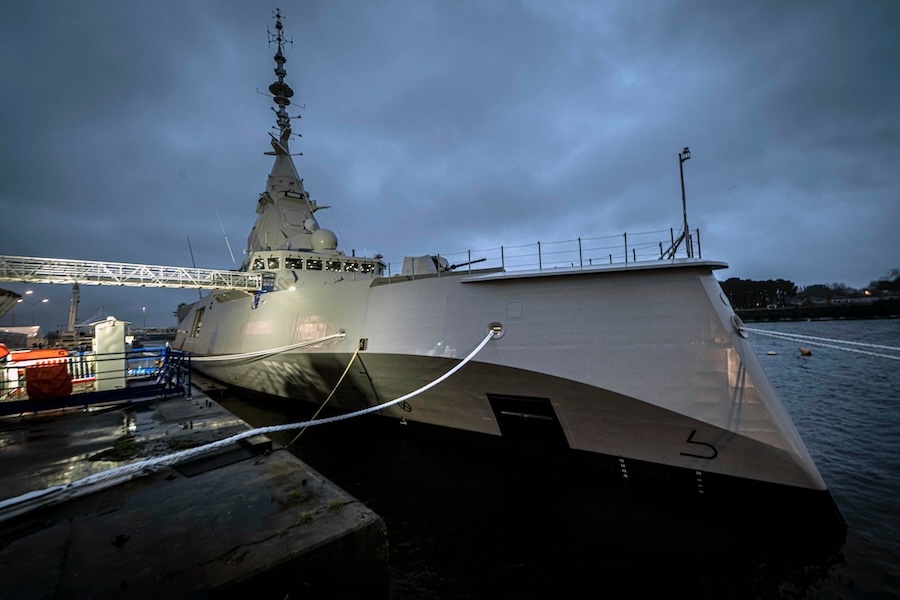
The Swedish government has described its logic remarkably openly. First, it is about time. The new ships are to be delivered between 2030 and 2034, in a window that is still militarily relevant. This is only possible because Naval Group has not offered a hypothetical export design, but a platform whose integration is already being tested. Second, it is about maturity. SeaFire radar, Aster air defense, SETIS command and control, and the anti-submarine component with CAPTAS are not political promises, but existing system components. Third, it is about effect. Stockholm itself speaks of a tripling of maritime air defense capacity.
This order is typical of the current European security situation. Not symbolism, but delivery time; not industrial flag-waving, but system maturity; not debates about strategic autonomy, but the question of what can actually be operational in the Baltic Sea before 2035. This is precisely why the decision is interesting from Weber's perspective. It refutes the convenient assumption that European integration fails primarily due to a lack of money. Sweden shows the opposite: When a credible product exists, Europe can indeed find common solutions. The problem arises where Europe preaches cooperation institutionally but provides nothing deliverable technologically.
Moreover, Stockholm is not signing a pure import contract. The future Lulea class is to combine French core architecture with Swedish sensors, weapons, and support services. Saab and Bofors components remain part of the package. This is not national autarky, but also not a complete relinquishment of sovereignty. Rather, a hybrid model is emerging: France provides the integrated backbone, while Sweden maintains national niche competencies. This is what functioning defense integration in Europe looks like today.
The Project is Only European in Geography
However, this is also where the institutional finding lies. These frigates are European because an EU and NATO member is purchasing from another European state. They are not European because an EU institution has produced this capability. Neither PESCO nor the European Defense Fund nor the ritualized talk of a common defense union has produced this result. It has been produced by a classic intergovernmental deal: a buyer under time pressure, a supplier with a real platform, and a shared threat perception in the Baltic Sea.
This may sound banal, but it is strategically important. Europe is currently integrating capabilities not through joint planning, but through the selection of national champions. France is not only winning an export order here but also a political lever. Whoever delivers the platform will, in the medium term, provide modernization paths, software logic, munitions architecture, and training. Should the French offer for the MdCN cruise missile materialize on these ships, Paris would not only contribute to Sweden's maritime air defense but potentially also to its conventional deep strike capability in the Baltic region.
This is not a scandal. It is, in fact, the precise opposite of Brussels rhetoric. The European sovereignty that is so often spoken of does not appear here as a common supranational capability, but as a redistribution of dependencies within Europe. Sweden reduces its dependence on non-European shipyards and system houses, but in return accepts a stronger integration into the French industrial and operational architecture. Autonomy does not disappear; it merely changes address.
What the Baltic Sea Makes of This Decision
The war in and around Ukraine has radically changed Sweden's threat horizon. For a Baltic Sea state that is now a NATO member, coastal defense in the classical sense is no longer the only consideration. Integrated air and missile defense at sea, anti-submarine warfare, resilience in conjunction, and the ability to operate in a saturated sensor environment are now required. The choice of the FDI also shows that the Baltic Sea is no longer viewed as a secondary maritime theater. It is becoming a space where layered air defense and networked maritime strike capabilities become the standard.
This is precisely why the decision for an already integrated French system is rational. But it also reveals a European paradox. The more acute the threat, the less time there is for ideal-type European industrial policy. In times of crisis, it is not the politically prettiest consortium that wins, but the most advanced product. Europe likes to talk about openness, standardization, and joint capability development. In reality, the time pressure compresses the selection to very few providers. Integration then arises not from equality, but from hierarchy.
I would even say: This is one of the healthier European procurement decisions of the year, precisely because it is unromantic. Sweden is ordering real capabilities within a realistic timeframe and with clear operational logic. But this very success is also an institutional admission. If Europe only integrates when one state chooses another state as the general contractor, then the EU still lacks a viable mechanism to produce such capabilities itself. Europe's defense is becoming more common. European defense policy in the narrower sense, however, remains surprisingly national.
The paradox is thus complete: The FDI decision strengthens Europe militarily because it creates quickly available, interoperable combat power. However, it weakens the myth that Brussels is the natural engine of this integration. Europe's security is becoming more concrete. Europe's defense union, on the other hand, remains for the time being an administrative term for decisions that continue to be made in Paris, Stockholm, and other capitals.
Sweden formalized a defense agreement with France to acquire four FDI frigates, enhancing its maritime air defense capabilities in the Baltic Sea. The deal, valued at 4.25 billion euros, is set to deliver the ships between 2030 and 2034, reflecting a strategic shift towards bilateral defense cooperation in Europe. This acquisition aims to address urgent military readiness in response to regional threats, integrating French and Swedish military technologies.
- Sweden is purchasing four French FDI frigates for 4.25 billion euros.
- The frigates will enhance Sweden's air defense capabilities in the Baltic Sea.
- The deal reflects a shift towards bilateral defense cooperation in Europe.
- Sweden's decision is influenced by the urgency of military readiness due to regional threats.
- The integration of French and Swedish military technologies is part of the agreement.