
FP-5 "Flamingo" Strikes Volgograd and the "Oreshnik" Supply Chain in June 2026
 Dmitri Volkov
FP-5 "Flamingo" Strikes Volgograd and the "Oreshnik" Production Chain in June 2026
Five cruise missiles targeting a factory 400 kilometers from the Ukrainian border is not a dramatic detail of the nightly news, but rather a more unpleasant arithmetic for Moscow. On the night of June 26 to 27, Ukrainian FP-5 "Flamingo" missiles struck the Volgograd enterprise "Titan-Barricades," which is involved in the development and production of the ground component of Russian missile systems. If the data from the Ukrainian General Staff, ISW, Meduza, and Militarnyi are correct, at least in part, this is not just a fire at another industrial site. The strike hit one of the nodes where the Soviet school of heavy engineering still supports the modern Russian missile war.
What is Known About the Night Strike
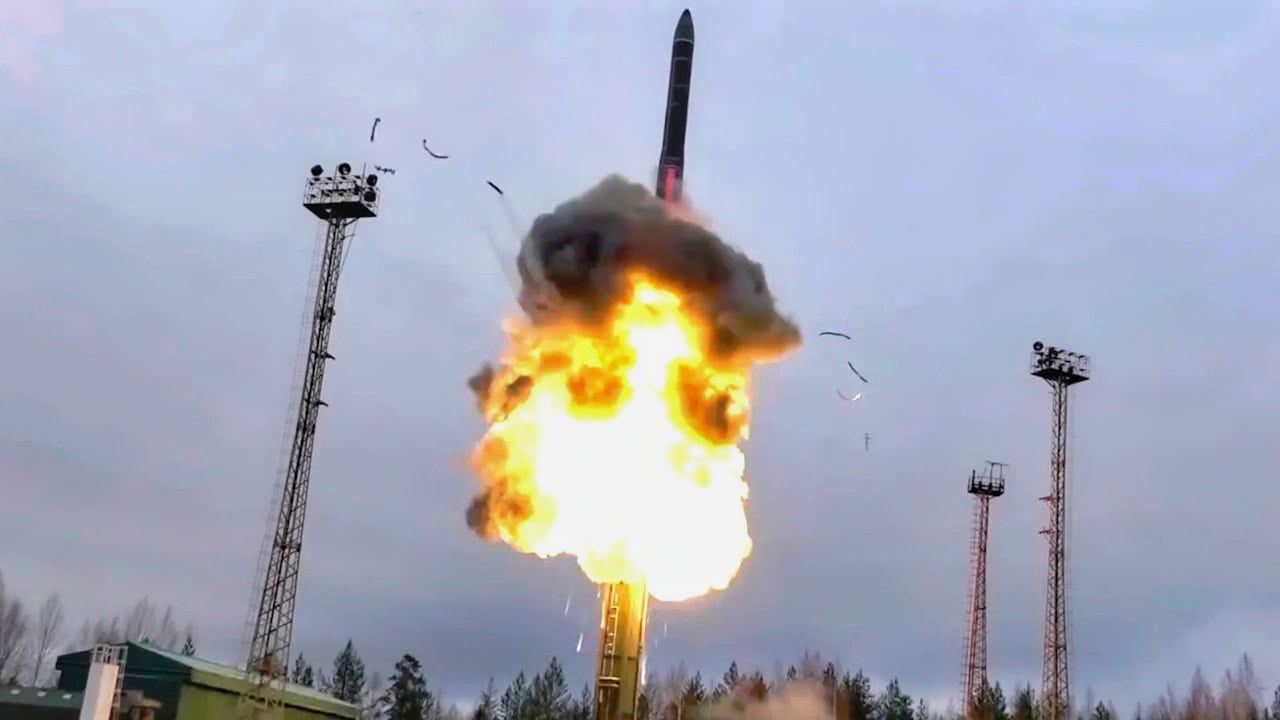
ISW reported on June 27 that Ukrainian forces struck the "Titan-Barricades" facility in Volgograd with FP-5 "Flamingo" missiles, and President Volodymyr Zelensky confirmed the use of these missiles. According to Ukrainian and OSINT data, at least five missiles were involved, with at least three hits on workshop No. 2, the production building of workshop No. 38, and another facility of unspecified purpose. Governor of Volgograd Region Andrey Bocharov acknowledged damage to the industrial enterprise after the attack by "high-speed aerial targets"; later, Russian regional authorities reported one dead worker and 11 hospitalized injured (Meduza, June 27, 2026). This formula of Russian reporting is already familiar: the object is not named until the name becomes obvious from video footage, coordinates, and secondary sources.
"Titan-Barricades" is not an ordinary repair facility. The enterprise is part of the "Roscosmos" structure and has historical ties to launch systems and ground equipment for "Topol-M," "Yars," "Iskander-M," as well as artillery themes, including the 152-mm systems "Msta-B" and "Msta-S." Ukrainian intelligence and independent Russian sources have previously linked the factory to the launch system of the "Oreshnik" complex. This is why the strike appears more significant than most attacks on oil depots: oil can be rerouted through another terminal, but competencies related to heavy transport-launch systems cannot be quickly transferred to a neighboring workshop or region.
Why "Flamingo" Changes the Cost of Russian Depth
The Russian military system has relied for decades on simple geography: strategic and operational-strategic production in the Volga region, the Urals, and Siberia are beyond the regular reach of the enemy. This geography has not disappeared, but it has become more expensive. The FP-5 "Flamingo," judging by open data, is not a wonder weapon in the romantic sense; it is a large long-range tool that forces the enemy to distribute air defense, electronic warfare, camouflage, and engineering protection not only around airfields and oil refineries but also around specialized factories. Military economies rarely collapse from a single strike. They begin to function worse when each new production cycle requires additional security, reservation, repair, and bureaucratic reporting upwards.
It is also important to note the trajectory. A Russian military commentator quoted by ISW suggested that successful strikes by the "Flamingo" in 2026 could have utilized low altitudes and water landmarks, complicating interception. This is an important observation, even if it has not yet been fully proven. The Russian shortage of A-50 AWACS aircraft, especially the upgraded A-50U, has long ceased to be a private problem for aviation. With a lack of airborne radar surveillance, a low-flying cruise missile becomes not only a task for air defense systems but also a test for the entire early warning system. The USSR built an echeloned defense against a mass air-space strike; today's Russia is forced to patch holes selectively, often only after the enemy has shown the direction of the next risk.
Strike on "Oreshnik" as a Strike on a Political Symbol
The military significance of the "Oreshnik" in Russian doctrine is less than its political weight. After its first use in 2024, the complex was employed by the Kremlin as an argument for strategic intimidation: a demonstration that Moscow possesses a means between conventional missile warfare and nuclear hints. Meduza reminds us that during the full-scale war, Russia has used the "Oreshnik" three times: against Dnipro in November 2024, against Lviv region in January 2026, and against Kyiv region in May 2026. If the factory associated with the ground component of this complex indeed sustained damage, the Ukrainian strike has a dual effect. It may not stop production, but it shows that the symbolic missile also depends on quite material workshops, machines, welding lines, warehouses, and people.
In Russian military culture, there is an old habit of equating range with safety. The Volgograd episode reminds us that range has become a variable rather than a guarantee.
It is important not to exaggerate. One night strike does not destroy the production of "Iskander" or "Oreshnik," does not cancel Russian stockpiles, and does not make the Ukrainian long-range campaign automatically sustainable. But it introduces a new risk factor into the calculations. If Kyiv is capable of repeating such strikes at intervals of weeks rather than once a year, the Russian defense industry will be forced to either disperse narrow productions or turn each key enterprise into a separate protected object. The first requires time and skilled personnel; the second demands air defense systems, which are already in short supply for the front, Crimea, oil refineries, and large cities.
Strategic Conclusion
The most significant aspect of the attack on "Titan-Barricades" is not the fire or even the number of hits, but the choice of target. Ukraine is gradually shifting its long-range campaign from energy pain to the industrial anatomy of the Russian war. Oil infrastructure hits revenues, fuel, and logistics. Strikes on enterprises like "Titan-Barricades" target the reproduction of complex systems, where the design school cannot be replaced by an imported part from a gray channel. This is less spectacular than destroying an aircraft at an airfield, but in a long war, it may prove more painful.
My cautious prediction is as follows: Russia will retain the ability to produce and deploy operational-tactical and long-range missile systems, but the cost of this capability will increase. If the FP-5 "Flamingo" becomes a serial tool of the Ukrainian campaign, 2026 may be remembered not for a "wonder missile," but for the end of the old confidence of the Russian defense industry in the safety of depth. For the military-industrial complex, this is almost always worse news than one-time damage: a factory can be repaired, but geographical confidence cannot.
Ukrainian forces launched an airstrike using FP-5 "Flamingo" cruise missiles against the Titan-Barricades plant in Volgograd on the night of June 26-27, 2026. The attack resulted in at least three confirmed hits, one fatality, and eleven injuries. This facility is crucial for the production of Russian missile systems, marking a significant escalation in Ukraine's targeting strategy.
- Ukrainian FP-5 "Flamingo" missiles struck the Titan-Barricades plant in Volgograd.
- At least five missiles were launched, with three confirmed hits on specific production areas.
- One worker was killed and eleven were hospitalized due to the attack.
- The Titan-Barricades plant is linked to Russian missile systems production.
- The strike represents a shift in Ukrainian targeting strategy towards industrial capabilities.