
France fires THUNDART rocket for the first time
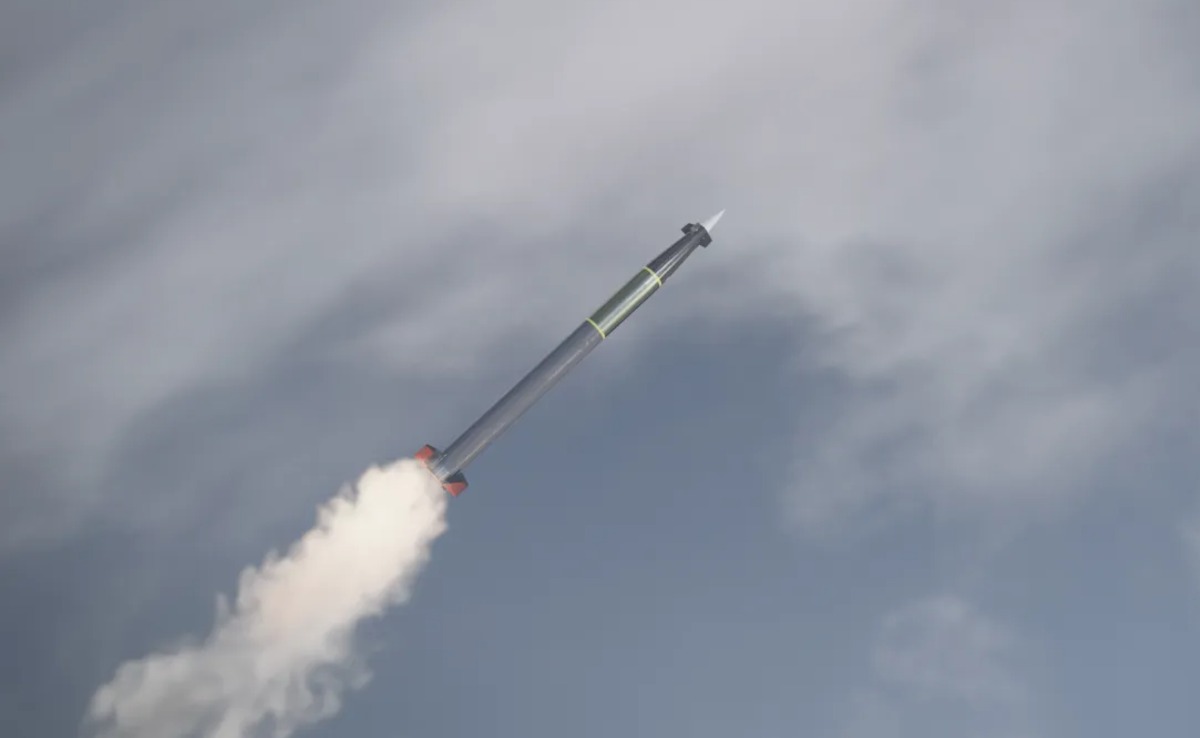
On April 14, teams from MBDA and Safran Electronics & Defense conducted the inaugural live test of THUNDART, a new long-range artillery rocket developed entirely within France, with support from the Directorate General of Armament Missile Testing division, known as DGA EM.
The test took place at the Île du Levant test range and validated the system’s propulsion design and key engineering choices. Both companies confirmed the rocket’s performance exceeded projections.
Eighteen months from blank page to live fire. That timeline matters, because THUNDART now enters the frame as the only sovereign European system to have demonstrated a deep-strike capability exceeding that of France’s current Lance-Roquettes Unitaires — the aging M270-based rocket launchers, known as LRUs, that the French Army has relied upon for decades and which are heading toward obsolescence by 2030. France currently operates just nine of them, and with four transferred to Ukraine, the pressure to field a successor is not abstract. It is urgent.
The LRU fires the M31 guided rocket out to 70 kilometers. THUNDART is designed to reach beyond 150 kilometers — more than double the current range — putting it in a different strategic class entirely and addressing a gap that French military planners and parliamentary reports have flagged as one of the Army’s most significant capability shortfalls. The DGA launched the FLP-T program — Frappe Longue Portée Terrestre, or Long-Range Land Strike — in 2023 to fill that hole, with a requirement for an operational solution by 2030. MBDA and Safran are competing for that contract against a rival consortium of Thales and ArianeGroup, with a DGA selection expected in 2026. The April 14 test puts the MBDA-Safran team directly in the running at the right moment.
The propulsion system was developed by Roxel — now a wholly owned MBDA subsidiary — in just over a year. Roxel has prior experience manufacturing solid-propellant motors for the European variant of the GMLRS guided rocket, the same family used in HIMARS and M270 systems, which gave the team the industrial foundation to move fast without reinventing fundamentals. The guidance kit comes from Safran’s AASM program — the Armement Air Sol Modulaire, better known as the HAMMER — a modular air-to-ground weapon that Safran has refined through years of operational use and whose INS/GPS guidance architecture was adapted for the new ground-launched rocket. Integrating a proven guidance system reduced both risk and non-recurring development costs, and the April test confirmed that the AASM kit performs robustly in the specific and constrained environments of a rocket trajectory.
The industrial picture behind the test is as deliberate as the technical one. MBDA plans to invest €2 billion in France between 2026 and 2030 and has projected a 40 percent increase in production output in 2026 relative to 2025. Safran, for its part, has already quadrupled AASM production at its Montluçon facility between 2022 and 2025. Both companies say the THUNDART production line would share infrastructure with existing AASM manufacturing, making mass production achievable without building an entirely new industrial base. The entire supply chain is French, spanning five regions, which the two companies frame explicitly as a contribution to sovereign industrial security and workforce continuity — not just a procurement preference, but a structural hedge against the kind of supply disruptions that have complicated allied ammunition programs across Europe since 2022.
More than a hundred engineers and technicians across both companies are currently mobilized on the program. MBDA and Safran are also studying the creation of a 50/50 joint venture to carry the THUNDART development forward, and both have flagged potential future evolutions into longer-range artillery systems — capitalizing on the deep-strike expertise each brings to the table. The FLP-T program envisions a second development phase targeting ranges of 500 to 1,000 kilometers for operational-depth strike, though that remains a future ambition rather than a current program of record.
Content preview only. Full article available at source. View Full Article
MBDA and Safran Electronics & Defense conducted the inaugural live test of the THUNDART long-range artillery rocket on April 14, 2023, at the Île du Levant test range. The rocket demonstrated a range exceeding 150 kilometers, significantly surpassing the capabilities of France's current M270-based rocket launchers. This development is part of France's urgent need to replace aging artillery systems and enhance its military capabilities ahead of the 2030 deadline for operational solutions.
- THUNDART rocket successfully tested on April 14, 2023.
- THUNDART has a range exceeding 150 kilometers, more than double that of the current M31 guided rocket.
- France operates nine M270-based LRUs, with four transferred to Ukraine.
- The DGA launched the FLP-T program in 2023 to develop long-range strike capabilities by 2030.
- MBDA plans to invest €2 billion in France between 2026 and 2030.