
From 45 to 1,000: The Rarely Mentioned Data Gap Behind China's Nuclear Warhead Expansion
 Li Minghui
From 45 Tests to 1,000 Warheads: The Rarely Mentioned Data Gap Behind China's Nuclear Expansion
On June 22, 2020, about 700 kilometers east of Kazakhstan's Lake Balkhash, a seismic monitoring station belonging to the Comprehensive Nuclear-Test-Ban Treaty Organization (CTBTO) — PS23 Makanchi Station — recorded a 2.75 magnitude earthquake signal. This number would normally not be noteworthy: a magnitude of 2.75 is equivalent to the sensation of a heavy truck passing by several kilometers away. However, the epicenter of this signal was approximately 720 kilometers from China's Lop Nur nuclear test site in Xinjiang.
Six years later, on February 17, 2026, Christopher Yeaw, the U.S. Assistant Secretary of State for Arms Control and Nonproliferation, publicly claimed at the Hudson Institute in Washington that this was a "yield-producing nuclear explosion" — meaning it triggered a chain reaction of nuclear material. He also added that China used "decoupling" technology to conceal the true yield.
How Reliable is This Evidence?
From a purely technical perspective, the evidence provided by the U.S. has clear limitations.
The official statement from the CTBTO is quite cautious: the organization confirmed detecting "two very small seismic events 12 seconds apart," but explicitly stated that "these data alone cannot determine their cause." Ben Dando, a seismologist at the Norwegian seismic monitoring agency NORSAR, pointed out that the issue is that this signal was only detected at a single site in Kazakhstan. The gold standard for global nuclear explosion monitoring is multi-site cross-validation — single-site data means that background noise, geological activity, and other natural factors cannot be effectively ruled out.
Based on the magnitude, if it was indeed an underground explosion, an un-decoupled 2.75 magnitude event would correspond to a yield of about several tens of tons of TNT. However, if decoupling technology was used — excavating a large cavity in the rock and placing the nuclear device at the center for detonation — the actual yield could be 10 to 100 times higher, which means several hundred tons or even close to 1,000 tons, falling within the range of a small nuclear test.
The controversy itself cannot be resolved from publicly available information for now. However, interestingly, the background of this debate — why China might need more test data for its nuclear weapons — is a question that has not been discussed sufficiently.
The Data Gap from 45 Tests
According to statistics from the Arms Control Association, China conducted a total of 45 nuclear tests before announcing a moratorium on nuclear testing in 1996. About half of these were atmospheric tests, while the other half were underground tests. In contrast, the United States conducted 1,054 tests, the Soviet Union/Russia 715 tests, and the United Kingdom 45 tests (most of which were conducted jointly with the U.S.).
The data from these 45 tests supported China's decades-long "minimum deterrence" strategy, with the number of nuclear warheads maintained at around 200 at that time. This figure was generally considered credible until 2019.
However, according to the U.S. Department of Defense's 2025 Annual Report on Military and Security Developments Involving China submitted to Congress, China's current warhead count is nearing 600, with a clear target set for 1,000 by 2030.
The question arises: the number of warheads has more than tripled, but the volume of verification data for nuclear weapon designs has not increased proportionally.
Why the Data Gap is a Problem
Nuclear warheads are not ordinary industrial products. Each new model involves physical processes under extreme conditions — high temperatures, high pressures, and precise timing of neutron flux — any slight deviation in parameters could lead to a "dud." The U.S. maintains its existing warhead stockpile through supercomputer simulations combined with subcritical tests (using a very small amount of weapon-grade plutonium without triggering a chain reaction). This system is built on decades of accumulated empirical data from hundreds of nuclear tests.
China's situation is different. Zhao Tong, a senior fellow at the Carnegie Endowment for International Peace, pointed out that the infrastructure at Lop Nur has significantly expanded in recent years — satellite images show new tunnel entrances, expanded equipment areas, and increased accommodation facilities. These investments are inconsistent with a testing site that is merely "maintaining the status quo."
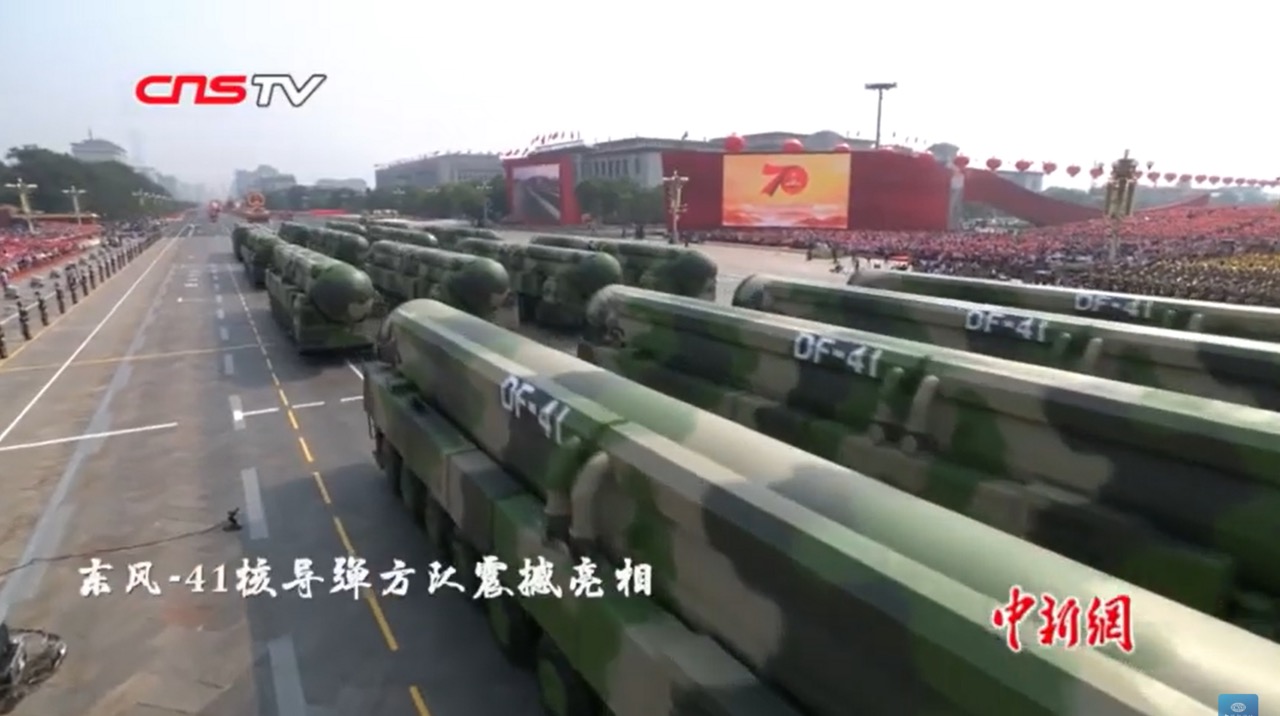
In simple terms: if a certain type of warhead is to be modified for a Multiple Independently Targetable Reentry Vehicle (MIRV) configuration suitable for the DF-41, or if a new miniaturized warhead is to be developed for the DF-17 hypersonic glide vehicle, some empirical anchor points are always needed beyond computer simulations. There is industry debate over whether the historical data from 45 tests can cover these entirely new design parameters.
Political Context and Timing
The timing of the U.S. revealing more details is noteworthy. On February 5, 2026, the last binding nuclear arms control treaty between the U.S. and Russia, the New START Treaty, officially expired, leading the global nuclear order into a phase of unprecedented lack of institutional framework in decades.
The Trump administration subsequently announced plans to resume nuclear testing "on a reciprocal basis" and prioritized trilateral nuclear control negotiations (U.S., Russia, China) as a diplomatic focus. In this context, publicly naming China for "secret tests" serves a clear diplomatic purpose — to pressure China into joining a formal negotiation framework.
Chinese Foreign Ministry spokesperson Lin Jian stated: "The U.S. accusations regarding China's nuclear explosion tests are completely unfounded. China opposes the U.S. creating excuses for its own resumption of nuclear testing."
Beijing's response is to be expected. Regardless of what happened in 2020, China will not publicly acknowledge any actions that violate the current ban.
An Unresolved Engineering Issue
Is the 2.75 magnitude earthquake signal a nuclear test? I cannot draw a definitive conclusion from publicly available information, and I believe most independent seismologists would agree.
However, this controversy points to a more substantive question: Can China reliably verify the various new warhead designs required for its expansion plans given its relatively limited historical test data? If the answer is "more empirical data is needed," then the ongoing expansion at Lop Nur takes on another layer of interpretation — regardless of whether this interpretation has been confirmed by the earthquake signal from June 2020.
China is reportedly expanding its nuclear arsenal, with projections indicating a rise to 1000 warheads by 2030. A 2.75 magnitude earthquake detected near Lop Nur in 2020 has raised suspicions of a nuclear test, although evidence remains inconclusive. The US has expressed concerns over China's nuclear capabilities and testing practices, particularly regarding the use of decoupling technology to obscure test yields.
- China's nuclear warhead count is projected to reach 1000 by 2030.
- A 2.75 magnitude earthquake was detected near Lop Nur, possibly indicating a nuclear test.
- China has conducted 45 nuclear tests before halting in 1996, significantly fewer than the US and Russia.
- The US claims China is using decoupling technology to mask the true yield of its nuclear tests.
- China's nuclear testing infrastructure has expanded recently, suggesting preparations for more tests.