
Fujian Ship's First Live-Weapon Training at Sea: J-35 and KJ-600 Propel Electromagnetic Catapult Towards Fleet Integration
 Li Minghui
Fujian Aircraft Carrier Conducts First Live Training at Sea, J-35 and KJ-600 Push Electromagnetic Catapult Towards Fleet Integration
This time, what really draws attention to the Fujian aircraft carrier is not that it has gone to sea again, but that the official statement describes the mission as "the first live training at sea since its commissioning." The Chinese military network disclosed that the Fujian, Yan'an, Tongliao, and other vessels formed a carrier strike group, completing tasks such as formation sailing, joint search and rescue with aircraft, and takeoff and landing of carrier-based aircraft; various types of carrier-based aircraft, including J-35, J-15T, J-15DT, and KJ-600, successively completed multiple rounds of catapult launches and landings on the ship. The South China Morning Post also added that the Fujian has a displacement of over 80,000 tons, making it China's first domestically produced aircraft carrier equipped with an electromagnetic catapult and arrestor recovery system.
From "Can Launch" to "Can Organize Operations"
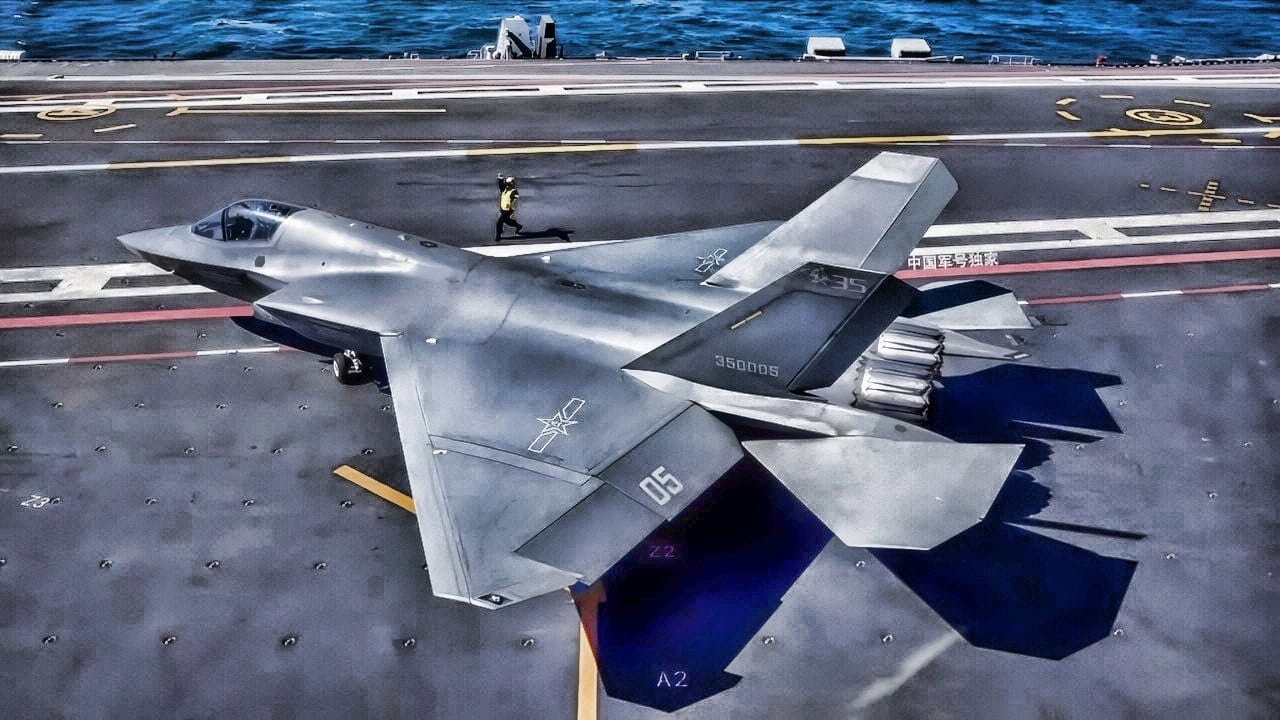
Previously, when the Fujian completed the first catapult launches and landings of three types of carrier-based aircraft, the focus of external attention was mainly on the electromagnetic catapult system itself. That was an engineering verification issue: whether the catapult track, energy storage, power scheduling, and arrestor wires could match different aircraft types. Now, entering live training at sea, the question has shifted to another level: can the ship, aircraft, escort vessels, and search and rescue forces be organized along combat lines?
In simple terms, the combat capability of an aircraft carrier is not just about a plane flying off the deck. The real challenge lies in completing transport, armament loading, refueling, launching, recovery, fault handling, and search and rescue plans within the limited deck space. The Chinese military network specifically mentioned that "all personnel on board efficiently completed the transport, operational preparation, and takeoff and landing support for various types of carrier-based aircraft." This statement may seem plain, but it is precisely the key to the Fujian transitioning from a test ship to a combat platform.
System Outline Revealed by Four Types of Carrier-Based Aircraft
The four types of aircraft publicly named this time are quite interesting. The J-35 provides stealth penetration and air superiority, the J-15T is equivalent to a catapult version of a heavy multi-role carrier-based aircraft, the J-15DT undertakes electronic warfare suppression, and the KJ-600 brings a fixed-wing early warning aircraft to the deck. Together, they are not merely showcasing "new aircraft," but are assembling the framework of a carrier air wing.
- The value of the J-35 lies in reducing the risk of aerial exposure when the formation advances, especially suitable for seizing the first wave of air superiority.
- The J-15T retains the advantage of heavy payload, capable of undertaking long-range interception, anti-ship, and ground strike missions.
- If the J-15DT matures, it will provide the carrier strike group with onboard electronic attack capabilities, filling the gap left by the previous ski-jump carriers.
- The KJ-600 is the most critical; it elevates early warning radar from helicopter height to a fixed-wing platform, directly affecting the distance of maritime situational awareness.
I believe the importance of the KJ-600 may be underestimated by the average reader. Without a fixed-wing early warning aircraft, carrier aviation is like a nearsighted person wielding a spear; with it, the long-range operational radius of the J-35 and J-15T has command chain support. The U.S. Navy's carriers have long relied on the E-2 series, not because it is conspicuous, but because it determines whether carrier-based aircraft can operate as a system in complex airspace.
Fujian Aircraft Carrier is Still in the Climbing Phase
Of course, we cannot equate the Fujian with the U.S. Navy's Ford-class just because of one live training exercise. The electromagnetic catapult system is just the foundation; the aircraft sortie rate, pilots' day-and-night landing experience, spare parts support, and sustained maintenance capability at sea are the more challenging aspects to tackle. Especially since both the J-35 and KJ-600 belong to new platforms, there is currently very little public information on engine life, avionics reliability, and maintenance cycles in a salt spray environment on the ship, so we can only make cautious speculations.
This time, the Fujian strike group also included joint search and rescue exercises, which is noteworthy. In the early stages of carrier training, the most likely issues are not the dazzling catapults, but recovery, go-arounds, and emergency handling. The numerous lessons learned from decades of accidents in the U.S. Navy indicate that the faster the deck rhythm, the more robust the safety chain must be. The Chinese military network emphasizes "improving and optimizing processes," which indirectly indicates that the Fujian is still in the phase of converting engineering capabilities into crew muscle memory.
Pressure in the Western Pacific Will Not Change Immediately
From a strategic perspective, the Fujian's first live training at sea will not immediately change the balance of power in the Western Pacific. It typically takes years for an aircraft carrier to develop sustainable combat capability, not just one outing. However, it will alter the assessments of the speed at which the Chinese Navy is growing. The Liaoning solved the issue of "from nothing to something," the Shandong addressed domestic production and training cycle compression, and the Fujian needs to tackle the system upgrade brought by the catapult aircraft carrier and fixed-wing early warning aircraft.
What Japan, the United States, and Taiwan really need to account for is not how many aircraft the Fujian can deploy today, but whether the Chinese Navy can stably maintain a carrier strike group that includes stealth carrier-based aircraft, electronic warfare aircraft, fixed-wing early warning aircraft, and large destroyers by around 2027. This number may seem abstract, but it will have very concrete impacts on air vigilance, anti-ship firepower projection, and maritime control rhythms around the first island chain.
I am more concerned about whether we will see night landings, full fuel and armament catapults, and multiple recovery waves in the upcoming public footage. If these tasks begin to appear regularly, the significance of the Fujian will no longer be just "the third aircraft carrier," but rather the first time the Chinese Navy has truly touched the threshold of a modern catapult aircraft carrier air wing.
The Fujian aircraft carrier conducted its first live naval training exercise in Fujian Province, involving multiple vessels and aircraft including J-35 and KJ-600. The exercises focused on carrier operations, aircraft launches, and joint search and rescue missions, marking a significant step in the operational readiness of the People's Liberation Army Navy. This event highlights the transition of the Fujian from a test platform to a combat-ready naval asset.
- Fujian aircraft carrier conducted its first live naval training exercise.
- Multiple aircraft including J-35 and KJ-600 participated in the exercises.
- The exercise included carrier operations, aircraft launches, and joint search and rescue missions.
- Fujian is China's first aircraft carrier equipped with electromagnetic catapults and arrestor wires.
- The training aims to transition from testing capabilities to operational readiness.