
G7 License Production for IRIS-T and Patriot Shows Europe's Air Defense Dilemma 2026
 Dr. Klaus Weber
G7 License Production for IRIS-T and Patriot Shows Europe's Air Defense Dilemma 2026
The G7 did not decide in Évian to simply send more anti-aircraft missiles to Ukraine. On June 17, 2026, they announced something politically more sensitive: Kyiv will be able to obtain licenses to produce Western air defense and long-range capabilities either independently or in collaboration with European companies. This sounds like strategic autonomy. In reality, it is initially an admission that the previous procurement routes for Patriot, PAC-3 MSE, and European systems like IRIS-T SLM have reached their industrial limits.
The Decision from Évian
The official G7 statement cautiously formulates the core. The heads of state and government want to increase the delivery of air defense capabilities, additional systems, interceptor missiles, and long-range capabilities, and are willing to open licenses for Ukraine to enhance its own military production. President Volodymyr Zelensky clarified after the meeting that it is about more anti-aircraft missiles, licenses for the production of corresponding systems, and American backing for these lines.
Friedrich Merz stated the crucial sentence after reports from Évian: Everyone is currently producing too little, and this gap can be closed through licenses for companies with existing capacities, including European and Ukrainian firms. This is not a technical footnote. It shifts Ukraine's assistance from the logic of stock withdrawal to the logic of shared production rights.
The next day, concrete signals followed in Brussels. According to Ukrainian reports, Germany announced an additional package of $400 million for Ukrainian air defense, of which $200 million is for air defense ammunition and $200 million for PAC-3 missiles as part of an accelerated procurement mechanism. Sweden, the Netherlands, and Belgium linked their own contributions with PURL, F-16, and drone cooperation. The pattern is visible: Europe continues to buy American ammunition in the short term while trying to escape this dependency in the long term through license production.
Why Patriot Remains the Test Case
The critical bottleneck is not political will, but interceptor ammunition. PAC-3 MSE is the most important Western missile against ballistic threats in the Patriot system. The U.S. Army increased Lockheed Martin's maximum annual rate from 550 to 650 PAC-3 MSE at the end of 2024 and explicitly described the missile as a key component for EUCOM, CENTCOM, and INDOPACOM. Even if newer industrial plans aim for higher numbers, the institutional fact remains: Ukraine, European NATO states, Israel, Gulf states, and the U.S. are competing for the same scarce production line.
A license does not automatically solve this problem. Patriot is not a single tube with a missile, but a system of sensors, fire control, launchers, software, export control, spare parts, and qualified personnel. Those who only relocate the final assembly of a missile to Europe or Ukraine gain time but not complete sovereignty. Conversely, those who want to relocate seekers, solid rocket motors, electronics, test facilities, and software approvals touch American intellectual property and ITAR logic. This is precisely where the political hardness of the Évian decision lies.
The earlier European debate on strategic autonomy often framed this problem aesthetically: more European flags on European weapons. Ukraine is now forcing a more sober question. Who owns the license, who controls the production increase, and who decides on priorities in a crisis? If Washington grants the license but central components remain in the U.S., independence does not emerge. A faster form of dependency arises.
IRIS-T Shows the European Alternative and Its Limits
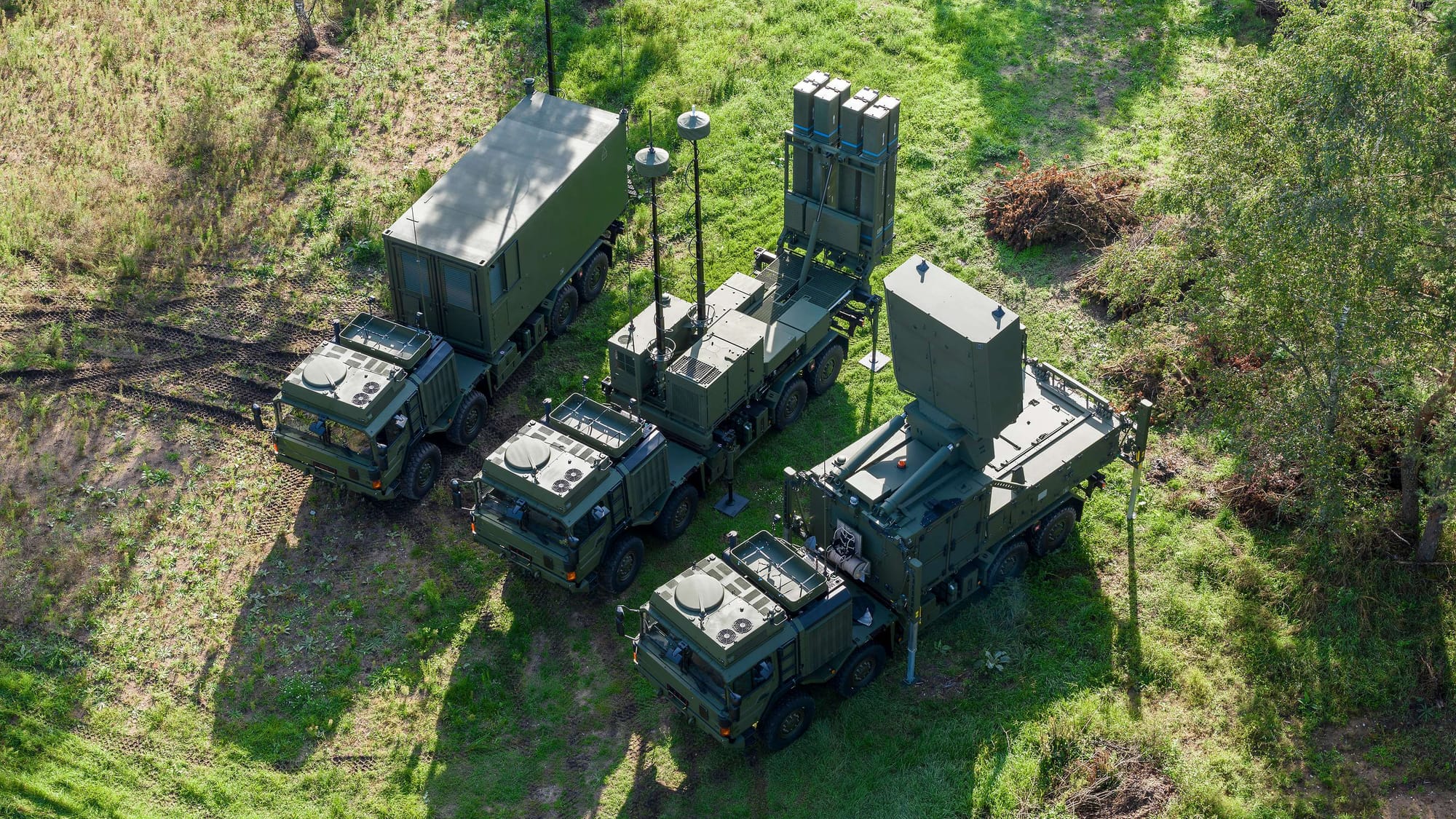
IRIS-T SLM is the obvious counterproof for Europe. The system from Diehl Defence combats aircraft, helicopters, cruise missiles, and drones at distances of up to 40 kilometers and altitudes of 20 kilometers. A fire unit includes a launcher, radar, and tactical operations center. According to Diehl, eleven countries have now chosen this solution as part of the European Sky Shield Initiative; the broader IRIS-T family counts 21 user states. This is exactly the kind of standardization that European defense planners have been preaching for years.
But IRIS-T SLM does not replace Patriot. It is valuable against drones, cruise missiles, and aircraft; against heavy ballistic threats, Patriot with PAC-3 MSE remains a different capability class. For Ukraine, this means no either-or decision, but a layered model: IRIS-T, NASAMS, SAMP/T, and Gepard against various threats, Patriot against the most dangerous ballistic attacks. Europe's problem is therefore not that it cannot produce anything at all. Europe's problem is that the capability pyramid at the top remains American.
This is where the license question becomes strategic. If European companies manufacture American systems under license, Europe can deliver faster without immediately developing its own counterpart. At the same time, such a solution can cement its own industry into a subcontractor role. The production hall may be in Europe, but sovereignty remains in the contract document in the United States.
The PURL Logic Remains Politically Convenient
PURL was politically convenient for Europe because it circumvented the most difficult question: Should Europe finance its own, risky, multi-year armament programs, or should it buy existing American systems for Ukraine? The answer so far has been: buy. Germany's fourth participation in PURL and the new commitments from Sweden and the Netherlands confirm this line. For Ukraine, this is rational in the short term. A PAC-3 missile in six months is more valuable than a European development program in six years.
However, this rationality is dangerous for European defense policy. Every PURL contribution improves Ukrainian air defense while simultaneously stabilizing the American industrial centrality. Every licensing step can ease the supply situation while also showing that Europe cannot even control its own acceleration without American approval. This is not a moral critique of Washington. It is a sober description of property rights, export control, and production capacity.
What Germany Must Decide Now
For Berlin, Évian is particularly uncomfortable. Germany presents itself as the main European actor in Ukrainian air defense, financing Patriot ammunition, supplying IRIS-T, and supporting PURL. At the same time, the Federal Republic has not built its own high-performance architecture against ballistic missiles for decades. The turning point has mobilized money, but it has not clarified the relationship between national capability planning, European standardization, and American technology dependence.
The right German response would therefore not be to sell license production as a triumph of European sovereignty. It would be to clearly separate three levels. First, Ukraine must now receive ammunition, even if it comes from American licenses or American production. Second, Europe must identify all industrial subprocesses that it can control itself: solid rocket motors, launchers, sensor integration, software interfaces, spare parts chains. Third, Europe needs a realistic division of labor between Patriot licensing, IRIS-T expansion, SAMP/T further development, and future defense against ballistic and hypersonic threats.
The G7 license decision is therefore neither a breakthrough nor symbolic politics. It is a crisis instrument. Its value lies in buying time. Its risk lies in Europe consuming this bought time again with procurement conferences, national industry quotas, and legal self-soothing. More production in Ukraine would be real progress. But only if Europe understands that license production is not a substitute for industrial sovereignty. It is the receipt for the fact that this sovereignty has not yet been created.
Sources
- G7 Évian Leaders’ Statement, June 17, 2026
- Presidential Office of Ukraine on the G7-Ukraine Meeting, June 16, 2026
- NATO, Press Preview of Defense Ministers Meeting, June 17, 2026
- Kyiv Independent on New European Aid Packages, June 18, 2026
- Diehl Defence on IRIS-T SLM and ESSI, December 9, 2025
- U.S. Army on PAC-3 MSE Production Increase, November 27, 2024
On June 17, 2026, the G7 announced that Ukraine would receive licenses to produce air defense systems, marking a significant shift in military support. Germany pledged an additional 400 million dollars for Ukrainian air defense, including funds for PAC-3 missiles. This move aims to enhance Ukraine's military production capabilities and reduce reliance on existing stockpiles.
- G7 announced licenses for Ukraine to produce air defense systems on June 17, 2026.
- Germany pledged an additional 400 million dollars for Ukrainian air defense.
- The focus is on increasing production capabilities rather than just supplying existing stockpiles.
- IRIS-T and PAC-3 missiles are key components of the air defense strategy.
- The decision reflects a shift towards strategic autonomy in European defense.