
G7 Licenses for Patriot and Air Defense Will Not Solve Europe's Production Crisis in 2026
 Dr. Klaus Weber
G7 Licenses for Patriot and Air Defense Will Not Solve Europe's Production Crisis in 2026
June 17, 2026, Évian: The G7 promises Ukraine more air defense, additional interceptors, long-range capabilities, and the possibility to produce Western systems under license. This sounds like the moment Kyiv has been pushing for months. In reality, it is more of an institutional stress test. A license is not a factory, a political signal is not yet serial production, and an American yes to examining technology transfer is not yet a European production consortium.
The wording of the G7 is deliberately cautious. The joint statement indicates a willingness to grant Ukraine the benefits of licenses to increase its military production. Wolodymyr Zelensky clarified after the meeting that it concerns air defense missiles, anti-ballistic systems, and American backing. It is precisely in this difference between political willingness and industrial reality that Europe's problem lies.
The License is No Substitute for Capacity
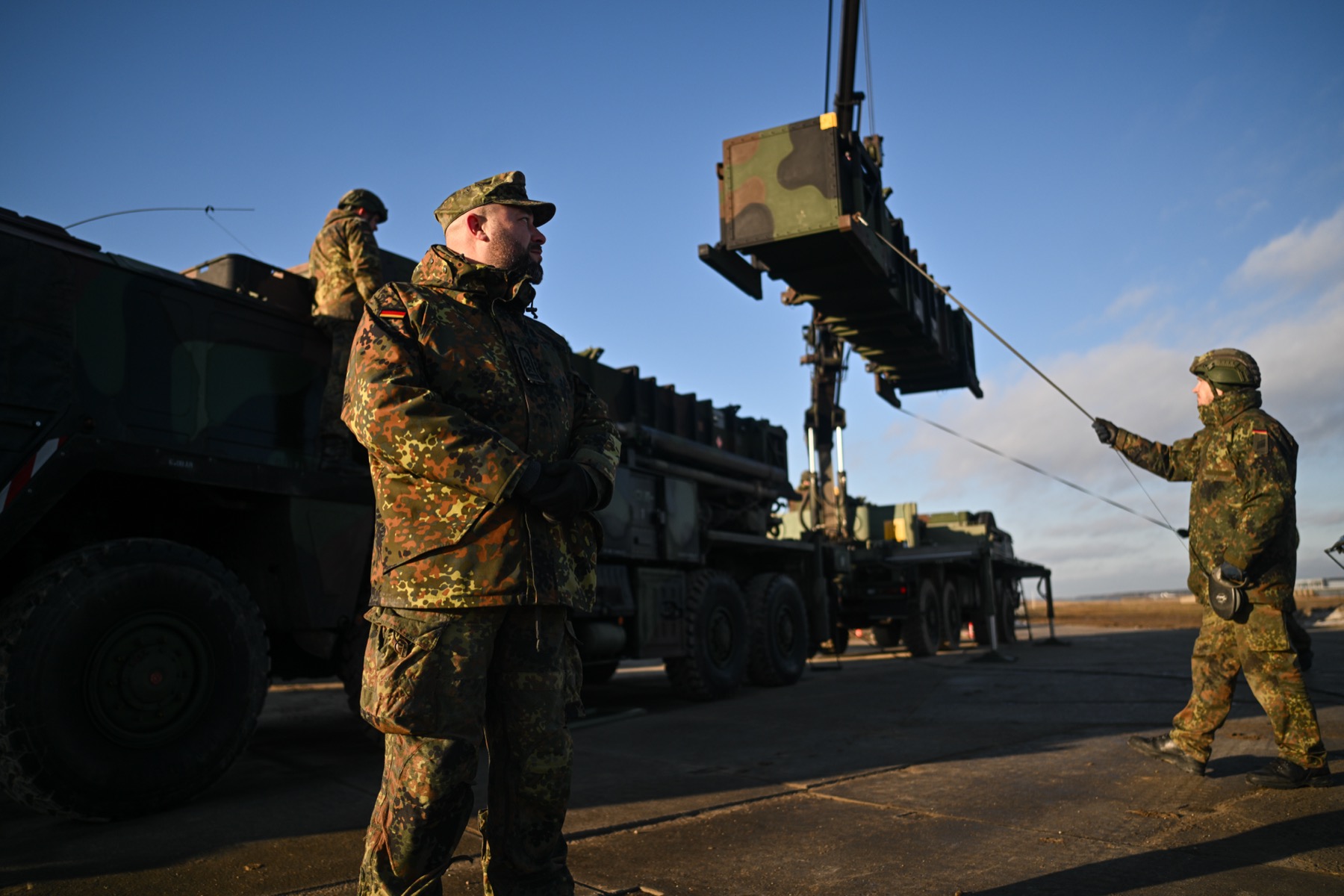
A license addresses the legal question, not the capacity question. It allows a company to manufacture a system or components thereof according to agreed rules. However, it does not automatically resolve the bottlenecks in explosives, seekers, rocket engines, test stands, qualified personnel, and export control procedures. Announcing a Patriot or GEM-T license today does not mean there will be additional interceptors in the magazine tomorrow.
This is evidenced by the existing European Patriot structures. Raytheon reported in April a contract worth $3.7 billion for the delivery of Patriot GEM-T interceptors for Ukraine. The new GEM-T production facility in Schrobenhausen is expected to play a central role; it is operated by COMLOG, a joint venture of Raytheon and MBDA Germany. As early as 2024, it was stated that COMLOG would expand European GEM-T production. Patriot is used by eight European countries and Ukraine against cruise missiles, ballistic missiles, drones, and aircraft. This is not a small series for a single customer, but an overloaded common demand base.
The European debate therefore too often confuses access rights with production power. A licensing agreement shifts a legal barrier. It does not replace three years of neglected investments in munitions stocks, spare parts chains, and redundant suppliers. For Ukraine, it does not matter whether Europe has a more robust industrial architecture in 2028. What matters for Kyiv is whether there are enough interceptors available in winter 2026.
G7 and NATO Discuss the Same Deficit
The coincidence of the G7 statement with the NATO defense ministers' meeting in Brussels is no accident. Mark Rutte stated on June 17 that the allies need more forces, more resources, and a much stronger industrial base. At the same time, he pointed out that European allies and Canada had increased their core defense investments by more than $90 billion in 2025, nearly 20 percent in one year. The figure is impressive. But it primarily proves that money can be decided faster than production lines can be built.
The American embassy in Brussels was even harsher. Pete Hegseth announced a six-month review of the US troop presence in Europe and stated that Europe should irreversibly move towards taking primary responsibility for its own defense. His phrasing that Europe was not intended to be a dependency of the United States was polemical. But it hits a sore point. In air defense, reconnaissance, strategic transport, and nuclear deterrence, Europe is still a user of American systems, not an equal producer of strategic effects.
Here lies the real paradox. The US is pushing Europe for more responsibility but retains the crucial rights, production data, and export controls for many key technologies. Europe demands strategic autonomy but buys American systems in a crisis because European alternatives have not been scaled quickly enough. Ukraine is asking for licenses because both sides know that the previous mechanism of stock disposals, reorders, and PURL-funded US purchases is insufficient.
IRIS-T Shows European Possibility and Its Limits
Germany likes to refer to IRIS-T SLM as a counterexample. The system is European, combat-proven in Ukraine, and politically easier to export than American high technology. Diehl has significantly expanded production, and Berlin has made IRIS-T a symbol of the turning point. Nevertheless, IRIS-T does not replace Patriot. Range, interception profile, and anti-ballistic capabilities are in different categories. For Russian ballistic missiles, Patriot or a comparable high-performance system remains central.
The temptation now is to treat licensed production as a shortcut: American technology, European money, Ukrainian urgency. But this equation overlooks governance. Who holds the technical authority? Who is liable for quality issues? Who prioritizes deliveries when Ukraine, Germany, Poland, the Netherlands, Romania, and other users want to fill their magazines simultaneously? And who decides whether a missile manufactured in Europe or Ukraine can be used against targets in Russia?
These are not bureaucratic trivialities. In European defense policy, such questions determine whether a program generates a capability or merely extends a procurement list. FCAS is not failing due to a lack of money but due to unclear industrial leadership. SAFE mobilizes loans but lacks a unified procurement culture. The license debate threatens to repeat the same mistake: first report political unity, then negotiate for years over division of labor, data access, and export rights.
The Operational Gap Will Remain in 2026
For Ukraine, the short-term calculation is brutally simple. Russia attacks cities, energy facilities, airfields, and arms factories with a mix of drones, cruise missiles, and ballistic missiles. Every Patriot battery without sufficient interceptors becomes a scarce political symbol rather than a protective system. If the G7 now promises additional systems and interceptors, that is militarily more important than any licensing formula. Production under license is the second wave, not the first.
For Europe itself, the lesson is uncomfortable. The EU heads of state and government will discuss the implementation of the European defense readiness agenda and the eastern flank following drone incidents in EU airspace on June 18 and 19. But readiness is not a document state. It is the sum of stocks, maintenance, crews, training cycles, and political decision speed. Air defense, in particular, shows how low the tolerance for symbolic politics has become.
A reasonable European response must therefore separate three levels. First, available interceptors must be sent to Ukraine immediately, even if that burdens national stocks. Second, ongoing production lines like GEM-T and IRIS-T must be secured with binding multi-year contracts, not annual crisis packages. Third, Europe needs clear rights to maintenance, component manufacturing, and export approvals for new licensing models. Otherwise, it is merely buying an extended workbench under foreign system oversight.
The G7 license commitment is politically correct but still militarily incomplete. It shifts Europe's problem from the question of whether America allows it to the question of whether Europe can deliver.
Sources and Context
- G7 leaders statement on geopolitical issues, June 17, 2026
- President of Ukraine on G7 air defense and production licenses, June 16, 2026
- NATO Secretary General preview of Defence Ministers meeting, June 17, 2026
- Raytheon contract for Patriot GEM-T interceptors for Ukraine, April 14, 2026
Europe's dilemma thus remains unchanged, only more precisely visible. Without American technology, short-term protection is lacking. With American technology, strategic dependence remains. More money is necessary but not sufficient. Licensed production can become a tool of European agency; however, it can also merely be the latest form of old dependency, this time with a European label and Ukrainian urgency.
On June 17, 2026, G7 nations pledged to provide Ukraine with enhanced air defense capabilities, including additional interceptors and the ability to produce Western systems under license. However, the statement underscores the disparity between political commitments and the actual industrial capacity to meet military needs. The U.S. is also reassessing its troop presence in Europe, pushing for greater European self-reliance in defense.
- G7 nations promised Ukraine more air defense and interceptors on June 17, 2026.
- The G7 statement emphasizes the need for increased military production capabilities in Europe.
- There is a significant gap between political commitments and actual production capacity for military equipment.
- The U.S. is reviewing its troop presence in Europe, urging European nations to take more responsibility for their defense.
- The report highlights the ongoing challenges in European defense production and reliance on American technology.