
General Atomics Wildfire Drone Changes the Pacific ISR Math in 2026

General Atomics Wildfire Drone Changes the Pacific ISR Math in 2026
General Atomics has unveiled the Wildfire, a proposed successor to the MQ-9A Reaper, with a specification that matters more in the Pacific than in the Middle East: a reported ferry range above 8,000 nautical miles. Breaking Defense reported the aircraft on September 10, 2026, as a long-endurance reconnaissance and strike platform that could carry two Long-Range Anti-Ship Missiles and cost roughly $10 million per copy. Those figures are company claims, not a contract award. But they point to a real change in the unmanned-aircraft problem.
The Reaper was built around persistent surveillance and selective strike from permissive or lightly contested airspace. The Western Pacific is different. Distances are longer, bases are exposed, and a drone that cannot get near the target is only useful if another platform can provide the missing sensors and weapons. Wildfire appears designed to stretch the first part of that equation: getting an unmanned aircraft into the operating area and keeping it there.
The Numbers That Matter
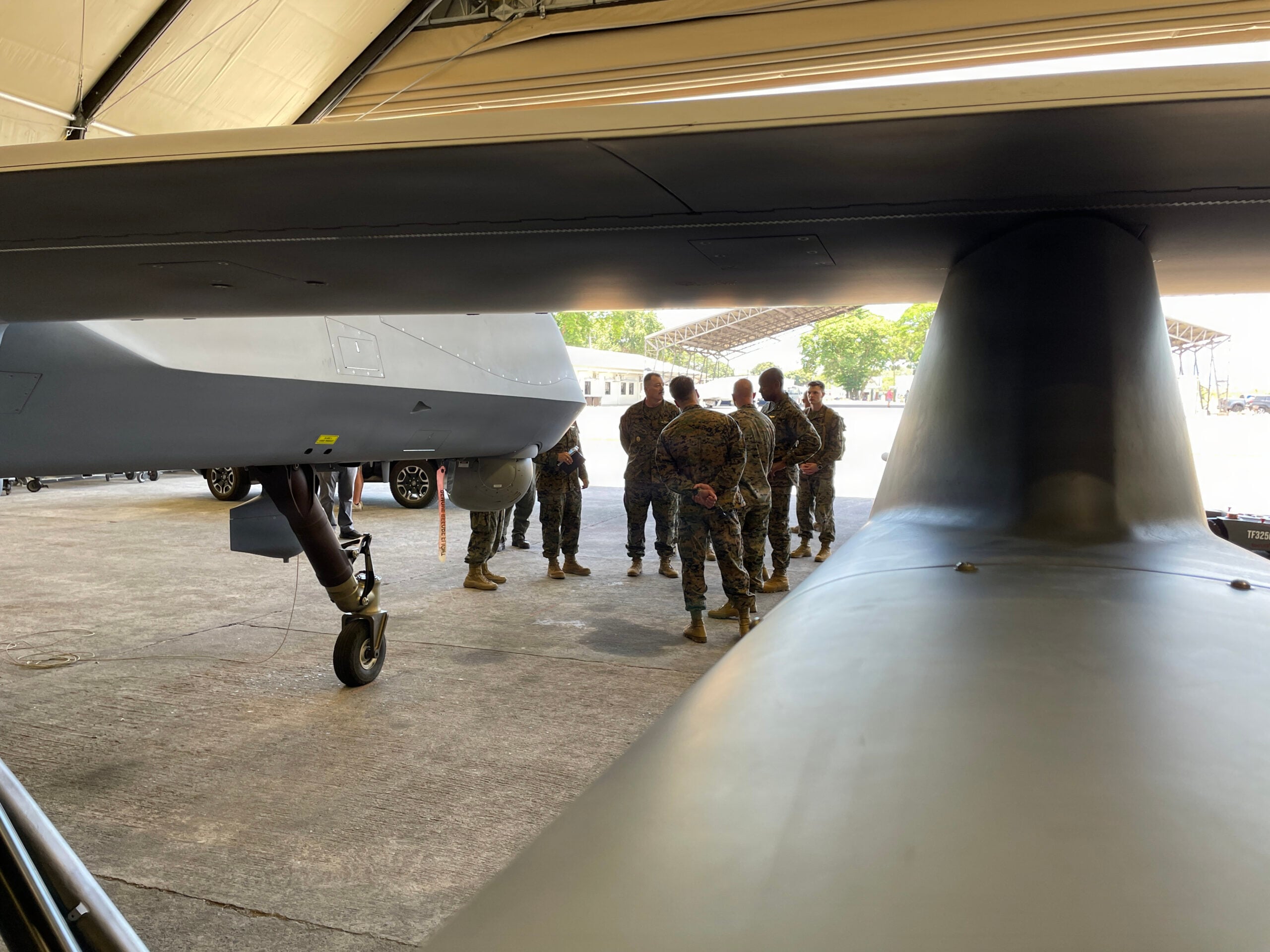
The MQ-9A has an endurance of more than 27 hours and a published range of about 1,000 nautical miles in its standard configuration, according to the United States Air Force. It is a useful aircraft, but its reach is normally discussed in relation to its ground control architecture, tanker support, and forward operating locations. It also carries a substantial sensor and weapons load only when the air-defense environment permits it to operate at useful altitude and speed.
Wildfire reverses the planning emphasis. An 8,000-nautical-mile ferry figure does not mean an 8,000-nautical-mile combat radius. Payload, fuel reserves, datalink equipment, weather, and the need to loiter all reduce the usable number. Even so, the difference between a platform that needs a chain of forward airfields and one that can self-deploy across the Pacific is operationally significant. A drone based in the continental United States, Hawaii, Guam, Australia, or the Philippines could be moved between theaters without treating every regional runway as a permanent dependency.
The reported two-missile fit is equally important. A pair of anti-ship missiles does not make Wildfire a substitute for a bomber or a destroyer. It does create a distributed firing option. If a commander can put ten aircraft on station, the force presents a theoretical salvo of twenty weapons while spreading launch platforms across multiple bases. The calculation is not about replacing the carrier strike group. It is about forcing the opposing navy to search a larger number of low-cost launch platforms.
What It Changes Near Taiwan
China has spent two decades building a layered system intended to find, fix, and strike major American platforms: satellites, shore-based radars, maritime patrol aircraft, fighter aircraft, submarines, and ballistic and cruise missiles. Wildfire would not walk through that system untouched. A large unmanned aircraft remains detectable, its communications can be jammed, and its runway can be attacked. The aircraft also needs a targeting chain capable of producing a valid moving-ship solution before the missile is released.
That is why the aircraft matters as part of a network rather than as an isolated weapons truck. Its sensors could extend the coverage of distributed naval forces, while other aircraft, submarines, or satellites provide targeting updates. Its long endurance could also allow it to wait outside the densest threat rings instead of rushing toward the target on a predictable sortie. In a Taiwan contingency, that creates more opportunities to watch amphibious shipping, replenishment vessels, and air-defense nodes before the main force commits.
There is a limit. Two missiles per aircraft produce a thin magazine if the mission requires repeated attacks. A fleet of 50 aircraft would carry 100 missiles before accounting for maintenance, attrition, and aircraft held in reserve. That is useful capacity, but it is not an answer to a blockade by itself. The value is persistence and distribution. The missile salvo is the sharp end of a much larger surveillance problem.
The $10 Million Question
A reported unit price near $10 million would put Wildfire below the cost of almost every crewed strike aircraft and far below the replacement value of a carrier-based fighter. That comparison can be misleading. The aircraft still needs satellite bandwidth, mission-control crews, spares, weapons, secure bases, and a trained maintenance force. A cheap airframe does not create cheap operations automatically.
It does, however, improve the attrition calculation. Losing one Reaper is painful because the platform is scarce and its mission may be politically sensitive. Losing one Wildfire in a contested sortie would still matter, but commanders could accept more risk if production is fast and the supply chain is domestic. The Pentagon has repeatedly discovered that the limiting factor in a long war is not the first aircraft. It is the tenth replacement and the hundredth missile.
General Atomics is reportedly pitching delivery ahead of the current fiscal year 2031 timeline. Until the company publishes a flight-test record, weapons-integration plan, and production schedule, that should be treated as marketing, not capability. The Air Force has a long history of selecting impressive prototypes and then discovering that software, datalinks, and sustainment consume the calendar.
Beijing Should Watch the Production Line
Wildfire will not make the MQ-9 obsolete, and it will not solve the United States basing problem in the Pacific. Its significance is narrower: it offers a way to turn long-range unmanned aviation from a forward-base asset into a distributed theater asset. That distinction matters when China can hold Guam, Okinawa, and Philippine facilities at risk.
The decisive test is not whether Wildfire can fly 8,000 nautical miles in a brochure. It is whether Washington can buy enough airframes, stock enough anti-ship missiles, and keep enough control nodes alive to sustain sorties after the first week of a war. If the answer is yes, China must defend against a larger and more mobile launch network. If the answer is no, Wildfire is another elegant aircraft trapped inside an inadequate magazine.
The Pacific does not need another drone optimized for a parade or a permissive counterinsurgency fight. It needs an aircraft that can survive the logistics arithmetic of a missile war. Wildfire has the right headline numbers. Now General Atomics and the Pentagon have to prove that those numbers can be manufactured, networked, and replenished under fire.
Sources
- Breaking Defense, report on the General Atomics Wildfire unveiling, September 10, 2026.
- United States Air Force, MQ-9 Reaper fact sheet.
- General Atomics Aeronautical Systems, official unmanned aircraft and advanced airpower materials.
- CSIS, analysis of distributed maritime operations and the Indo-Pacific missile balance.
General Atomics unveiled the Wildfire drone on September 10, 2026, designed for long-endurance reconnaissance and strike missions in the Pacific. The drone features a ferry range exceeding 8,000 nautical miles and can carry two Long-Range Anti-Ship Missiles. This development aims to improve operational capabilities against Chinese naval forces, providing a distributed launch option for U.S. military operations.
- Wildfire drone has a ferry range above 8,000 nautical miles.
- It can carry two Long-Range Anti-Ship Missiles.
- The unit cost is reported to be around $10 million.
- Wildfire is designed for long-endurance reconnaissance and strike missions in the Pacific.
- The drone aims to enhance operational capabilities against Chinese naval forces.