
General Yang Zhibin's First Meeting with the U.S. Pacific Commander in Victoria: China-U.S. Military Command-Level Dialogue Resumes After Two Years
 Li Minghui
General Yang Zhibin Meets US Pacific Commander in Victoria for the First Time, Resuming Military Dialogue After Two-Year Hiatus
On August 31, in Victoria, Canada, outside the venue of the 28th Indo-Pacific Defense Chiefs Conference, a group photo was actively released by the US Pacific Command: on the left is Admiral Paparo, Commander of the US Pacific Command, and on the right is General Yang Zhibin, Commander of the Eastern Theater of the People's Liberation Army (PLA). This marks the first face-to-face meeting between the two, and the first direct contact at the command level between the Chinese and US militaries after a hiatus of about two years.
An Unusual Attendee
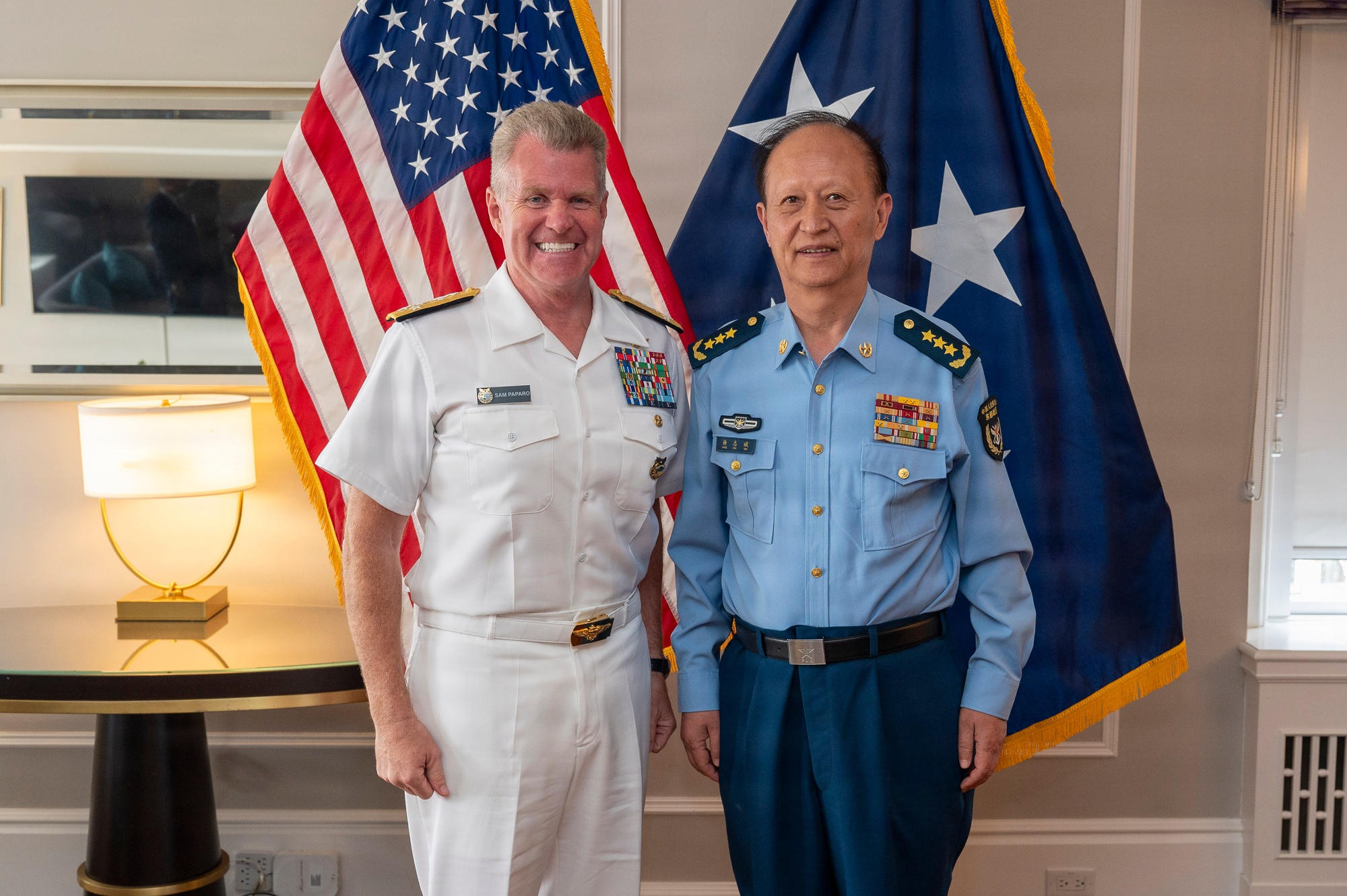
This detail is worth elaborating on. The Eastern Theater is the only one of the PLA's five theaters that focuses primarily on the Taiwan Strait as its strategic direction, directly facing US and Japanese military presence. It is uncommon for a theater commander to lead a delegation abroad for such meetings—previously, the PLA typically sent officials from the Joint Staff Department of the Central Military Commission or the Ministry of National Defense's foreign affairs system to multilateral occasions like this.
According to a statement released by the Pacific Command on September 3, Paparo held bilateral talks with Yang Zhibin during the conference from August 31 to September 2, focusing on maintaining open communication channels between senior military leaders of China and the US, reducing the risk of misjudgment, and promoting safe professional actions by both militaries. Defense Ministry spokesperson Jiang Bin confirmed the relevant itinerary on September 4: the Chinese side spoke at the conference, introducing its position and achievements in maintaining regional peace and stability, proposing that regional countries strengthen defense exchanges and cooperation, and held bilateral meetings with representatives from the US, France, Singapore, and other countries.
What Level of Communication is Being Resumed?
Note the careful wording in public statements: there was no mention of the Taiwan Strait, no mention of the South China Sea, and no list of achievements. The purpose of this meeting is to restore communication and manage risks, rather than to resolve differences. In simple terms, the signal value of both sides being willing to sit at the same table may outweigh the specifics of what was discussed.
There is a mechanism issue that is easily overlooked. Communication between the Chinese and US militaries operates at several levels: the highest is between the defense ministers and the chair of the Joint Chiefs of Staff, with policy consultations in the middle, and only then does it reach the routine coordination between the Pacific Command and the PLA theaters. What has been cut off for the past two years is precisely the theater-level communication that needs to operate regularly—the daily adversaries for the US military in the Indo-Pacific are precisely the Eastern Theater and Southern Theater units. Yang Zhibin leading a delegation to the conference and meeting Paparo separately effectively reconnects that severed line. For frontline troops, this is more practical than issuing a few principle statements from the capitals of both countries: when ships and aircraft meet in the sea and air, at least there are identifiable contacts and usable channels.
A Meeting Does Not Equal Mechanization
My judgment is that this meeting should not be over-interpreted. While in Victoria, Paparo also met with representatives from over a dozen countries, including the UK, Australia, India, Japan, and South Korea, without any side events for AUKUS or the Quad Security Dialogue. China is just one stop along the way, not the only one.
What truly needs to be observed are the mechanistic actions following the meeting: will the working group of the China-US maritime military security consultation mechanism be restored, will the two militaries arrange to rebuild video conferencing or direct communication lines, and when ships and aircraft encounter each other closely in the Taiwan Strait next time, will there be someone on the other end of the newly connected channel to respond? As of the time of writing, there are no clear answers to these questions. Meanwhile, military activities around the Taiwan Strait have not ceased—Taiwan's defense department was still releasing updates on the PLA's naval and air readiness patrols in early September. The effectiveness of the reestablished channel will depend on how it performs under pressure, rather than how good the handshake photo looks.
One question remains for future observation: after two years of disconnection, the first call on the reconnected line went smoothly. When it rings again—such as during another confrontation between ships and aircraft in the Taiwan Strait—will there still be someone on the other end to answer?
General Yang Zhi-bin of the Eastern Theater Command met with Admiral Paparo of the U.S. Pacific Command in Victoria from August 31 to September 2, 2023. This marked the first direct contact between U.S. and Chinese military leadership in two years, focusing on communication channels and risk management. The meeting did not address specific regional tensions, emphasizing the importance of dialogue over resolving differences.
- General Yang Zhi-bin met with Admiral Paparo for the first time in two years.
- The meeting focused on maintaining communication and reducing risks of misjudgment.
- The Eastern Theater Command is the only PLA command focused on the Taiwan Strait.