
Germany to set up first drone regiment next year, modeled after Ukraine war lessons
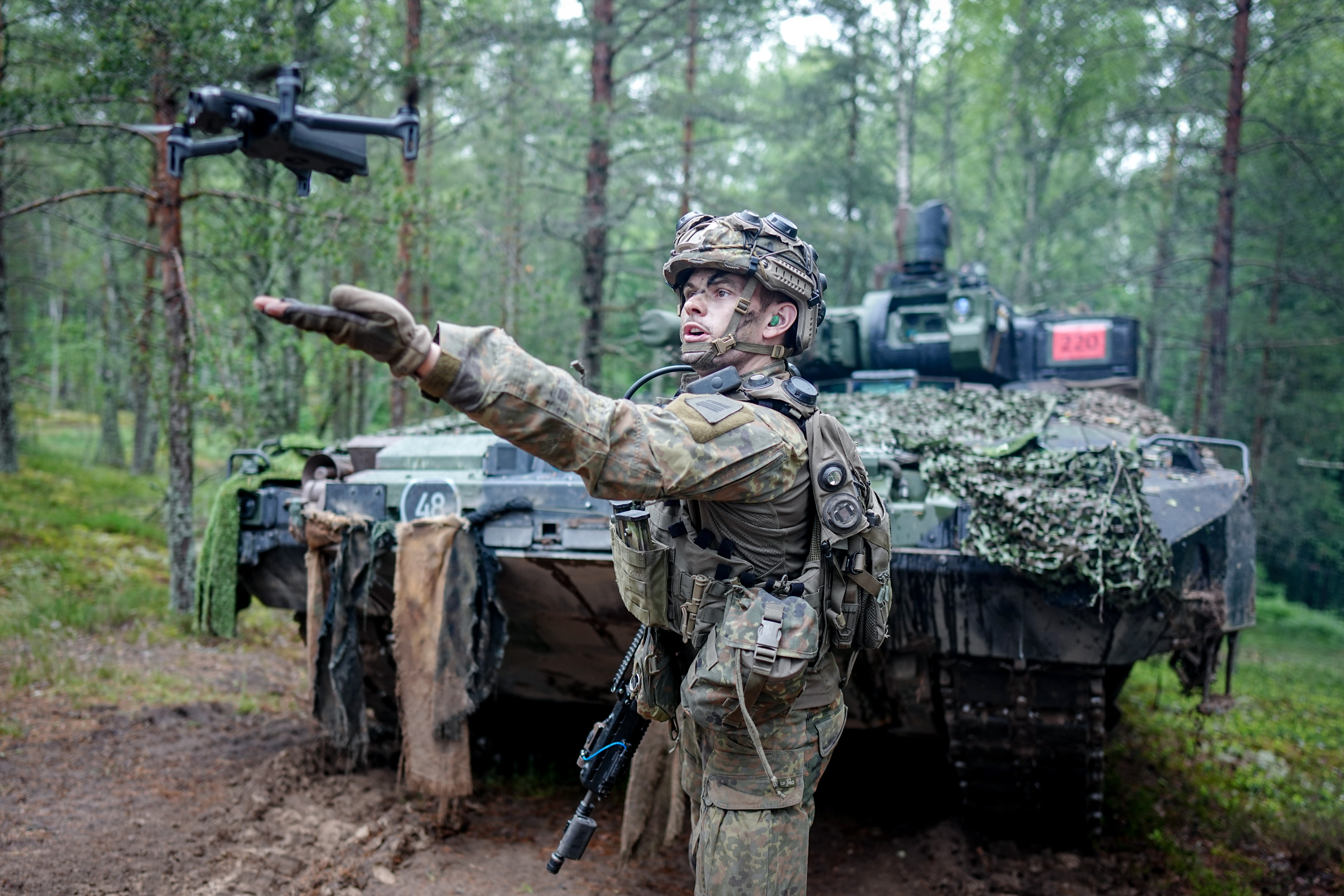
VIENNA — Germany plans to stand up its first dedicated drone regiment next year, Defense Minister Boris Pistorius announced, as Berlin attempts to institutionalize lessons from the war in Ukraine after years of domestic foot-dragging on unmanned warfare.
Speaking Oct. 1 at the Bergen military training area during the army’s “Experimentalserie Land” trials, Pistorius said ground forces will begin forming the regiment in 2027. Officials credited direct operational exchanges with Ukrainian frontline units for shaping the live-fire trials, which tested both aerial drones and unmanned ground systems. Pistorius emphasized that ground robotics will serve as an equal operational pillar alongside aerial systems, with the regiment consolidating reconnaissance, deep-strike capabilities, unmanned ground vehicles, electronic warfare, and counter-drone defenses under a unified command.
Once-reluctant Germany goes big on one-way attack drones
The regiment will serve as a divisional asset assigned to the 10th Panzer Division − the formation earmarked as Germany’s high-readiness “Division 2025” pledge to NATO, which also oversees Panzerbrigade 45 in Lithuania.
German Army Chief Lt. Gen. Christian Freuding said the Bundeswehr is pursuing a dual-track strategy that envisions setting aside dedication formations while also institutionalizing drone usage throughout the entire force.. At the turn of the year, the service will simultaneously begin fielding tactical unmanned systems directly across three core combat branches: light infantry, reconnaissance, and armor units.
The army plans to recruit between 300 and 350 personnel for the regiment’s initial footprint in 2027 before expanding the unit to an end strength of up to 600 troops, according to Freuding. In remarks to German wire service dpa, Freuding said planners target full operational capability by 2029.
The envisioned structure comprises five or six companies, including units for close-range combat, deep strikes at ranges of up to 500 kilometers depending on commercial equipment availability, electronic warfare, counter-UAS protection, and an internal trials company intended to fast-track operational testing. The Bundeswehr also plans to equip the formation with loitering munitions, which are currently undergoing evaluation and should reach troops in 2027, according to dpa information.
Unmanned systems have fundamentally reshaped modern combat, accounting for the vast majority of casualties on the battlefield in Ukraine. Western militaries have often lagged in retrofitting their forces, slowed by peacetime procurement practices and protracted political debates over weaponized drones and autonomy.
Key procurement questions surrounding the new unmanned-tech formation remain. The defense ministry has yet to finalize a permanent basing location or award contracts for the specific long-range platforms the regiment requires.
Germany plans to establish its first dedicated drone regiment in 2027, as announced by Defense Minister Boris Pistorius at the Bergen military training area. The regiment will be part of the 10th Panzer Division and aims to integrate aerial and ground robotics for enhanced military capabilities. Initial recruitment will range from 300 to 350 personnel, with a target of 600 by 2029, focusing on reconnaissance, deep-strike, and electronic warfare capabilities.
- Germany plans to establish its first dedicated drone regiment in 2027.
- The regiment will be part of the 10th Panzer Division.
- Initial personnel strength will be between 300 and 350, expanding to 600.
- The regiment will include capabilities for reconnaissance, deep-strike, and electronic warfare.
- Full operational capability is targeted by 2029.