
Germany touts pan-German space command amid European push to supplant US tech

VIENNA — Germany’s defense minister used a rare four-nation gathering of German-speaking defense chiefs this week to push forward plans for a European military space command, calling on close partners including Austria, Switzerland and Luxembourg, to help shape the initiative rather than simply join it.
Boris Pistorius, Germany’s defense minister, announced at a press conference in Berlin that Germany is developing a European Space Component Command alongside a Weltraumakademie − a multilateral space training academy − and insisted that partner nations will be “embedded in the design phase” rather than presented with finished structures.
The meeting, billed as the first “DACH+L” format, expanding the traditional German-Austrian-Swiss defense dialogue to include Luxembourg, served as a platform for Pistorius to demonstrate traction on Germany’s €35 billion ($40.7 billion) military space investment pledged last fall. That program spans encrypted low-earth-orbit satellite constellations, military-grade launch capacity, and an expanded Space Command within the Bundeswehr.
Austria’s Defense Minister Claudia Tanner reaffirmed that Austria plans to put three operationally designated military satellites plus a test object into orbit next year, developed partly with Austrian startups. The program centers on two projects: LEO2VLEO, a joint initiative with the Netherlands covering imaging and navigation in very low Earth orbit, and BEACONSAT, an Austrian navigation satellite built for under €1 million ($1.16 million). Tanner said the satellites would be made available to partners and framed the push as essential for communications independence in a crisis.
Austria is neutral by constitution, though some have questioned how its deepening defense ties with European neighbors can be squared with this tradition and legal requirement.
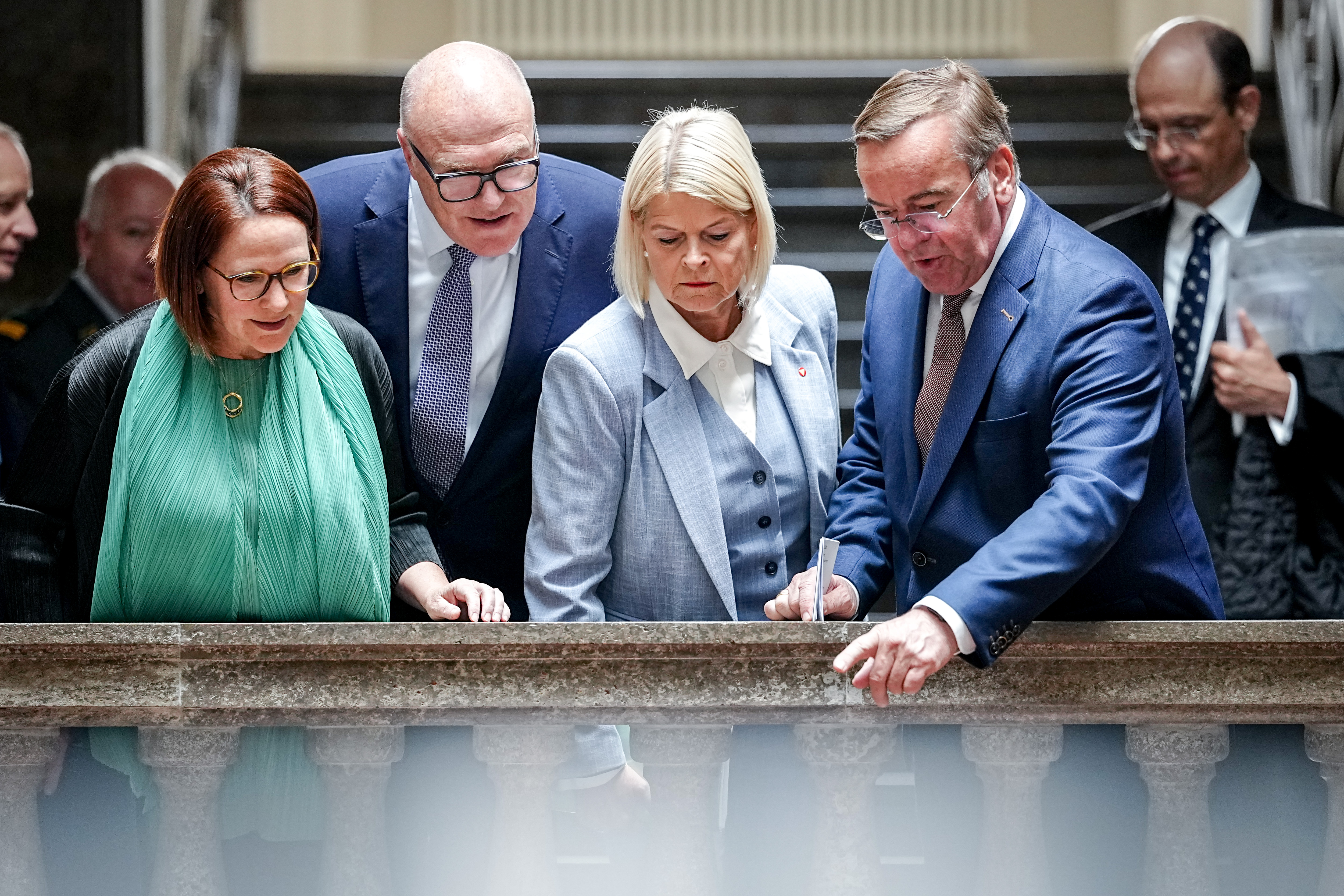
Luxembourg’s Defense Minister Yuriko Backes, attending a DACH meeting for the first time, pointed to her country’s niche: established SATcom and Earth observation expertise that Luxembourg is “very willing to make available to allies and partners.” She and Tanner both referenced a forthcoming cooperation deal between the two countries on satellite use in July, without elaborating.
Swiss Federal Councilor Martin Pfister noted that there is no domain where Europe faces a greater dependency on non-European technology providers than in the space domain. “It is not possible for one country to solve this alone,” he said, though he called out Swiss state-owned company Beyond Gravity as a potential industrial contributor to a European solution.
Switzerland, too, has bent the limits of its longstanding neutrality to deepen its integration into European defense projects since the war in Ukraine. The joint accession of both Austria and Switzerland to the German-led European Sky Shield Initiative in 2023 was a prime example of this new thinking.
The latest moves signal a further deepening of these Central European defense ties. The conference alone was a remarkable signal, expanding the more established German-Austrian-Swsiss DACH format to Luxembourg as a fourth member.
What Monday’s meeting produced in concrete terms was modest: a reaffirmation of existing cooperation threads, a cyber exercise result − Luxembourg, together with the three other German-speaking countries, placed second at NATO’s Locked Shields event under German leadership in April − and political momentum behind space initiatives that remain largely conceptual. But the message was still clear: German-speaking Europe is serious about wanting to become a player in space, and the push for independence from the U.S. has gained additional momentum.
Germany is advancing plans for a European military space command, collaborating with Austria, Switzerland, and Luxembourg. At a recent meeting in Berlin, Defense Minister Boris Pistorius emphasized the importance of partner nations being involved in the design phase of the initiative. Austria announced plans to launch three military satellites next year, while Luxembourg expressed readiness to share its satellite expertise. This initiative aims to enhance European defense capabilities and reduce reliance on U.S. technology.
- Germany is pushing for a European military space command involving Austria, Switzerland, and Luxembourg.
- Austria plans to launch three operational military satellites next year.
- The meeting marked the first DACH+L format gathering of German-speaking defense chiefs.
- Luxembourg is willing to share its satellite communication and Earth observation expertise with allies.
- The initiative aims to reduce dependency on non-European technology providers in the space domain.