
Germany's 8.7 Billion Krona Saab Deal Shows the Costs of the F126 Failure
 Dr. Klaus Weber
Germany's 8.7 Billion Krona Saab Deal Shows the Costs of F126 Failure
8.7 billion Swedish Krona is not a large amount in the scale of European rearmament. Converted to around 900 million dollars, Germany is purchasing sensors, composite structures, and combat management systems from Saab for four new MEKO A-200 DEU frigates. Politically, however, this contract is larger than its sum. It shows what remains of the German turning point when an overly ambitious procurement program fails due to time, cost, and industrial complexity, and Berlin subsequently opts for a pragmatic, yet by no means simple, replacement solution.
On July 16, Saab announced that the company would supply the 9LV combat management and fire control systems, Sea Giraffe 4A fixed-face radars, Sea Giraffe 1X radars, and composite structures for TKMS. Deliveries are expected to take place between 2029 and 2032. This aligns with Berlin's goal of launching the first new frigate before the end of the decade. However, it also fits a more uncomfortable finding: Germany is not simply buying faster. It is buying faster because the original F126 program was no longer politically or administratively viable.
From the 10,550-Ton Design to the 4,000-Ton Frigate
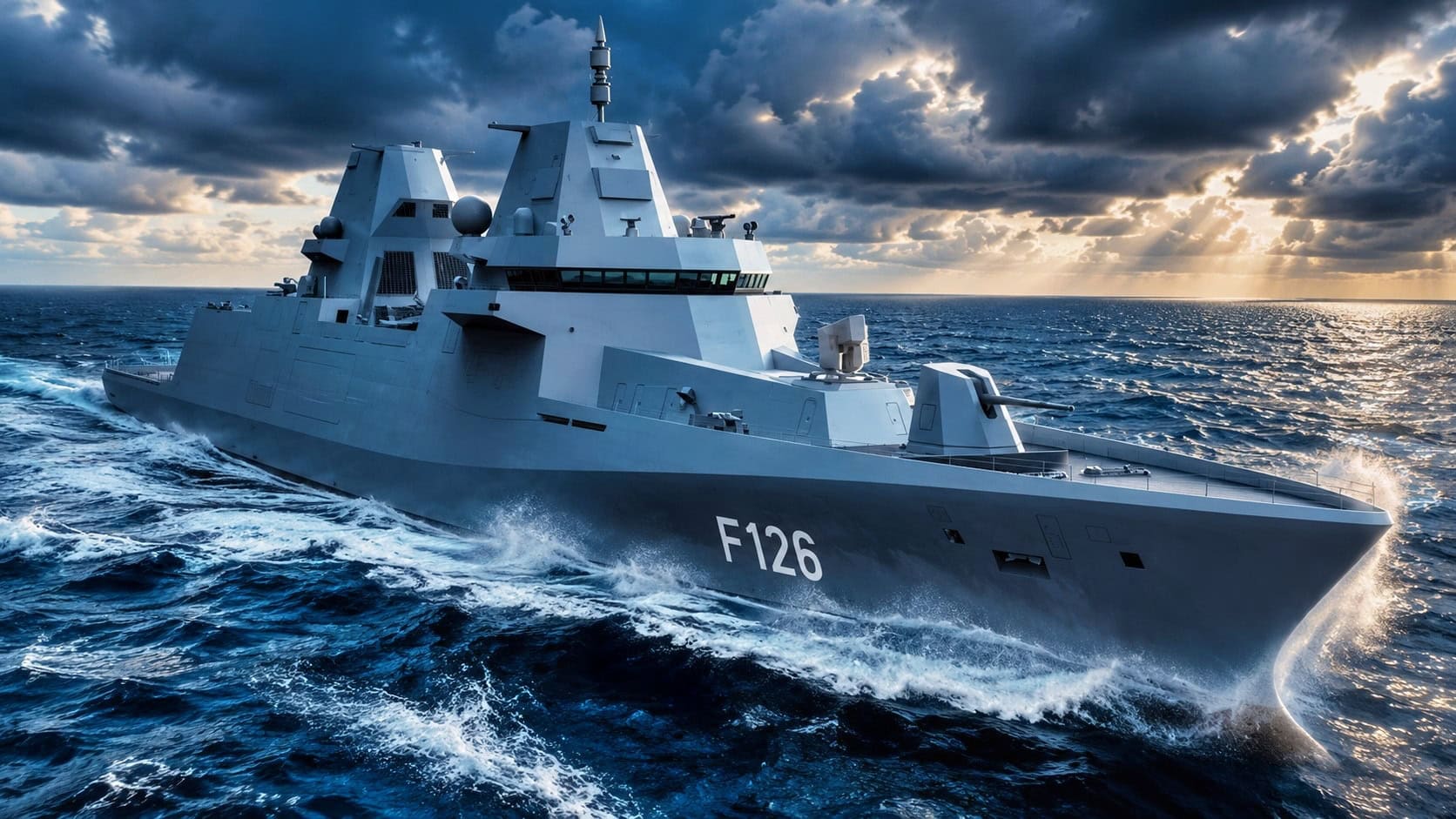
The abandoned F126 was supposed to be a specialized, approximately 10,550-ton multi-purpose frigate. The original contract with Damen Schelde Naval Shipbuilding was around 10 billion euros for six ships. After delays, cost increases, and the consideration of switching the general contracting to Naval Vessels Lürssen, the bill escalated to a different magnitude: around 15.2 billion euros for a continuation under new leadership, more than 18 billion euros including already completed work and support contracts (Defense News, June 24, 2026). This is not a normal inflation surcharge. It is an institutional warning signal.
The new path is formally more modest. The Budget Committee of the Bundestag approved on July 8 the procurement of four TKMS-built MEKO A-200 DEU for about 6.3 billion euros, with an option for four additional hulls for around 5.3 billion euros. Eight ships would thus cost approximately 11.6 billion euros. On paper, this sounds like a return to reason: smaller platform, proven design, German prime contractor, Swedish sensors, NATO capability gap closed. But is that enough?
The MEKO A-200 DEU is not merely a cost-saving variant. It must fulfill German anti-submarine warfare commitments to NATO, cover air and surface combat, and at the same time be integrated into a multinational system architecture on a tight schedule. This is precisely where the point lies. The F126 problem was not just the size of the ship. It was Germany's tendency to bundle operational urgency, industrial division of labor, legal risk avoidance, and technological wish lists into a single procurement object. When everything is to be achieved simultaneously, often nothing is achieved on time.
Saab Provides Integration, Not Just Hardware
The Saab contract is therefore more than a supplier change. With 9LV, Sea Giraffe 4A, and Sea Giraffe 1X, Germany is purchasing part of the digital and sensor architecture of its future frigates. Combat management systems determine how radar, fire control, data link, and weapon systems interact. Whoever integrates here shapes the operational logic of the ship. This is no less strategic in the navy than the question of who controls the Combat Cloud Stack in a combat aircraft.
Interestingly, this reflects a pattern from other European programs, but in reverse. In the FCAS, Paris and Berlin argued for years over industrial leadership roles, system architecture, and technological sovereignty until the project effectively collapsed. In the MEKO frigate, Berlin is now accepting a Swedish key role because the political priority is not symbolic German-French equality, but delivery capability. This is sober. It is also an admission that European defense cooperation works when responsibilities are clear and national industrial policy does not overshadow every technical decision.
Sweden is an instructive partner in this regard. Saab is not the largest European defense contractor, but the company has an industrial depth in sensors, electronic warfare, submarine technology, and combat management systems that many larger states would politically desire. Germany is thus buying European, but not in the usual Brussels sense of a large framework initiative. It is purchasing a concrete capability from a specific provider because the national navy must meet a deadline. This may sound banal. In European defense policy, banality is often a step forward.
The NATO Deadline Forces Honesty
The crucial pressure does not come from Brussels, but from NATO. Germany's navy needs anti-submarine warfare capabilities for the North Atlantic, the Baltic Sea, and the protection of transatlantic reinforcement. Russian underwater activities, the vulnerability of critical infrastructure, and the return of large-scale alliance defense make frigates not prestige objects, but critical capabilities. The Bundeswehr cannot explain to NATO that its industrial process architecture is unfortunately still incomplete.
Here, the limits of German procurement culture become apparent. Germany has mobilized a lot of money after 2022: special funds, higher individual plans, new commitment authorizations. However, money does not create time. A euro that flows into a delayed program remains militarily unproductive until the capability is actually available. This is the difference between spending and capacity. The F126 bill was politically devastating because it damaged both at the same time: it tied up money and did not deliver timely capability.
The MEKO decision partially corrects this mistake. It reduces complexity, supports TKMS as the German shipbuilder, and utilizes Saab as an established European system provider. Nevertheless, the risk remains considerable. A 4,000-ton platform is not simply a halved F126 concept. It requires different compromises in range, endurance, mission modules, crew, anti-submarine warfare equipment, and growth reserves. If Berlin overloads the new frigate with the ambitions of the old program, the replacement solution will only become a smaller F126 problem.
European Industrial Policy Needs Discipline
The European Commission welcomed a political agreement on the AGILE program on July 16, which aims to bring disruptive defense innovation from the lab to the field more quickly. On July 3, it proposed five new European Defence Projects of Common Interest. These initiatives are sensible, but they must not be confused with capability generation. Innovation is not a substitute for program management. Joint projects are not a substitute for hard prioritization.
Germany provides a case study with F126 and MEKO. European defense autonomy does not arise from every major program carrying as many flags as possible on the slide. It arises when European states are willing to give a provider responsibility, accept technical leadership roles, and discipline political wishes before contract signing. Saab on German frigates is in this respect more European than some grandly announced cooperation initiative because the contract specifies a concrete capability, a timeline, and a responsible party.
The price of this honesty is politically uncomfortable. Berlin must explain why an abandoned 10 billion euro program has led to a new 6.3 billion euro procurement while potential compensation claims against Damen are still being legally examined. It must also demonstrate that the MEKO path is not only cheaper but operationally sufficient. And it must prevent the transition to TKMS and Saab from appearing as mere national industrial diversion. If the option for four additional ships is exercised by the end of 2026, it will determine whether Germany is truly committed to serial capability or remains stuck in budgetary half-decisions.
The Lesson for Berlin and Brussels
The Saab deal is not a defeat for European sovereignty. On the contrary: it is an indication of how it could become more realistic. Germany builds the ships at TKMS, integrates Swedish sensors, and orients the program to a NATO capability deadline. This is not pure national autarky and not abstract EU industrial policy. It is collaborative European defense under time pressure.
Yet for this reason, no one should romanticize the contract. The real lesson is not that MEKO is better than F126. It is that Europe must choose between two bad habits: either holding on to perfect programs for too long until they politically collapse, or accepting imperfect, deliverable solutions early enough. More money does not automatically make this choice easier. It can even obscure it. The paradox of the German turning point is that Berlin can spend more today than before, but precisely for that reason must make harder decisions about what will no longer be built.
Germany is procuring four MEKO A-200 DEU frigates from Saab, with deliveries expected between 2029 and 2032, in response to the failed F126 program. This deal, valued at approximately 900 million USD, includes advanced combat systems and reflects a shift towards integrating Swedish technology to meet NATO requirements. The procurement aims to enhance Germany's naval capabilities amid increasing geopolitical pressures.
- Germany is spending 8.7 billion Swedish Krona (approximately 900 million USD) on new frigates from Saab.
- The procurement is a response to the failure of the F126 program, which faced significant cost overruns and delays.
- Deliveries of the new frigates are expected between 2029 and 2032, with a focus on NATO capabilities.
- The deal includes advanced combat management and radar systems from Saab, indicating a shift in military procurement strategy.