
Germany's FCAS Exit 2026 Makes 35 F-35s a Symptom of European Weakness
 Dr. Klaus Weber
Germany's FCAS Failure 2026 Makes 35 F-35s a Symptom of European Weakness
Germany has already ordered 35 F-35A. An additional 15 aircraft are now explicitly back on the table as a bridging solution following the end of the Future Combat Air System. These two numbers describe Germany's dilemma more precisely than any explanation about European sovereignty: Berlin wanted to develop a sixth-generation fighter jet with France and Spain but is now temporarily back with Lockheed Martin.
This is not a technical embarrassment but an institutional finding. France and Germany have effectively abandoned the manned fighter jet core of the FCAS after years of blockage. According to reports from Reuters, Defense News, and The Guardian, President Emmanuel Macron and Chancellor Friedrich Merz concluded that Airbus and Dassault Aviation can no longer be brought into a viable development mode. The program was launched in 2017 as a German-French core of European defense integration, with Spain joining later. Its political price tag was around 100 billion euros.
The Dispute Was Not a Misunderstanding About Engineering
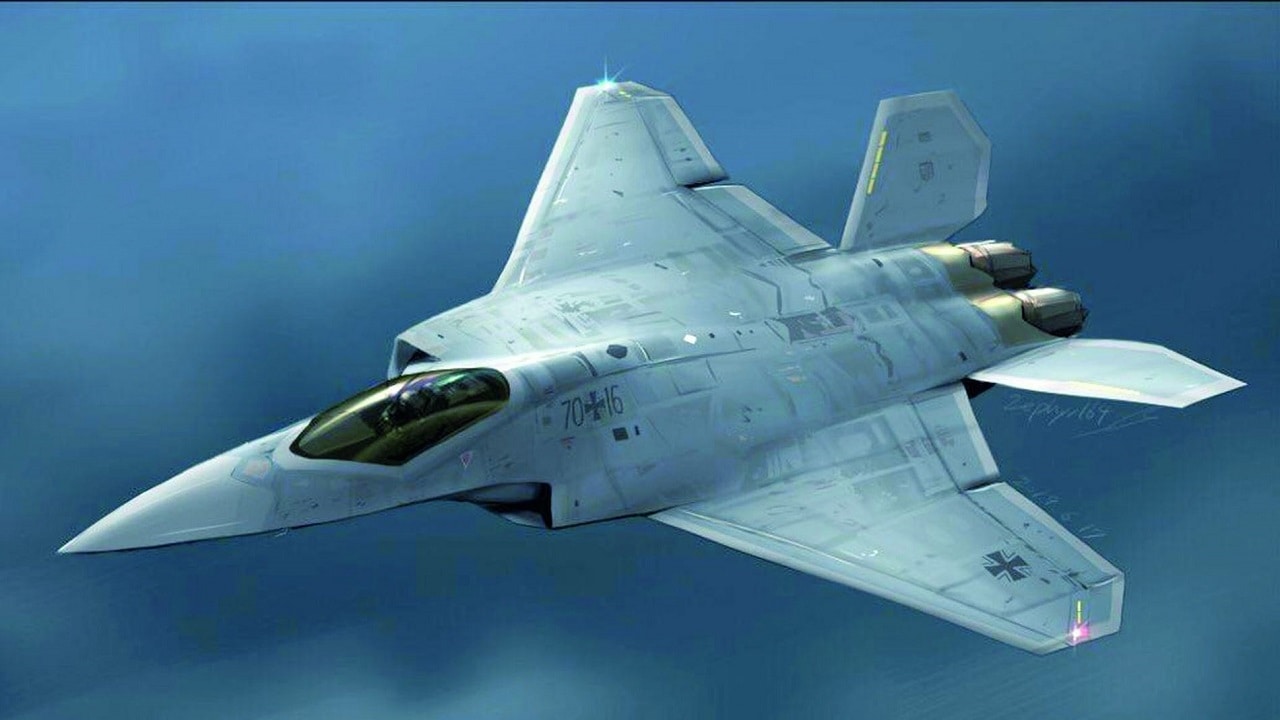
Those who describe the dispute merely as an industrial squabble between Dassault and Airbus underestimate it. Of course, it was about intellectual property, leadership roles, work packages, and system integration. Dassault did not want the Next Generation Fighter to be co-managed; Airbus demanded a more balanced role for Germany and Spain. But beneath that lay a military-political difference that was never cleanly resolved.
France needed an aircraft that could fulfill nuclear roles and operate from an aircraft carrier. Germany primarily needs a replacement for the Eurofighter and a credible air force capability within NATO. These requirements are not identical. Merz had already questioned whether a manned sixth-generation fighter jet in the planned form was even sensible for Germany. One might consider this question provocative. It is not incorrect.
The real failure was that the program pretended for years that a common political symbol could replace the lack of a common operational doctrine. Weber's rule number one of European armament policy: Whoever does not clarify military needs before the industrial distribution key will end up with neither integration nor capability.
Pistorius Names Three Options and Omits the Fourth Truth
Defense Minister Boris Pistorius outlined three paths after the FCAS failure. First, Germany could buy additional F-35s from the United States. Der Spiegel had already reported on a possible order for 15 more aircraft for nearly 3 billion dollars; Defense News has now reported that this option is explicitly on the table. Second, Berlin could join an existing international program with sixth-generation features, effectively looking towards GCAP with the UK, Italy, and Japan. Third, Germany could start its own program under Airbus leadership with additional partners.
The fourth truth is: None of these options replaces FCAS by 2040 without costs. More F-35s secure nuclear participation, interoperability, and availability in the short term, but deepen dependence on US software, US approval, and US export control. GCAP offers a more realistic governance framework than FCAS, but Germany would join late and would have to accept that central architectural decisions have already been shaped by London, Rome, and Tokyo. A German Airbus program sounds sovereign but would quickly become an expensive industrial policy safe haven without French fighter jet experience, without clear export logic, and without guaranteed quantities.
Pistorius's statement that such a program would not be set up the same way today is therefore noteworthy. It is not a trivial afterthought but a late acknowledgment that FCAS was started incorrectly. It was not the industry that betrayed politics; it was politics that gave the industry an unsolvable mandate.
Team Gen 6 Does Not Automatically Solve the Airbus Problem
Alongside the ILA Berlin, a German industrial alliance formed around Airbus, described in media reports as Team Gen 6. Among others, Airbus Defence and Space, MBDA, Hensoldt, Diehl Defence, and MTU Aero Engines are mentioned. This constellation is industrially plausible: sensors, effectors, propulsion, networking, and system integration do not lie with a single company. However, it also shows why Germany has so far struggled to lead a fighter jet program.
France has a national fighter jet line with Dassault and an exportable product with the Rafale. Germany has strong subsystems, excellent suppliers, and Eurofighter experience, but lacks a sole political culture of fighter jet prime contracting. This is not a flaw but a structural fact. A team can build a system. However, it can only carry a sovereign program if the state decides in advance which capabilities are non-negotiable, which technologies will be shared, and what export policy will apply.
Without these decisions, Team Gen 6 will only be FCAS in a smaller circle. With them, it could become a European contribution to a larger, modular air combat system. The difference lies not in the logo on the trade show wall but in procurement law, in IP governance, and in the willingness of the Bundestag to commit funds long-term.
NATO Demands Speed, Not European Self-Therapy
The timing exacerbates the problem. On June 10, NATO Secretary General Mark Rutte called for more firepower faster at the Transatlantic Defence Industry Access Forum. He referred to transatlantic production projects, including the planned RTX-MBDA production for Patriot missiles in Europe and a munitions line from the MSM Group in Iowa, which is expected to produce nearly half a million artillery shells per year starting in 2029. These examples are politically uncomfortable because they show: Production occurs where contracts, approvals, capital, and government procurement come together. Not where ministers invoke European autonomy.
For Germany, this means: An additional F-35 purchase would be strategically unpleasant but militarily understandable. The air force needs capability, not in 2050, but before 2035. Breaking Defense reported the expectation that Germany must adopt a fifth-generation-plus system by then. This deadline brutally collides with European program reality. Anyone starting a new fighter jet program today will not buy an operational squadron in the next decade.
Here lies the difference between capability and capacity. The F-35 creates short-term capability. It does not create European capacity. A German or GCAP-related program could create capacity but comes too late for the most urgent capability gaps. Europe needs both but has organized its planning cycles as if it must choose.
The European Pattern Repeats Itself
FCAS was never just an aircraft. The system was supposed to connect manned jets, drones, sensors, and a protected Combat Cloud. That the Combat Cloud elements may continue under the name FCAS is politically useful but analytically limited. A nervous system without a common body remains a research field, not an air force.
European defense policy thus repeats a familiar pattern. First, a large integration symbol is created. Then, national industrial interests are translated into work packages. After that, the armed forces discover that their operational requirements do not align. In the end, some partners buy American, others modernize national systems, and all declare that the next cooperation will be better prepared.
One should not conclude from this that European armament cooperation is impossible. It is possible, but only if three conditions are met before the start: a common military need, an accepted system leadership, and a binding export and IP regulation. FCAS did not stably resolve any of these three conditions. Therefore, it did not die from too little European spirit but from too much institutional ambiguity.
The Uncomfortable Decision for Berlin
Berlin must now act on two fronts. In the short term, Germany will hardly be able to avoid additional US technology if the air force is to remain credible in the 2030s. In the medium term, it must decide whether to enter GCAP as a late, disciplined partner or build a more limited European system with Airbus and Spain. Selling both simultaneously as a full-fledged national leadership ambition would be the next self-deception.
The temptation is great to rhetorically downplay the FCAS failure: Combat Cloud remains, European cooperation continues, France and Germany remain friends. All true, but not sufficient. Europe's problem is not that it has too few formats. Europe's problem is that it often uses formats as a substitute for decisions.
The paradox is thus clear. Germany needs the F-35 because Europe could not deliver FCAS. But the more Germany needs the F-35, the less credible the claim becomes that European sovereignty arises automatically from higher defense spending. More money can buy time. It does not buy governance. And without governance, the next billion-dollar program will again first be a symbol and only much later perhaps a capability.
Source Basis
- Reuters/Defense News, June 8, 2026, on the German-French decision to end the FCAS fighter jet core.
- Defense News, June 9, 2026, on Pistorius' options after the FCAS failure, including additional F-35s.
- The Guardian, June 8, 2026, on the political and industrial causes of the project termination.
- NATO, June 10, 2026, speech by Secretary General Mark Rutte on accelerating transatlantic defense production.
- Breaking Defense, June 10, 2026, on German requirements for a fifth-generation-plus system by 2035.
Germany is reassessing its military aircraft procurement strategy in 2026 after the failure of the Future Combat Air System (FCAS), considering additional purchases of F-35A aircraft. The German Air Force has ordered 35 F-35A and may acquire 15 more, reflecting a shift in defense policy amid NATO's call for enhanced military capabilities. The abandonment of FCAS highlights the differing military needs between Germany and France.
- Germany has ordered 35 F-35A aircraft and is considering an additional 15.
- The Future Combat Air System (FCAS) project has been effectively abandoned by Germany and France.
- Germany's military needs are not aligned with France's requirements for the FCAS.
- NATO has called for increased military capabilities in Europe.
- Germany's Air Force needs to enhance its capabilities before 2035.