
Germany's LORA Test Shows Europe's Rearmament Is Still Imported
 Alexandra Reeves
Germany's LORA Test Shows Europe's Rearmament Is Still Imported
Europe says it wants strategic autonomy. Then Germany goes into the North Atlantic, loads an Israeli ballistic missile onto a frigate, and proves how far that ambition still has to travel.
The German Navy's dual live-fire trial of Israel Aerospace Industries' Naval LORA system this week was not just another weapons demo. According to IAI's statement, reproduced by EDR Magazine and Eurosatory's European Security & Defence, the missile was fired twice under Germany's Operational Experimentation programme, or OPEX, and hit its target precisely in both scenarios. Defence Blog, citing Reuters, added the detail that the test took place between Ireland and Iceland and that Berlin is now preparing to move ahead with procurement.
That matters because Germany does not merely need more missiles. It needs more options for long-range conventional strike at sea, fast. The old European habit was to talk about the threat, form a working group, and discover five years later that the Americans had solved the problem first. This test suggests Berlin no longer thinks it has that kind of time.
What Germany Actually Tested
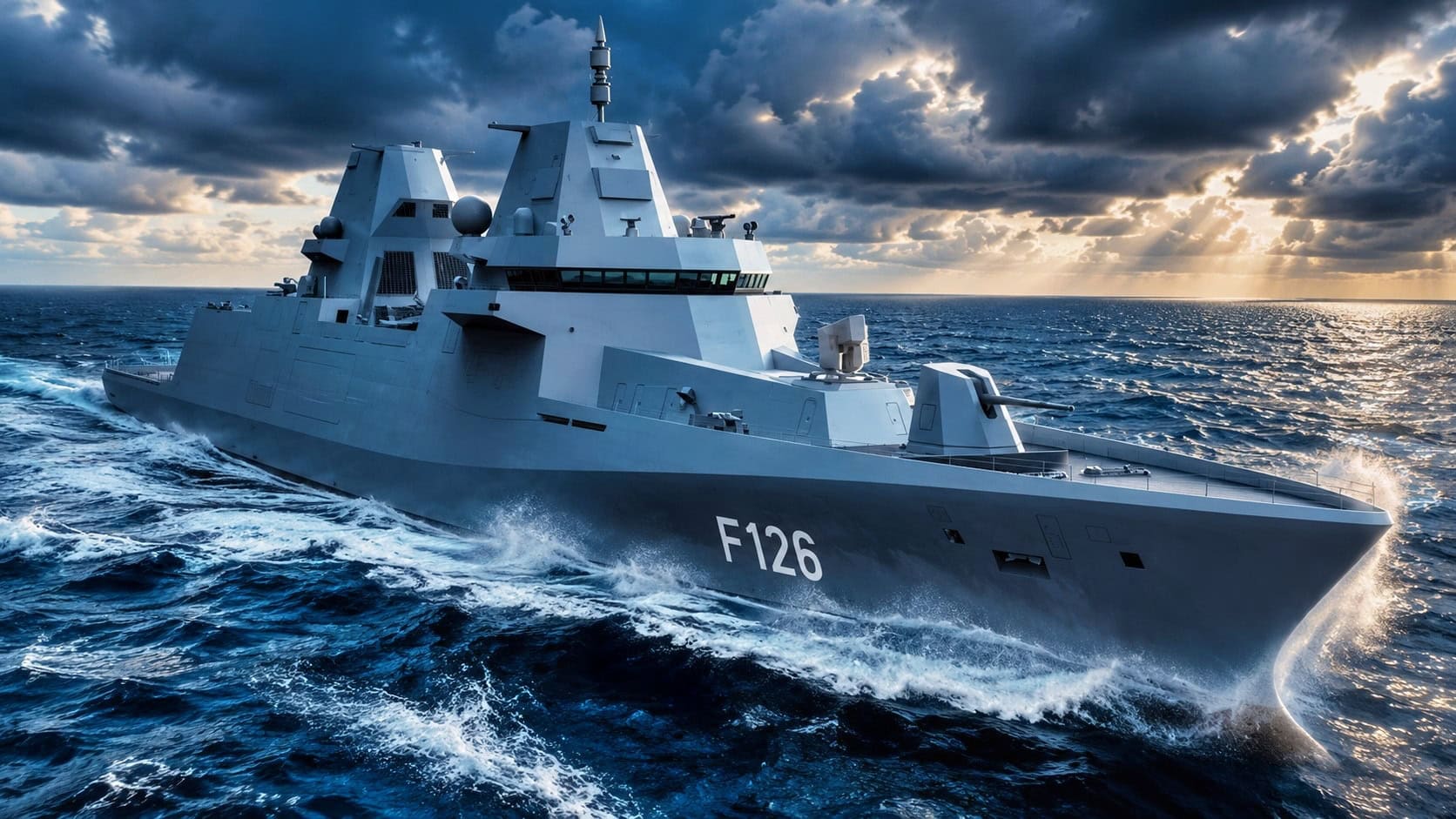
IAI describes Naval LORA as a containerised ballistic strike system built for sea-to-shore and sea-to-sea missions. The company says the missile can be launched within minutes, uses GPS and inertial guidance, and is designed to hit with a circular error probable of about 10 metres. Published specifications cited by European Security & Defence put the standard range at 90 to 430 kilometres. Yet reporting around the German test repeatedly described the trial configuration as exceeding 500 kilometres.
That gap between brochure range and reported trial range is not a trivial footnote. It points to one of two things: either Germany tested an enhanced configuration, or the public export-facing specification has not caught up with what Berlin was shown at sea. In either case, the message is the same. Germany is looking for a weapon that can hold targets at risk well beyond the reach of its current shipboard firepower.
Shephard reported that German Navy video appeared to show the frigate Sachsen-Anhalt, one of the Baden-Wurttemberg-class ships, and German media said two frigates were deployed for the exercise. That is also telling. Berlin is not waiting for some pristine future surface combatant to arrive before experimenting with long-range strike. It is testing whether existing hulls can be turned into credible missile carriers now.
Why Berlin Is Moving So Fast
The easy reading is that Germany simply saw a capable Israeli system and liked it. The harder reading is more interesting. Berlin is reacting to a Europe-wide realisation that deterrence on the alliance's eastern flank is not only about air defence, armour, or troop presence. It is also about deep fires: the ability to hit launch sites, logistics nodes, and command infrastructure before Russia can shape the next phase of a crisis.
That problem has become sharper over the last year. Russia's war against Ukraine keeps rewarding range, speed, and the ability to strike from unexpected vectors. At the same time, European governments have discovered that rebuilding inventories is slow, multinational design programmes are slower, and the political appetite for waiting has largely disappeared. OPEX exists because the German Navy knows the normal acquisition cycle is a luxury item.
Vice Admiral Jan Christian Kaack's reported comment that the launch opened a new chapter for deterrence at sea was not hype. It was a blunt acknowledgement that Germany wants a naval role in long-range strike that it did not have before. That does not automatically turn the Bundeswehr into a maritime missile power. But it does mark a shift from talking about future lethality to testing it under operational conditions.
The Israeli Angle Europe Should Not Ignore
There is another uncomfortable point here. Europe's most ambitious rearmament projects still keep circling back to non-European answers. Germany already bought Israel's Arrow 3 for upper-tier missile defence. Now it is trialling an Israeli ballistic strike system for maritime use. Separate reporting has also tied Berlin to US Tomahawk plans. The pattern is hard to miss.
European politicians like the phrase strategic autonomy because it sounds expensive in a dignified way. But autonomy is not a slogan. It is an industrial condition. If Europe's answer to every urgent military gap is to buy Israeli interceptors, Israeli strike missiles, and American land-attack cruise missiles, then what it is building is not autonomy. It is a faster import pipeline.
That is not necessarily a mistake. In fact, in military terms it may be the right call. Deterrence has a calendar. Industrial sovereignty does not stop a missile raid next year. If Berlin can field a credible sea-based deep-strike option by adapting proven Israeli hardware, the operational logic is obvious. Still, Europe should be honest about what that means. It is buying time, not solving dependence.
What to Watch Next
The next question is not whether the test succeeded. It did. The real question is whether Germany can turn a dramatic trial into a fielded capability without getting trapped in its own procurement culture. Watch for three things: whether Berlin formally confirms a purchase, whether the Navy standardises a launcher concept across more than one ship class, and whether other NATO navies start asking the same question about long-range ballistic fires at sea.
If that happens, this week's launch will look less like a one-off experiment and more like a warning shot for the European defence industry. Germany has shown what urgency looks like when fear outruns process. The irony is that Europe's rearmament may become more serious at exactly the moment its dream of self-reliance looks least convincing. Berlin just tested a ballistic answer to a Russian problem. It also exposed a European one.
Germany's Navy conducted a successful live-fire trial of the Israeli LORA missile system between Ireland and Iceland, demonstrating its capability to hit targets accurately. This test is part of Germany's Operational Experimentation programme, indicating a shift towards enhancing its long-range strike capabilities at sea. The trial involved two frigates, including Sachsen-Anhalt, and reflects Germany's urgency in addressing military needs amid evolving security challenges in Europe.
- Germany conducted a live-fire trial of the Israeli LORA missile system.
- The test was part of Germany's Operational Experimentation programme.
- The missile hit its target accurately in both test scenarios.
- The test location was between Ireland and Iceland.
- Germany is preparing to procure the missile system.