
Germany's MEKO A-200 Purchase in 2026 Reveals the Costs of the F126 Failure
 Dr. Klaus Weber
Germany's MEKO-A-200 Purchase 2026 Shows the Costs of the F126 Failure
8.7 billion Swedish Krona is not a large amount when compared to the now-discussed 18 billion Euros for the failed F126 program. This is precisely why the new Saab contract for the German MEKO-A-200-DEU frigates is politically revealing. Berlin is not simply purchasing radar and combat management systems. Berlin is paying, after years of delays, for an institutional correction that would have been cheaper earlier.
On July 16, Saab announced that the company would equip four new frigates for the German Navy with composite structures, 9LV combat management, fire control systems, Sea Giraffe 4A fixed-face radar, Sea Giraffe 1X radar, and passive sensors for TKMS. Deliveries are expected to take place between 2029 and 2032. Defense News additionally reported that the budget committee of the Bundestag approved the procurement of four TKMS ships amounting to around 6.3 billion Euros on July 8, with an option for four more units.
From the 10,550-Ton Claim to the 4,000-Ton Solution
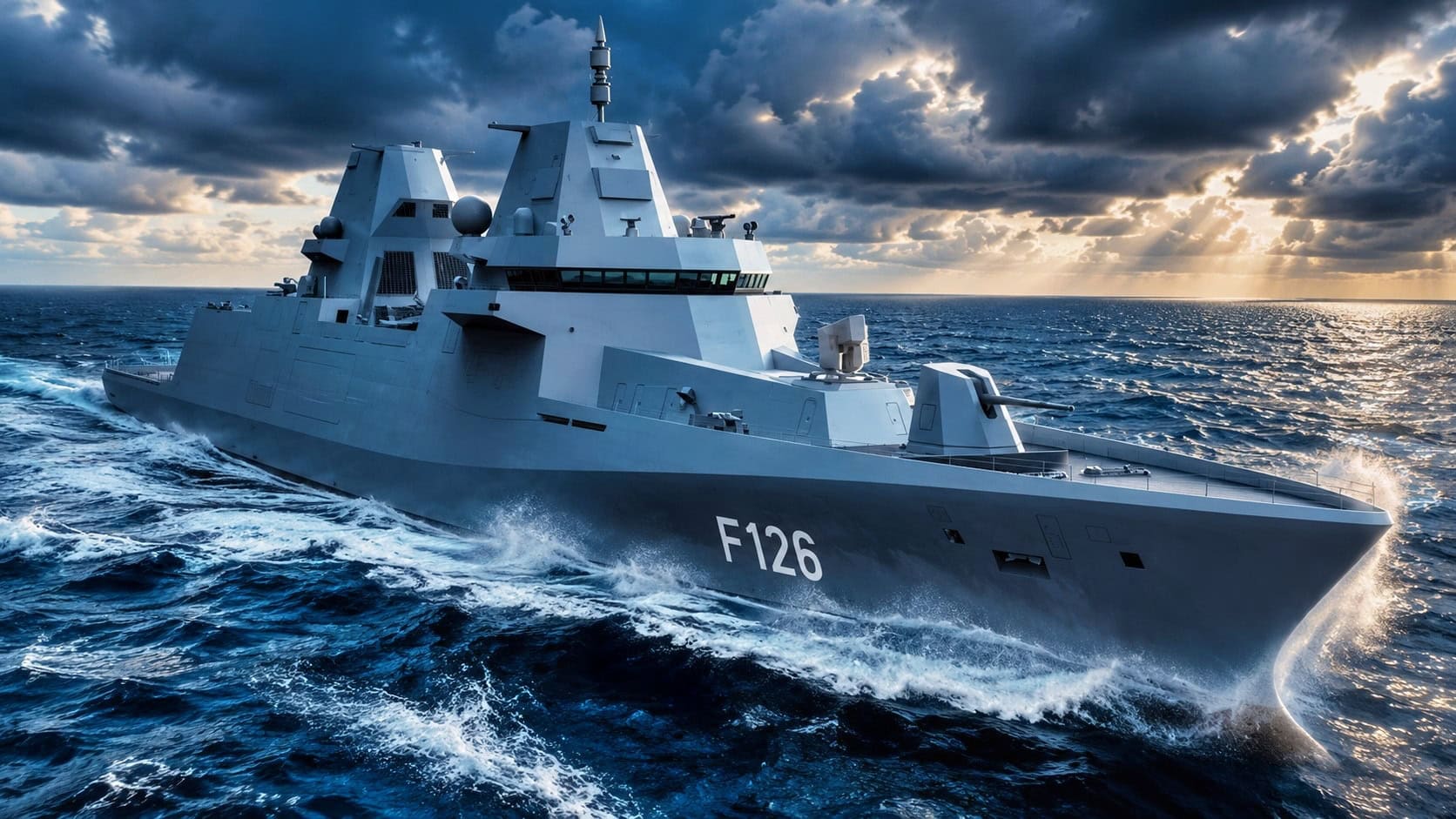
The numbers reveal the core of the problem. The F126 was planned as a 10,550-ton multi-role combat ship, 166 meters long, with global operational range, modules, and a crew of nearly 200 soldiers. Damen continues to describe the ship as a versatile platform for self-defense, combat operations, and situational awareness above and below water. However, in political practice, this turned into a procurement program that could no longer align schedule, price, and accountability.
The Ministry of Defense pulled the emergency brake in June. According to Defense News, Damen had signaled that it could not meet the agreed time and budget constraints. A change of the general contractor to Lürssen or the shipyard structure now taken over by Rheinmetall would have increased the continuation of the program to about 15.2 billion Euros for six ships. With already completed work and support contracts, the total requirement would have risen above 18 billion Euros. This is not a normal inflation surcharge. This is a governance failure.
The MEKO-A-200-DEU is smaller, more mature, and closer to market availability. This is exactly why it became attractive for Berlin. It is supposed to provide the urgently needed anti-submarine warfare capability that Germany has promised to NATO. But is that enough? A 4,000-ton frigate can make certain tasks available more quickly. However, it does not automatically replace the political logic from which the F126 emerged, namely the attempt to obtain a highly complex, modularly usable ship for global permanent presence.
Saab Provides Capability, Germany Imports Integration
The Swedish contract makes military sense. Sea Giraffe 4A offers wide-area airspace surveillance, Sea Giraffe 1X complements short reaction times against low-flying targets, and 9LV brings sensors, fire control, and combat management into an operational architecture. For the Baltic Sea, the North Atlantic, and the protection of maritime supply lines, such systems are more important than symbolic tonnage.
Politically, the decision is more ambivalent. Germany is building the ships at TKMS, thus nationally visible. However, the critical combat system integration comes from Saab. This is not wrong, as Sweden is a European high-performance provider. It just contradicts the frequent Berlin narrative that national procurement automatically means industrial sovereignty. Whoever integrates the combat management system shapes the modernization paths, the data architecture, and future weapon integration.
A familiar European pattern is repeating here. In the FCAS, France and Germany are arguing over who will be the system leader. In naval procurement, Berlin pragmatically decides in favor of a Swedish system house because the capability gap needs to be closed more quickly. In both cases, the real question is not where the final assembly is located, but who controls the technical architecture.
The NATO Deadline Disciplines, but It Does Not Reform
The pressure does not come from an abstract naval doctrine. Russia has once again made the North Atlantic, the Baltic Sea, and Europe's underwater infrastructure core areas of security policy. Germany must deliver mine countermeasures, convoy protection, air defense, and anti-submarine warfare not as prestige projects, but as alliance contributions. The NATO deadline forces Berlin to replace a delayed program with a faster one.
This is the positive part of the story. The negative side is that external deadlines rarely heal internal processes. Germany is good at financing a replacement solution after the crisis. It is worse at organizing responsibilities before the crisis so that price, risk, and delivery capability remain realistic. The special fund has covered this problem, not eliminated it. More money made the Bundeswehr more solvent, but not automatically more capable of procurement.
The European industrial perspective is also sobering. The new solution connects TKMS, Saab, and German budget funds. It is therefore European. But it did not arise from a clean joint armaments planning, but from the failure of another European model with a Dutch prime contractor. Europe is not integrating strategically here, but retroactively under time pressure.
The Real Lesson from the F126 Failure
For the German Navy, the MEKO course may be the right one. Four ships by the early 2030s are better than six theoretically superior units whose cost and delivery profile became politically untenable. The option for four more frigates also creates a fleet perspective that counts in the alliance.
However, one should not sell the change as a success story. It is a damage limitation. The Bundeswehr will likely receive platforms that are usable earlier, but it pays for this with lower ambition and a quiet admission that the original procurement architecture was not mastered.
The F126 question is therefore not whether the MEKO-A-200 is a good ship. The question is why Germany only returns to the sober rule that available capability counts more than programmatic size after years of delays.
Europe needs more warships. Germany needs them particularly. But if every delayed capability arises only through contract breaches, cost explosions, and emergency procurement, then the turning point will not lead to structural change. In the end, Berlin will buy European systems without mastering European procurement. That is the real paradox of this decision: less ambition may be militarily reasonable, but politically it remains the price of a failure defended for too long.
Source Situation
- Saab, press release from July 16, 2026, contract for combat systems and sensors of the MEKO-A-200-DEU frigates.
- Defense News, July 16, 2026, report on the Saab contract and the Bundestag's approval of the four TKMS ships.
- Defense News, June 24, 2026, report on the cessation of the F126 program and the switch to MEKO frigates.
- Damen, technical description of the Multi-Purpose Combat Ship F126 with 10,550 tons displacement.
Germany is procuring four MEKO-A-200-DEU frigates from Saab for 6.3 billion euros due to the failure of the F126 program. Deliveries are expected between 2029 and 2032, aiming to enhance Germany's anti-submarine capabilities in line with NATO commitments. This decision reflects a shift towards more readily available military solutions.
- Germany is purchasing four MEKO-A-200-DEU frigates from Saab for 6.3 billion euros.
- The F126 program was deemed a failure, leading to this new procurement.
- Deliveries of the new frigates are expected between 2029 and 2032.
- The procurement aims to enhance Germany's anti-submarine capabilities as promised to NATO.