
Germany's Titan Factory for 3,000 Interceptor Drones Monthly Exposes Europe's Procurement Problem 2026
 Dr. Klaus Weber
Germany's Tytan Factory for 3,000 Interceptor Drones Monthly Exposes Europe's Procurement Problem 2026
3,000 autonomous interceptor drones per month starting in August: This figure from Munich is small enough to be overlooked in Berlin and large enough to highlight a core problem of European defense policy. Tytan Technologies, a German counter-drone manufacturer, is reportedly preparing a new factory in Germany, according to Defense News. The company points to the deployment of its systems in Ukraine, customers in Germany and the Baltics, and potential additional plants in Poland and Hungary. At first glance, this sounds like a start-up success story. Politically, it is more: It is a test of whether Europe can learn a procurement logic from the drone war that is faster than its committees.
The Industrial Point Lies Not in the Aircraft, but in the Tactic
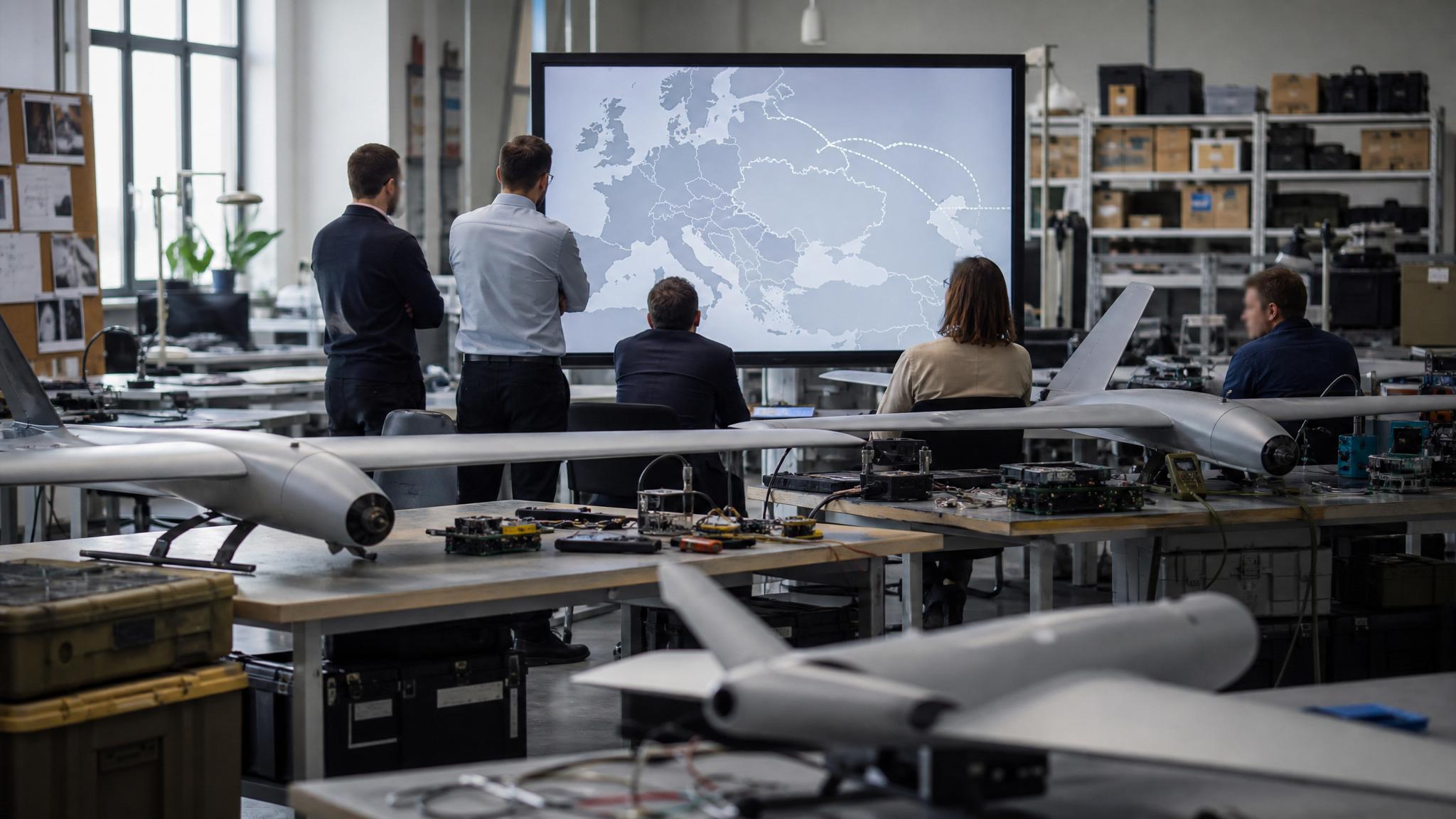
The military value of an interceptor drone system arises not only from range, sensor technology, or explosive effect. It arises from quantity, learning rate, and replaceability. Tytan mentions two product lines: EOS for small unmanned threats of NATO Class I and METIS as a long-range interception system against Class II drones. However, the crucial point is the production statement. 3,000 systems per month means 36,000 per year, before Poland or Hungary would even be realized as additional locations. For European air defense, which has thought in terms of batteries, guided missiles, and individual platforms for years, this is a different grammar.
The company’s CEO, Balázs Nagy, articulated the real attack on the old model to Defense News: Protecting the same airspace will be up to 200 times cheaper with such systems than with traditional solutions. This figure is, of course, a company claim and not a NATO certification. Nevertheless, it reflects an operational reality from Ukraine. Whoever fights a €20,000 drone with a million-euro missile may win the individual engagement but loses the cost calculation. The war has forced European air defense to distinguish between protective effect and financial logic.
Ukraine is No Longer Just a Recipient, but a Development Laboratory
In this report, Ukraine does not appear as a passive customer of European aid, but as an operational area where systems can quickly fail or become useful. This is precisely where the political discomfort lies. European ministries like to talk about innovation but continue to evaluate as if in the age of heavy platforms. An interceptor drone whose software must be changed after every Russian adaptation attempt fits poorly into procurement documents written for frigates, tanks, or air defense batteries.
The comparison with other German decisions from the same week is revealing. The Ministry of Defense has terminated the F126 frigate program after six ships would have approached a possible total burden of more than €18 billion from an initial budget of around €10 billion. Instead, eight MEKO-A-200 frigates from TKMS are to be procured, with the first four costing about €6.3 billion. At the same time, Germany plans to enter into a partnership with KNDS, while the tank manufacturer enters the stock market era of European armaments with a backlog of €33.1 billion and a targeted revenue growth of around 30 percent. This is not a criticism of frigates or battle tanks. It merely shows how differently Europe defines pace: for large platforms in budget years, for drones in software cycles.
SAFE Solves Financing Problems, but Not Iteration Problems
The European Union provides up to €150 billion in long-term loans through SAFE, linking this to the goal of strengthening Europe's technological and industrial defense base. In theory, Tytan fits perfectly into this narrative: European production, Ukrainian demand, Baltic interest, potential regional plants. But SAFE is a financing instrument, not a procurement operating system. It can lower loan costs, incentivize joint procurement, and relieve national budgets. It cannot automatically decide whether a battalion may accept new software versions monthly, whether liability rules for autonomous interception systems are clarified, or whether an army can organizationally manage the rapid exchange of sensors and radio modules.
This is the point that Berlin tends to underestimate. More money enlarges the market. It does not, by itself, change the institutional risk distribution. For classic procurement, risk is something that is minimized before contract signing. For counter-drone systems, risk is something that is learned and reduced during operation. If Europe does not accept this distinction, it will finance start-ups but not purchase military adaptability.
NATO Needs Mass Capability Below the Patriot Threshold
NATO documents describe hybrid threats as faster, more intense, and scaled than before. This language remains abstract until translated into drone swarms, cheap reconnaissance systems, and loitering munitions. The alliance cannot address every low threat with high-end air defense. Patriot, IRIS-T SLM, or SAMP/T remain indispensable against missiles, aircraft, and complex aerial targets. But they are structurally unsuitable to economically bear the entire lower drone layer.
That is precisely why the Tytan announcement is strategically more relevant for Germany than its industrial scope might suggest. It raises the question of whether European defense can truly procure a multi-layered air defense: high-end systems for high-value targets, mobile electronic warfare against simple drones, cheap kinetic interceptors against threats that get through. Technically, this is not a utopia. Institutionally, it is difficult because each layer requires different contract forms, training rhythms, and munitions logistics.
The German Lesson Must Not Again Be Just Export Policy
Poland and Hungary as potential additional factory locations sound like European scaling. However, they could also lead to the next fragmentation if national customers each demand their own variants, their own software approvals, and their own integration rules. Europe already has enough examples of how joint industrial policy disintegrates into national special requests. The advantage of a system like Tytan's interceptors would be precisely standardization with rapid adaptation: a common base platform, open interfaces, national operational rules, but no 15 incompatible product lines.
Germany should therefore not only ask how many interceptor drones Tytan can export. It should ask whether the Bundeswehr can organize framework contracts, test corridors, and operational data so that a system does not have to undergo two years of national requalification after three months of experience in Ukraine. That would be the real turning point in small: not another government statement on innovation, but a procurement process that brings together mass production, software adaptation, and frontline feedback.
The paradoxical conclusion is: Europe's drone defense problem is likely cheaper to solve than its frigate and battle tank issues, but institutionally not easier. 3,000 interceptor drones per month do not yet prove European defense capability. They only prove that industry can move faster than the state. If Berlin does not turn this into a procurement reform, the new factory will remain a useful enterprise. If it learns from this, it could become a rare example that Europe's armaments debate does not only begin with billion-euro platforms.
Tytan Technologies is set to produce 3000 autonomous counter-drones per month starting in August 2026 in Munich, addressing European defense procurement challenges. The systems will be deployed in Ukraine and have potential customers in Germany and the Baltics. This production rate signifies a strategic shift in European air defense, emphasizing the need for rapid adaptation in military procurement processes.
- Tytan Technologies plans to produce 3000 counter-drones per month starting August 2026.
- The production will address European defense procurement issues.
- The systems will be used in Ukraine and have potential customers in Germany and the Baltics.
- The production rate indicates a shift in European air defense strategy.
- The report highlights the need for rapid adaptation in military procurement processes.