
Greater Tunb Strikes in 90 Minutes Move the 2026 Hormuz War to the Arc of the Iranian Islands
 Ahmed Al-Rashid
Greater Tunb Strikes in 90 Minutes Shift the Hormuz War 2026 to the Arc of Iranian Islands
At 6 AM Eastern Time on July 15, 2026, the U.S. Central Command announced that its forces had begun a new wave of strikes against Iran, which concluded in about 90 minutes. The declared target was not a major city or a nuclear facility, but coastal defense systems and storage and launch sites for cruise missiles on Greater Tunb Island. These small details are what matter militarily; because the war over the Strait of Hormuz is no longer just a war of ships passing or not passing, but a war on the islands, radars, and launch bases that make any ship in the corridor a potential target.
A report from Defense News, citing Reuters, mentioned that the strikes came after the re-imposition of a maritime blockade on Iranian ports, and after a preceding night of American strikes that lasted seven hours against dozens of targets near the strait and on the Iranian coast. In response, Iran stated that the Revolutionary Guard struck American military targets in Bahrain, Kuwait, and Jordan, and threatened to close other energy export corridors. Here, we are not talking about an isolated incident, but about the transition of the conflict from a maritime deterrence equation to a pressure equation on the entire energy architecture in the Gulf.
Why Greater Tunb Means More Than Its Size
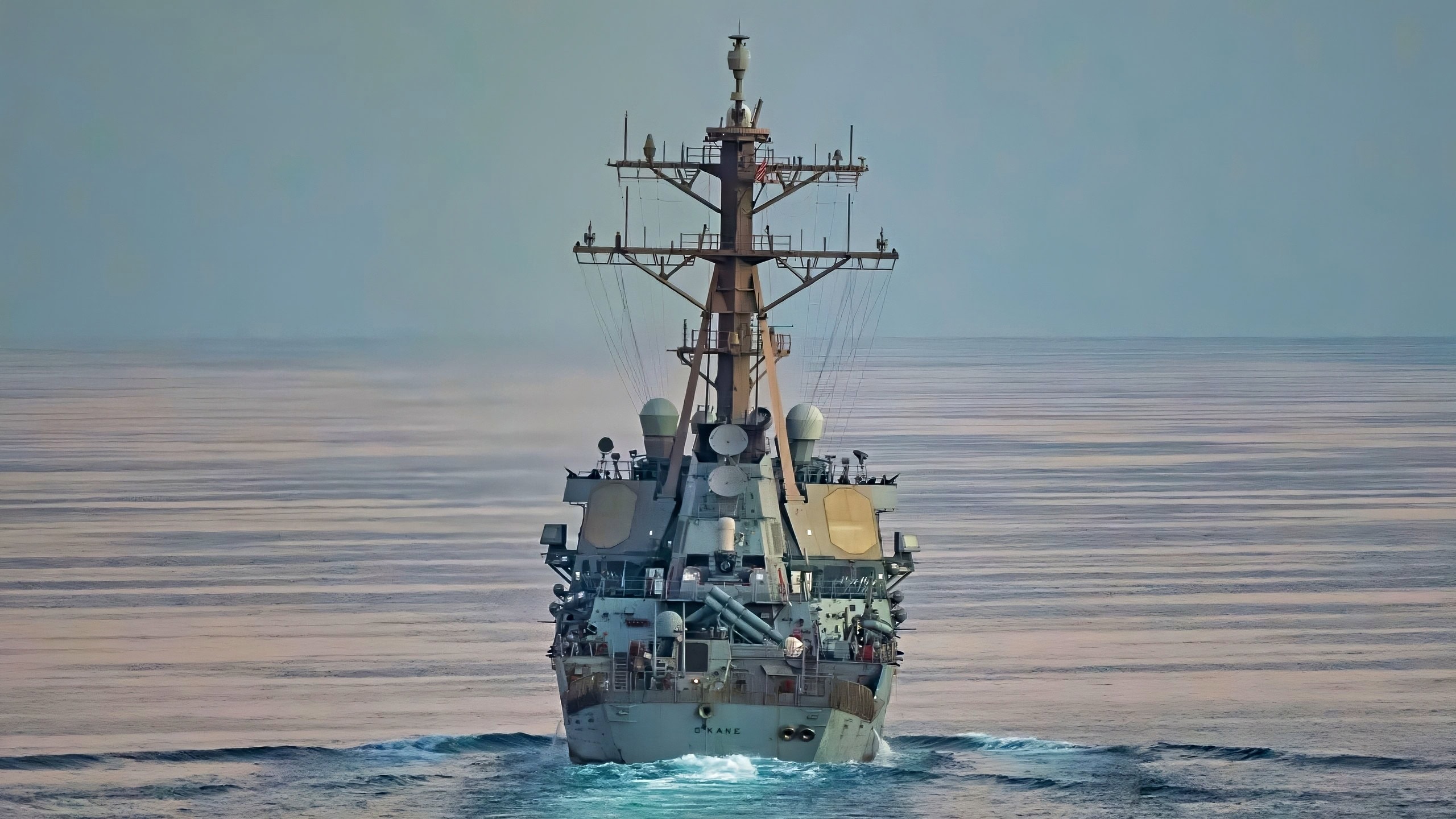
Greater Tunb Island is not a massive base by great power standards, but it is located within the geographic arc that Iran uses to monitor and threaten maritime movement. Militarily, the value of these islands does not come from their size, but from their location within a network that includes coastal radars, cruise missiles, fast boats, drones, and observation points close to the shipping line. When Washington strikes this island, it is not hitting an isolated piece of land; it is trying to break a knot in the Iranian anti-access network.
Al Jazeera noted in its analysis that the islands of Qeshm, Kish, Abu Musa, and other islands on the southern Iranian coast have been struck in recent days, and that the American question is no longer just how Washington can open the strait, but whether it can prevent Iran from using the islands as permanent pressure platforms. This is the point that Gulf decision-makers must understand: protecting an oil tanker at sea is easier than silencing the opposing coast every day.
The Iranian Triad Capability
I like to use a triangle of capability to evaluate armies: equipment, training, and institution. In the Iranian case, the equipment is not always the latest, but it is smartly distributed along a long coast and small islands and hideable sites. Training relies on repeating a known pattern: confusing navigation, raising the cost of insurance, and then forcing the opponent to spend precision munitions against relatively cheap targets. As for the institution, namely the Revolutionary Guard, the navy, and local agencies, it is built on withstanding strikes rather than completely preventing them.
Therefore, a 90-minute strike is not enough to change the balance of control in Hormuz. It may destroy a storage facility, a launch platform, or a radar, but it does not end Iran's ability to reposition. Al Jazeera quoted analysts that any attempt to control the islands or incapacitate them permanently would require much larger forces, perhaps from 5,000 to 10,000 troops in a limited operation if it came to holding ground. This number alone explains why Washington prefers air and naval strikes over occupying the islands.
The Gulf Dilemma Between Protection and Targeting
Iran's declared response to sites in Bahrain, Kuwait, and Jordan places Arab capitals in a difficult equation. These countries host American bases because they need a deterrent umbrella, but they become part of the Iranian target bank at the moment of escalation. The Secretary-General of the Gulf Cooperation Council condemned the attacks on Bahrain, Kuwait, and Jordan, and Qatar and the UAE also intercepted missiles and drones in recent days according to Al Jazeera coverage. However, political condemnation does not address the practical question: Can the Patriot and THAAD networks and the shared radars withstand long waves of drones and missiles if Hormuz and Bab el-Mandeb become two fronts together?
Before the war, about 100 ships passed through Hormuz daily, including tankers carrying nearly 20 million barrels of crude. After the June 17 memorandum, PortWatch reported only 603 ships over 25 days, or about 24 ships daily. This decline is not just an economic detail but a military indicator: when traffic drops to nearly a quarter of its normal level, the war is partially successful even without a complete closure. Iran does not always need to block the strait with iron chains; it is enough to make every crossing a costly security and political decision.
The Mistake of Reading the Strike as Just a Show of Force
In my view, reading the strike on Greater Tunb as a new American show of force obscures the reality. It is an attempt to reduce Iran's ability to use the coast and islands as a mobile fire system against ships. But at the same time, it is an acknowledgment that the old American security guarantee in the Gulf no longer works the same way. In the 1990s, the presence of a destroyer or an aircraft carrier was often enough to send the message. In 2026, the same destroyer needs reconnaissance drones, multi-layered air defense, electronic warfare, and a daily political decision about which target to strike and which target to leave.
The irony is that Gulf countries that have spent billions of dollars on air defense find themselves facing a problem that batteries alone cannot solve. If missiles are launched from small islands and changing coastal sites, the question is no longer just whether we have good interception, but whether we have immediate intelligence, a unified engagement decision, and a command chain that can withstand repeated strikes. In the Arab world, we say that iron does not fight alone. This applies here literally.
Bab el-Mandeb as a Heavy Shadow
The Iranian threat to close other energy corridors is not just a propaganda statement. If Tehran uses the Houthis to pressure Bab el-Mandeb, as analysts have warned, the Gulf will face a serious duality: Hormuz in the east, and Bab el-Mandeb in the southwest. Al Jazeera notes that Hormuz carries 27 percent of global maritime oil trade and 20 percent of liquefied natural gas trade, while Bab el-Mandeb is linked to about 11 percent of global maritime trade and 8 percent of liquefied gas trade. Combining the two does not only mean rising oil prices but also paralyzing military and commercial supply routes together.
Here, the limits of American deterrence appear. Washington can strike Iranian targets, but it cannot easily make every port, every island, and every corridor safe at the same time. As for Iran, it can lose platforms and continue to produce political danger. This is not an equality of capabilities; the United States is immeasurably stronger, but it explains why military superiority does not always translate into operational control over the strait.
Conclusion
The Greater Tunb strike indicates that the Hormuz War has entered a phase of precise geography: an island, a radar, a launch platform, a security ship, and an American base in a Gulf state. This phase is more dangerous than the phase of statements about closing the strait, as it makes every small point in the Gulf part of a wide battlefield. The United States will be able to weaken some Iranian capabilities, but the remaining question for Arab countries is the same one that has troubled me for years: Have we built regional defense institutions capable of managing the crisis, or have we bought excellent equipment and left the decision of war and peace to others? The structural tension has not changed; the Gulf wants American protection, but it does not want to become a battlefield for Iran's response to that protection.
Sources
- Defense News / Reuters, July 15, 2026, US launches new round of strikes against Iran.
- Al Jazeera, July 15, 2026, Could the US take control of Iran’s southern islands?
- Al Jazeera, July 15, 2026, Mapping the latest US strikes across Iran.
- Defense News, July 13, 2026, US to begin enforcing maritime blockade on Iran on Tuesday.
U.S. Central Command launched airstrikes against Iranian coastal defense systems and missile storage sites on Greater Tunb Island at 6:00 AM EST on July 15, 2026. This operation followed the re-imposition of a maritime blockade on Iranian ports. In retaliation, Iran's Revolutionary Guard targeted U.S. military sites in Bahrain, Kuwait, and Jordan, indicating an escalation in the conflict.
- U.S. Central Command launched airstrikes on Greater Tunb Island targeting coastal defense systems and missile sites.
- The strikes occurred after a maritime blockade was re-imposed on Iranian ports.
- Iranian Revolutionary Guard claimed to have targeted U.S. military sites in Bahrain, Kuwait, and Jordan in response.
- The conflict has shifted from naval deterrence to targeting strategic islands and military infrastructure.
- The U.S. may require significantly more troops for a sustained ground operation to control the islands.