
Here’s what Marine Expeditionary Units are designed to do

Source: Task & Purpose
Loading...Strong SignalCredibility: 81%
Report Content
When a crisis erupts in the Caribbean, Middle East, or elsewhere, a Marine Expeditionary Unit, or MEU, is often tasked with responding. The units are self-sustaining combat forces that can quickly deploy around the world for combat operations or humanitarian missions.
The 31st MEU recently arrived in the Middle East and the 11th MEU is headed to the region to support U.S. military operations against Iran. While their exact mission hasn’t been made clear, Sen. Lindsey Graham (R-S.C.) recently suggested that they could be used to capture Kharg Island, which processes about 90% of Iran’s crude oil exports.
The MEU is the smallest element of the Marine Air-Ground Task Force, the Corps’ organizing concept that combines ground, aviation, and logistics units into a task force under a single commander.
Each MEU is made up of about 2,200 Marines and includes a ground combat element, an aviation combat element, a logistics battalion, and the command structure needed to oversee all those disparate moving parts. They’re intended to be forward deployed — a unit that the U.S. can task at a moment’s notice to respond to a number of specific threats or crises.
Top Stories This Week
A MEU is a “great entry force,” said Jonathan Schroden, an expert on Marine Corps force design with CNA, a Washington, D.C.-based not-for-profit research and analysis organization.
“It’s a fully integrated military unit,” Schroden told Task & Purpose. “It has its own ground power. It has its own airpower. It is self-sustaining logistically for a period of time. It has the ability to defend itself, and it has the command element that can oversee those other parts, but also connect it to the rest of the joint force for support beyond its own capabilities. So it’s a great entry force, to put it that way.”
MEUs train to conduct a variety of combat missions, including amphibious landings and short-duration raids, along with non-combat missions, such as responding to natural disasters, Schroden said.
They typically move around in groups of three amphibious warfare ships. These formations are led by amphibious assault ships, which can carry fighter jets such as the F-35B Lightning II.
The fact that MEUs are based on ships allows them to “conduct operations from virtually anywhere,” Schroden said.
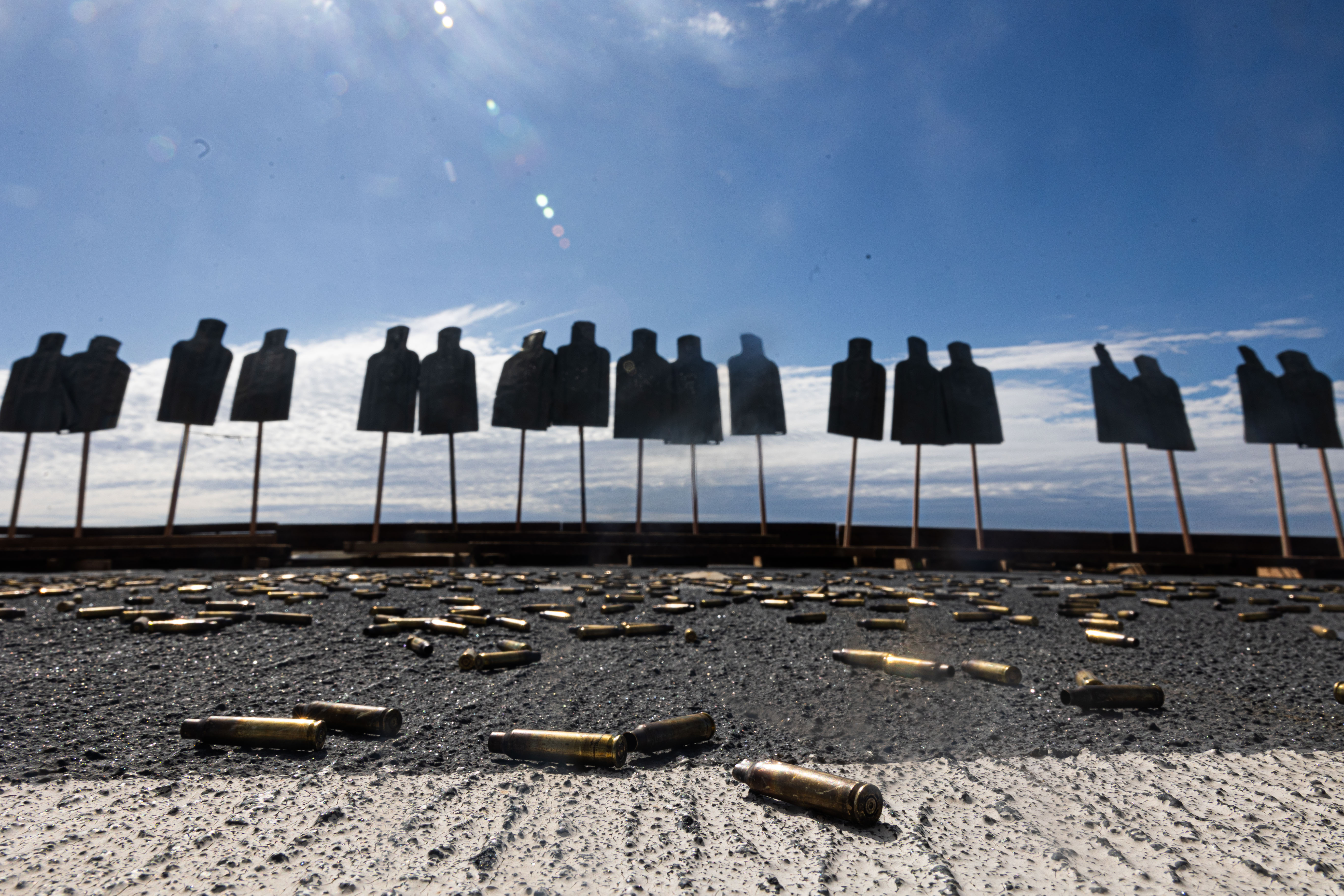 Marines with the 31st Marine Expeditionary Unit conduct a live-fire deck shoot aboard the amphibious transport dock USS San Diego in the Timor Sea on June 12, 2025. Marine Corps photo by Lance Cpl. Raul Sotovilla.
MEUs would be vulnerable in a war against China
In the 21st Century, Marine Expeditionary Units have deployed globally for all types of missions. They were sent to Afghanistan at the very beginning and during the chaotic end of that war. They evacuated Americans from Lebanon in 2006 and delivered aid to Haiti in 2010 after that country’s massive earthquake. They deployed to the Caribbean as part of the U.S. military buildup in the region that preceded the special operations mission in January that captured Venezuelan President Nicolás Maduro and his wife, who were initially held aboard the amphibious assault ship USS Iwo Jima.
But with the Marine Corps in the midst of a massive reorganization — one that sees it shift its focus from irregular warfare to conventional conflict in the Indo-Pacific region, it is unclear what role MEUs might play in a war with China, said Stacie Pettyjohn, director of the defense program at the Center for a New American Studies think tank in Washington, D.C.
In such a confrontation, the Marine Corps plans to fight from within the “First Island Chain,” a strategically important set of island nations in the western Pacific that includes Japan, Taiwan, the Philippines, and Indonesia. Pettyjohn said. The Corps refers to those forward-deployed Marines as “Stand-in Forces.”
However, the amphibious warfare ships on which MEUs are embarked would be “incredibly vulnerable” if they operated that close to Chinese forces, Pettyjohn told Task & Purpose.
“They don’t have a lot of organic defenses on them,” Pettyjohn said. “They’re very big ships, and they would be likely targeted by Chinese anti-ship ballistic missiles or cruise missiles.”
Toward that end of finding ways to operate within the range of Chinese weapons,, the Marines began creating littoral regiments that were designed to operate in the Indo-Pacific theater, she said. Such units are armed with long-range anti-ship missiles, and they have fewer heavy vehicles in favor of more drones.
“A key part of the concept is being small, agile, moving around, making it harder for China to target them, and also being able to move so that they can support wherever the Navy is operating or be wherever they need to be in terms of sea denial or maritime surveillance of key choke points within the first island chain,” Pettyjohn said.
Still, it remains unclear exactly which types of vessels would bring such stand-in forces ashore, and how those Marines would be resupplied, she said.
For more, check out our YouTube channel, where Task & Purpose’s video producer Kyle Gunn explains how MEUs fit into the Marine Corps’ warfighting concept.
The post Here’s what Marine Expeditionary Units are designed to do appeared first on Task & Purpose.
Classification
Region
West Asia
Analytical Domain
Operational
Primary Category / Secondary Categories
Military Operations / Force Movement
SALUTE Report
Size
Approximately 2,200 Marines per MEU
Activity
Marine Expeditionary Units (MEUs) are deployed for combat operations and humanitarian missions, with the 31st MEU currently in the Middle East and the 11th MEU en route to support operations against Iran.
Location
Middle East · Iran
Unit
31st Marine Expeditionary Unit, 11th Marine Expeditionary Unit
Time
Recent deployment
Equipment
F-35B Lightning IIamphibious warfare ships
Summary
The 31st Marine Expeditionary Unit (MEU) has deployed to the Middle East, while the 11th MEU is en route to support U.S. military operations against Iran. These self-sustaining units, consisting of around 2,200 Marines, are designed for rapid response to crises and can conduct both combat and humanitarian missions. Recent discussions suggest a potential mission involving Kharg Island, a key site for Iran's oil exports.
Key Facts
- The 31st MEU has arrived in the Middle East.
- The 11th MEU is headed to the region to support operations against Iran.
- MEUs are self-sustaining combat forces capable of rapid deployment.
- Sen. Lindsey Graham suggested a potential mission to capture Kharg Island.
- MEUs consist of approximately 2,200 Marines and various combat elements.