
Here’s what the commander of the 101st Airborne says the future of air assault looks like

Source: Task & Purpose
Loading...Strong SignalCredibility: 81%
Report Content
The 101st Airborne Division is tasked with flying and dropping thousands of soldiers into enemy territory overnight. Since its establishment as an airborne unit during World War II, the 101sthas mostly stayed true to that mission, even if they traded in parachutes for helicopters in the late 1960s. But these days they’re incorporating new technologies to move further and faster.
Maj. Gen. David Gardner, commander of the 101st Airborne Division, told Task & Purpose that the unit is expected to deliver a brigade’s worth of soldiers, about 1,500 to 2,500, for a large-scale air assault.
“We expect the place that we land to be contested by the enemy, and so we’ve got to set conditions. We’ve got to air assault a formation, and then we’ve got to fight as soon as we hit the ground and win,” Gardner said.
As the Army tries to gameplan for future battlefields, units are training to be more mobile and avoid enemy detection from drones and other sensing technologies. Gardner said they’re working out how new technologies, like the Infantry Squad Vehicle, allow them to move further, how additive manufacturing can help forces sustain equipment, or how unmanned systems may deliver supplies or perform casualty evacuations.
“We’re using autonomy and a lot of things in the modern era that make that air assault just a bit different,” Gardner said. “Maybe it’s not a helicopter or a plane that drops a parachute resupply. Maybe it’s an unmanned system that does that.”
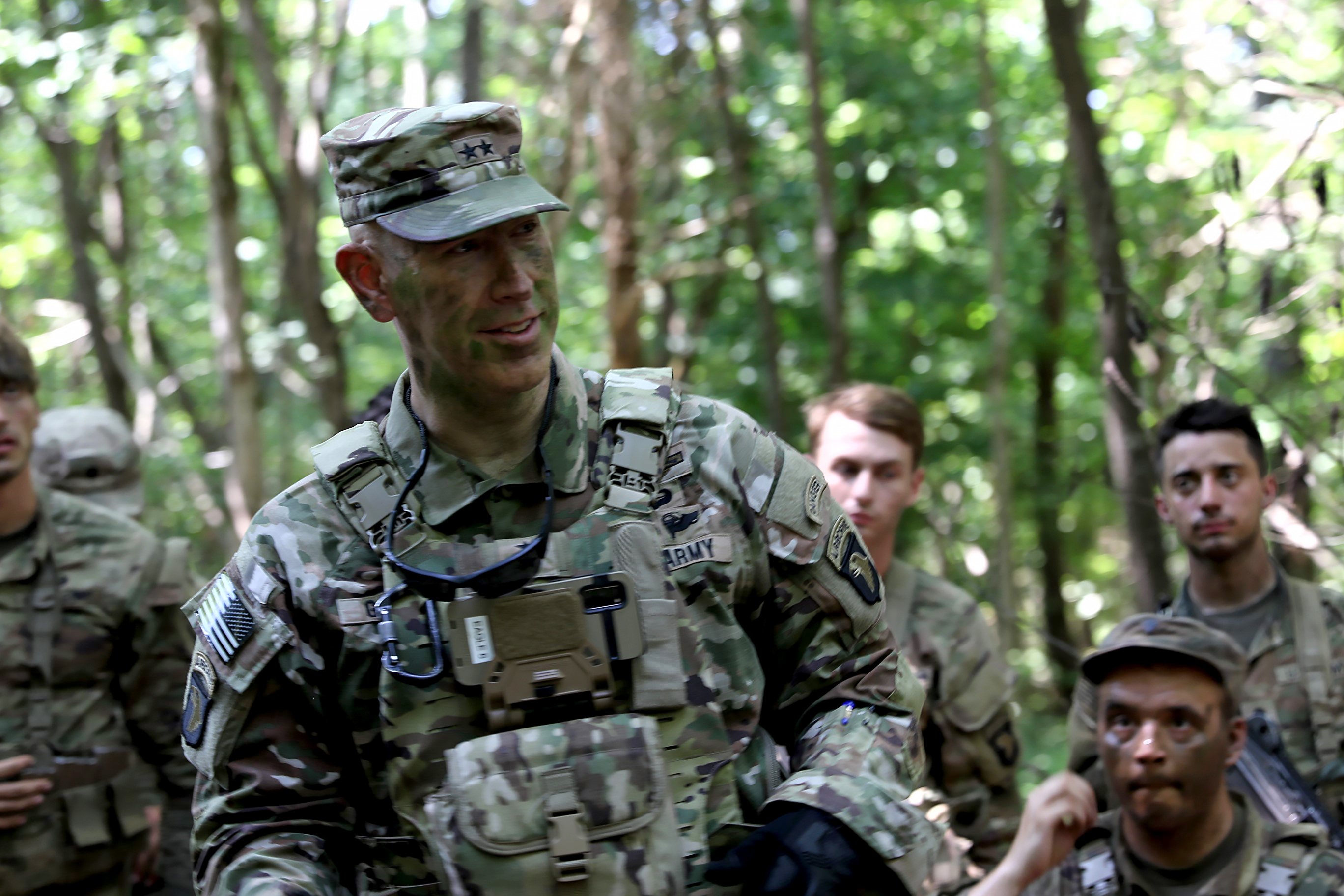 Maj. Gen. David Gardner, the commanding general of the 101st Airborne Division (Air Assault) addresses soldiers during at Fort Knox, Kentucky, August 19, 2025. Army photo by Maj. Jonathon Bless.
For a 21st-century air assault in a war against a peer threat, the 101st is training what it calls Large-Scale, Long-Range Air Assault, L2A2. The division first tested it out two years ago by flying more than 3,000 soldiers from the 2nd Mobile Brigade Combat Team across three states to a training exercise. Nearly 80 aircraft left Fort Campbell, Kentucky, on Aug. 13 and arrived four days later at the Joint Readiness Center at Fort Polk, Louisiana. In all, they traveled more than 500 miles and stopped at six forward arming and refueling points.
And as the 101st continues to train to cover more ground, their operations will include new aircraft. In 2025, the Army announced that the 101st would be the first to get the new tiltrotor aircraft, the MV-75 Cheyene, which is based on the V-280 Valor by Bell Textron Inc. According to Bell, the aircraft can fly twice as far and fast as the service’s current helicopter fleet.
At a Joint Readiness Training Center rotation at Fort Polk, Louisiana, in April, the 101st borrowed a Marine Corps MV-22 Osprey to simulate future operations with the MV-75.
Frank Lazzara, director of MV-75 Cheyenne sales & strategy for Bell, said the Osprey gives the Army a good idea of how they will use the tiltrotor aircraft in a few years because the V-22 can “simulate” the MV-75’s range.
“The ability to stay further away from the threat is becoming more and more critical, and that is one of the primary reasons there’s going to be more dispersed operations in the air assault playbook. Being able to push a combat force out further, from further away … out of the range of certain weapons, and then be able to keep them resupplied, that is not really going to be possible with the enduring fleet alone,” Lazzara said. “I think that’s why the 101st is overall the best combination of considerations to do this first.”
Gardner also said the Osprey was a “great surrogate” for the 101st to see what future operations look like with the MV-75, by combining it with lessons from previous exercises.
Top Stories This Week
“We did several [air assaults] over the last few years directly from Fort Campbell to the Joint Readiness Training Center, which is 500 miles, give or take. The Osprey can do that very fast and in one leap,” he said. “Our current helicopters, you’ve got to make some fuel and re-arming stops along the way, and the distance isn’t there. But now that helped us think through as a division how we were going to command and control something that moved, expanded our battlefield, so to speak, twice as far, three times, four times as far, and twice as fast.”
The commander said it helped the division work through how to manage more airspace and equipment, and plan for how to incorporate drones. In general, they had to work through new concepts that only apply to the current helicopter fleet.
“We can put some things inside the helicopter, and we can put some things under a helicopter with a sling load. We’re not going to sling load something moving 250-ish knots for 500 miles. We’re not going to hang Humvees under that,” he added. “We learned some things about how we need to get our equipment to the battlefield, how we need to get our sustainment to the battlefield at those distances, how we might need to rely on autonomous logistics delivery systems.”
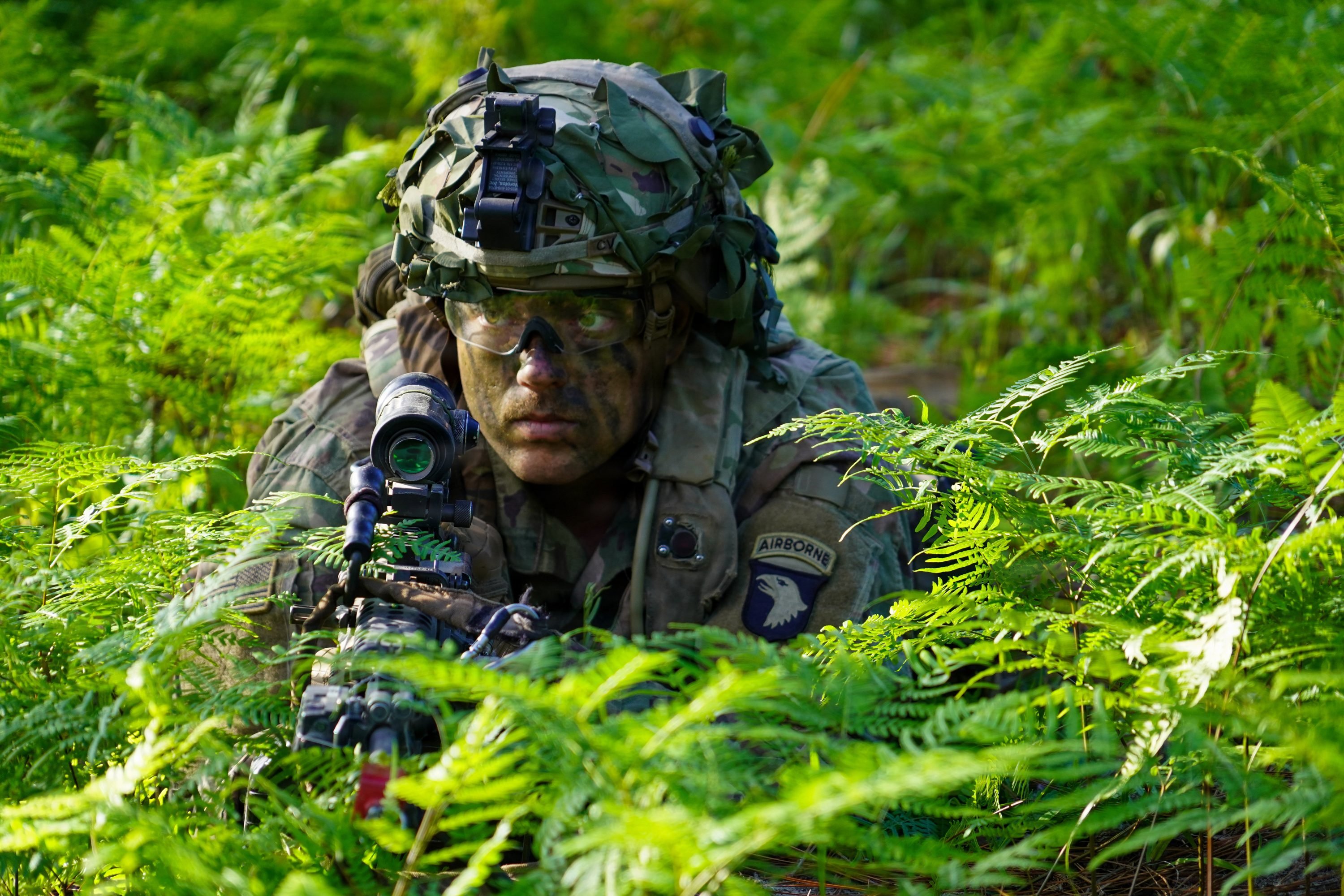 A soldier assigned to the Multi-Functional Reconnaissance Company, 3rd Mobile Brigade, 101st Airborne Division (Air Assault) takes up a security position with at the Joint Readiness Training Center, Fort Polk, Louisiana, April 8, 2026. Army photo by Master Sgt. Anthony Hewitt.
While the rest of Army aviation has seen cuts across its formations, the 101st added a battalion of CH-47 helicopters. Gardner said it’s the largest combat aviation brigade of any Army division.
“I did battalion-minus air assaults as a battalion commander in the 82nd when I was in Afghanistan, not against a large-scale peer threat,” he said. “But we are expected to be able to do a brigade in a single period of darkness, a deep air assault, and that’s why we’ve been resourced with some additional helicopters, and that’s why we train the way we do.”
The post Here’s what the commander of the 101st Airborne says the future of air assault looks like appeared first on Task & Purpose.
Classification
Region
North America
Analytical Domain
Operational
Primary Category / Secondary Categories
Military Operations / Logistics
Subcategory
Special Operations
SALUTE Report
Size
1,500 to 2,500 soldiers
Activity
Conducting large-scale air assaults and training for future operations
Location
Fort Campbell · Fort Polk · Kentucky · Louisiana
Unit
101st Airborne Division (Air Assault)
Time
August 2025
Equipment
MV-75 CheyenneCH-47 helicoptersMV-22 OspreyInfantry Squad Vehicle
Summary
The 101st Airborne Division is preparing for large-scale air assaults, expected to deploy 1,500 to 2,500 soldiers. They are incorporating new technologies and training for Large-Scale, Long-Range Air Assault (L2A2) operations. The division will receive the MV-75 Cheyenne aircraft in 2025 and has expanded its helicopter capabilities with additional CH-47s. Training exercises have included the use of the MV-22 Osprey to simulate future operations.
Key Facts
- The 101st Airborne Division is expected to deliver 1,500 to 2,500 soldiers for air assaults.
- They are incorporating new technologies for mobility and logistics.
- The division is training for Large-Scale, Long-Range Air Assault (L2A2).
- In 2025, they will receive the new MV-75 Cheyenne aircraft.
- The division has added a battalion of CH-47 helicopters.