
How the Army’s training ‘crucible’ bases are changing

Source: Task & Purpose
Loading...Strong SignalCredibility: 81%
Report Content
A year ago, an Army brigade rotating through the service’s major training center in Hohenfels, Germany might launch a few hundred drones during a 14-day exercise. Soldiers would get even less use of the systems designed to counter those drones.
The reasons ranged from German airspace restrictions over the training area to U.S. units simply arriving without any drones they knew how to use.
Now, that number has skyrocketed, according to the general in charge there.
“We went from about 400 [unmanned] systems and maybe 35 or 40 counter-UAS to, in the last rotation we did, we had almost 2,000 [unmanned aerial systems], with over 1,000 of that being consumable,” said Brig. Gen. Terry Tillis, commander of the 7th Army Training Command in Germany. “We picked that up as we watched what’s going on at [U.S. Central Command]; we watch what’s going on at the [U.S.-Mexico] border, we watch what’s going on in Ukraine. It’s all consumable munitions.”
Tillis addressed recent changes and upgrades at the Army’s main European training center this week at the annual Association of the United States Army conference in Washington, D.C. He spoke along with the commanders of the service’s other three Combat Training Centers: the Joint Readiness Training Center at Fort Polk, Louisiana; the National Training Center at Fort Irwin, California; and the Joint Pacific Multinational Readiness Center, which is headquartered in Hawaii with a major training center in Alaska.
Each center is designed as a major deployment for a brigade-sized force from a visiting unit. The hometown opposition forces, or OPFOR, at each center put visiting units through a 14-day “crucible” of combat simulation, testing units from light infantry to heavy mechanized units and even special operations. Units generally have to move through the sprawling training grounds of each center — at Fort Irwin, the range is larger than Rhode Island — and seize objectives, defend them, and fight off a host of problems that the Combat Training Centers planners throw at units.
Top Stories This Week
The OPFOR at each center are notorious opponents, well trained on each exercise and intimately familiar with their home terrain. As a result, Tillis said this week, “the first four of five days don’t go too well,” for visiting units.
Tillis said a major lesson that the Hohenfels teams have learned in the last year has been that success with drones goes much deeper than passing out quadcopters to soldiers as they head into “the box,” as each center refers to its notional battlefield.
“I thought it was all about getting kit in the hands of soldiers,” Tillis said. “Like, we gotta get 1,000s of drones and I thought the answer was, give them the technology, they’ll figure it out. But it’s not enough to give the technology because they don’t have a chance to train.”
The trainers at Hohenfels, he said, now bring Ukrainian units with extensive combat experience on each crucible.
“We’ve been given a lot of help, a lot of help from our Ukrainian teammates,” Tillis said. “They actually compete on both sides, the red and the blue.”
Tillis and U.S. officials at Hohenfels worked with German authorities to clear up airspace permission for U.S. units to fly so much. They also began mandating that soldiers who arrived for training did so with enough experience to use them.
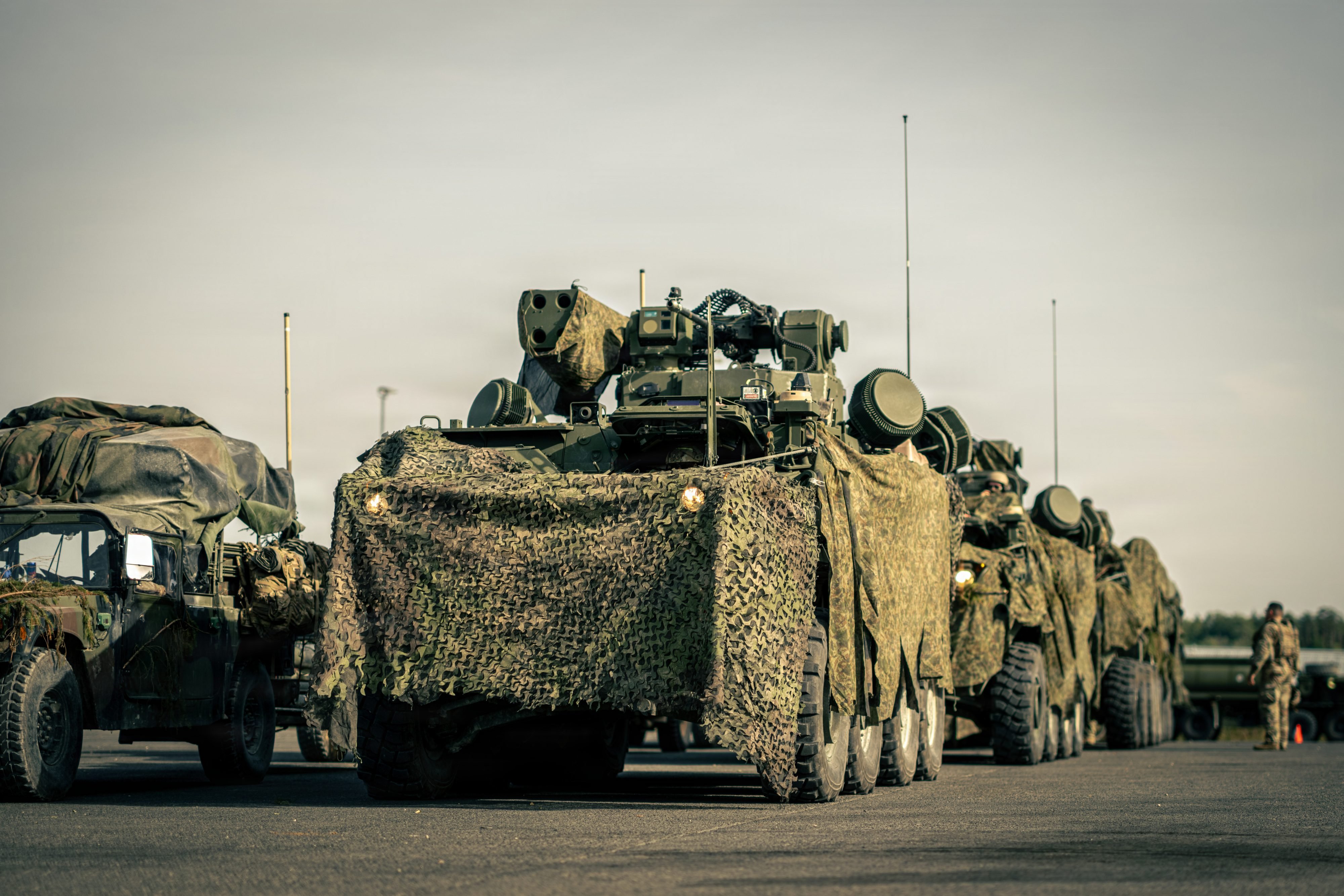 Short-Range Air Defense vehicles with 4th Air Defense Artillery Regiment, 52nd Air Defense Artillery Brigade, prepare to move at the Joint Multinational Readiness Center in Hohenfels, Germany, Aug. 27, 2026. Army photo by Sgt. Luis Garcia.
To get soldiers prepared for rotations in the U.S., units that deploy to Fort Polk, Louisiana, or Fort Irwin must now have owned and worked with any drones they want to use in their training for at least 180 days.
It was working with Ukrainians, Tillis said, that made him realize that U.S. training centers had not done enough to use so-called consumable systems, the small, cheap one-way strike drones that are meant to be destroyed in use.
“They came back with 40 or 50 of their actual operators and brought right around 600 systems,” Tillis said. “About 550 were consumable.”
The Army’s newest center is the Joint Pacific Multinational Readiness Center, which is focused on threats “West of the International Date Line,” said Col. Alphonse J. LeMaire, the commander of the training center.
“We are purpose-built for the Pacific theater,” LeMaire said at AUSA. Unlike the other centers, the Pacific training center operates in two opposite environments. The center puts on crucible training in jungle and tropical conditions on Oahu and at the Pohakuloa Training Area, Hawaii, which opened in 2021, and an Arctic center at Joint Base Elmendorf-Richardson, Alaska, which held its first formal rotation a year later in 2022.
The center also has stood up what LeMaire calls a mobile training unit in Guam. That unit, he said, puts on training events throughout Asia, including upcoming rotations with elements of the Hawaii-based 25th Infantry Division in the Philippines.
Both the Alaska and Hawaii centers, he said, expect to add a company-sized reconnaissance unit to the opposing forces, to develop experts in operating as fast-moving, hard-to-spot forces in both the mountains and jungle environments.
The post How the Army’s training ‘crucible’ bases are changing appeared first on Task & Purpose.
Classification
Region
North America, Europe
Analytical Domain
Operational
Primary Category / Secondary Categories
Weapons & Equipment / Military Operations
Subcategory
Drone/UAV
SALUTE Report
Size
Almost 2,000 unmanned aerial systems, over 1,000 consumable munitions
Activity
Increased use of drones and counter-UAS systems during training exercises
Location
Hohenfels · Germany · Fort Polk · Louisiana · Fort Irwin · California · Hawaii · Alaska
Unit
7th Army Training Command, U.S. Army
Time
Recent training rotations
Equipment
unmanned aerial systemscounter-UAS systemsShort-Range Air Defense vehicles
Summary
The 7th Army Training Command in Hohenfels, Germany, reported a significant increase in the use of unmanned aerial systems during training exercises, rising from 400 to nearly 2,000. This includes over 1,000 consumable munitions. U.S. units are now mandated to have prior experience with drones, and Ukrainian units are participating in training to enhance effectiveness. The training centers are adapting to include diverse environments and threats, particularly in the Pacific theater.
Key Facts
- The number of unmanned aerial systems used in training has increased from about 400 to almost 2,000.
- Over 1,000 of the unmanned systems are consumable munitions.
- U.S. units are now required to have experience with drones before training.
- Ukrainian units are involved in training exercises at Hohenfels.
- The Joint Pacific Multinational Readiness Center focuses on threats in the Pacific theater.