

The AK-47 Rifle – The Soviet Icon Has Remained Very Popular: No rifle has done more fighting with less fuss than the AK-47. Mikhail Kalashnikov built it while recovering from a wound he took near Bryansk in 1941. A soldier in the next hospital bed reportedly asked him why German infantry carried automatic rifles while Red Army conscripts were still splitting bolt guns two and three men to a weapon.
That question apparently stuck with him. By 1945 he was sketching designs, and after military trials in 1947 the Soviet Armed Forces officially adopted the [Avtomat Kalashnikova] in early 1949. The name is just the designer’s name and the year. No marketing needed.
The AK-47 is instantly recognized anywhere; it has been the weapon of Russian troops for nearly 80 years and has been the weapon of choice for bad guys across the planet.
Every terrorist organization carries AKs, and if you are watching a film from Hollywood, you can instantly tell who the bad guys are. They are the ones carrying the AKs.
Western arms manufacturers build aesthetically pleasing, effective weapons for their warriors. The Russian AK-47 is an icon of the Soviet Union and possesses the same qualities as life in the Soviet Union: ugly and drab but practical.
But there is a good reason the AK and its variants have survived for so long. They’re cheap, easy to build and maintain, and everywhere. The AK is in service in 106 countries worldwide.
AK-47: The Design Is The Point
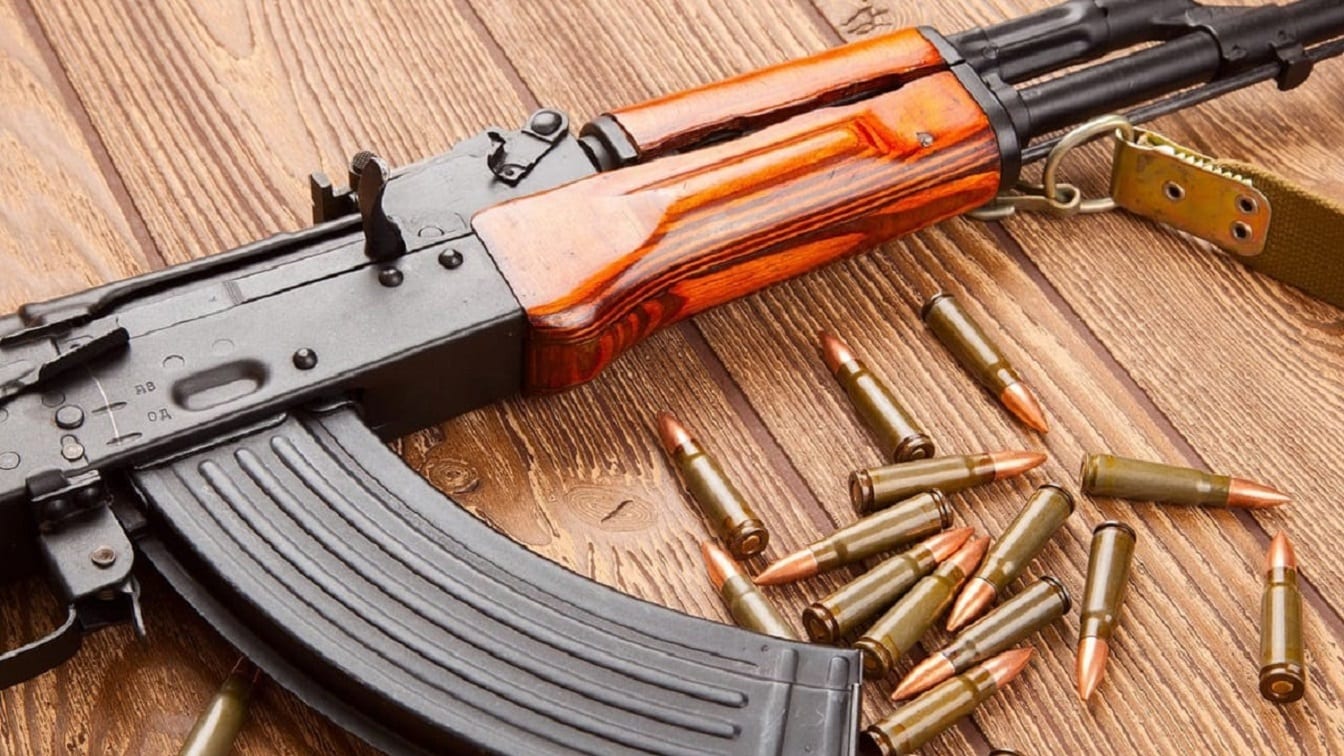
AK-47. Image Credit: Creative Commons.
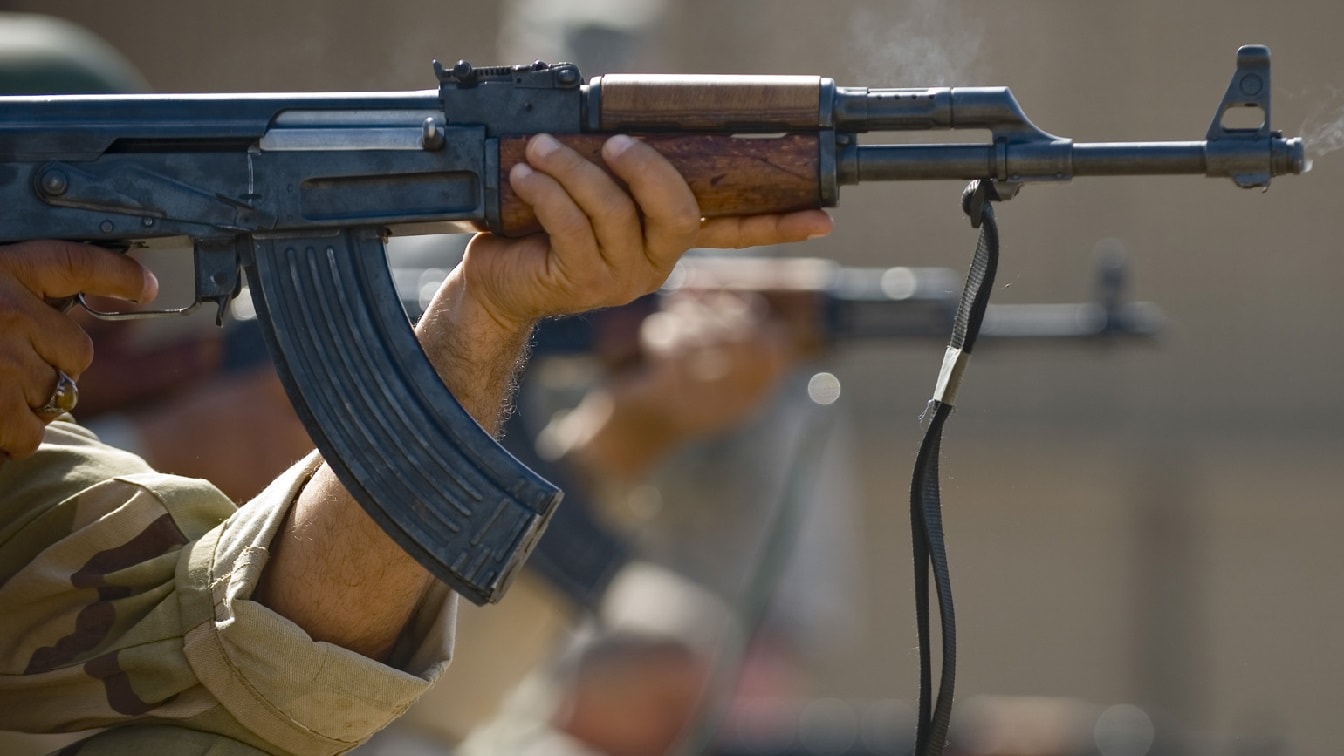
Iraqi airmen fire AK-47s during firing drills March 29, 2011. Members of the 447th Expeditionary Security Forces Squadron trained Iraqi security forces airmen ensuring weapons qualification and teaching defensive tactics, vehicle searches and other force protection measures. (U.S. Air Force photo/Staff Sgt. Levi Riendeau)
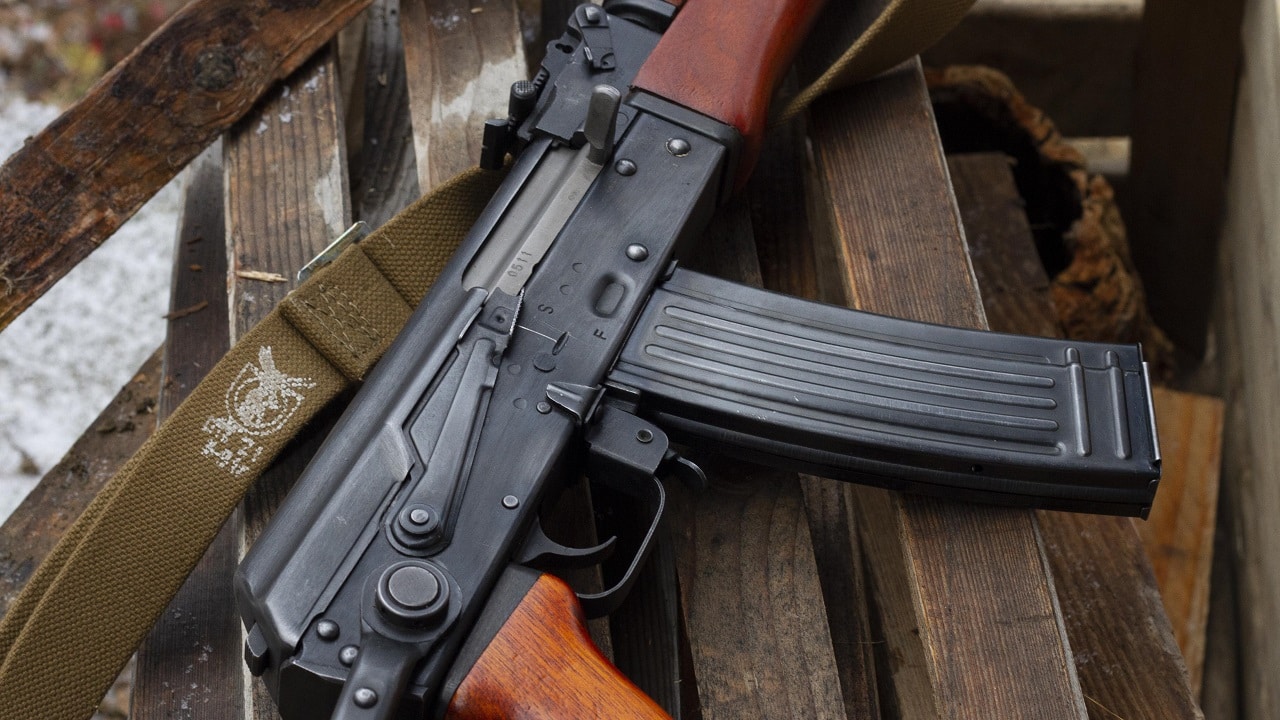
AK-47. Image Credit: Creative Commons.
Kalashnikov wasn’t chasing elegance. He borrowed the long-stroke gas piston layout found on the American M1 Garand and leaned heavily on the general profile of the German StG 44, then loosened every tolerance he could get away with.
That’s the whole trick. Where most rifle actions need tight-fitting parts to cycle cleanly, the AK’s bolt carrier rattles around inside its receiver with room to spare. Sand gets in. Mud gets in. The gun keeps running anyway.
I’ve handled plenty of weapons that jam the second sand hits the action. The AK isn’t one of them, and that’s not an accident. It’s the entire design philosophy.
Loose fit, a tapered cartridge case that extracts even out of a dirty chamber, and a free-floating firing pin instead of a spring-loaded one. None of that is glamorous. All of it works.
The Numbers Do The Talking
The specs are almost beside the point next to the reputation, but they’re worth putting down. The AK-47 fires the 7.62x39mm round at roughly 2,350 feet per second, cycles at 600 rounds a minute, and weighs about 7.7 pounds empty.
Effective range tops out around 350 meters, short by modern rifle standards. Nobody designed this thing to win a marksmanship match. It was built to put a conscript infantryman into a firefight with a weapon that would still run after being dragged through a swamp.
Over 50 countries have manufactured [AK variants since production started in 1948], and serious estimates on total output run from roughly 40 million on the low end to past 100 million.
However you slice it, that dwarfs the [M16, M4, and civilian AR-15 family combined, which tops out around 20 million after seven decades of American production. Nothing else in the history of firearms comes close.
Cheap To Build, Cheaper To Replace
However, raw reliability only explains half the story. The other half is economics. Stamped sheet-metal receivers replaced the milled steel of the earliest models by the late 1950s, and that single change slashed production time and cost.
A rifle any state arsenal, and eventually any warlord with a machine shop, could crank out by the thousands was never going to stay a Soviet exclusive. It got handed to client states across Africa, Asia, and the Middle East through the Cold War, and it kept flowing long after Moscow stopped writing the checks.
That’s the appeal and the problem in one sentence. A weapon simple enough for a teenager to field-strip blindfolded is also simple enough for that same teenager to be handed one and sent into a war.
The AK sits on the flag of Mozambique for exactly that reason, a liberation movement’s rifle turned into a national symbol.
The “Kalashnikov Legend” Lives On
Most of us have heard how the weapons maker came about designing the iconic weapon. But for those who haven’t:
Soviet Sergeant Mikhail Timofeyevich Kalashnikov designed the AK-47. He was drafted into the Soviet Army in 1938 and became interested in firearms design while serving as a tank driver-mechanic. After being seriously wounded in 1941, he heard his wounded infantry comrades lament the sorry state of Soviet infantry weapons.
He was given six months of medical leave and spent that time designing a submachine gun with his machinist friend Zhenya Kravchenko. His design was actually the second military assault rifle.
Kalashnikov himself said late in life that he wished he’d invented something that saved lives instead. He didn’t get that wish. The rifle he built to answer one wounded soldier’s question ended up answering it for half the world’s conflicts since.
Is The AK Russian… Or German?
Kalashnikov’s rifle was a close copy of the German Sturmgewehr-44. Called StG-44 for short. The StG-44 fired a 7.92×33 Kurz round, which was shorter than the standard Mauser 7.92×57 round. It was much easier to control firing short 4-5-round bursts.
American troops who captured it loved it, but the US Ordinance Corps ruled out any chance of producing this style of infantry weapon.
However, the Russians, or Kalashnikov especially, liked the idea of the short cartridge to “put a machine gun in every soldier’s hands” and adopted the 7.62×39 cartridge for his design.
In 1946, Kalashnikov sent his drawings for a new gas-operated rifle based on the 7.62×39 cartridge to the Main Artillery Commission in Moscow. The commission gave him the go-ahead to create a prototype.
From 1946 to 1948, work progressed on the Kalashnikov rifle. In 1949, one of his rifles, the Avtomat Kalashnikova (Automatic Kalashnikov) Obrazets 1947, was accepted by the Soviet Army and quickly dubbed the AK-47.
While the AK-47 is much more famous, both the AK-47 and the M-16 owe a great deal to the StG-44, or the MP-44 as it was sometimes called. Interestingly enough, the Army’s report on the captured German MP-44 as to its pros and cons sounds very similar to those of the AK-47.
No one knows whether the story of Kalashnikov’s brainstorming and design, with no experience as a gunsmith, is true, but he was promoted from Sergeant to Lieutenant General (honorary) and, in true Soviet tradition, given a chestful of medals.
Kalashnikov lived to be 93 years old but never gave interviews.
However, as practical and plentiful as they are, they are not great weapons. That sounds hypocritical, but it is true; they aren’t the most comfortable weapons to shoot. And they aren’t terribly accurate either.
But they remain great at what they were designed for. Giving every soldier an automatic weapon. And given the Soviet style of massed infantry attacks, it fit their tactical doctrine perfectly.
About the Author: Steve Balestrieri
Steve Balestrieri is a 19FortyFive National Security Columnist. He served as a US Army Special Forces NCO and Warrant Officer. In addition to writing for 19FortyFive, he covers the NFL for PatsFans.com and is a member of the Pro Football Writers of America (PFWA). His work was regularly featured in many military publications.