

The SIG Sauer P229 is an excellent pistol that earned its reputation with the people who guard the president. From 1999 to 2019, members of the U.S. Secret Service, Federal Air Marshals, and a long list of state police agencies carried the compact SIG. It was heavy, a little thicker, and expensive. None of that mattered to the people who were issued it.
They wanted a gun that worked every time, shot straight, and could handle a hot cartridge without falling apart.
The P229 did all three.
However, the duty world has since moved on to striker-fired 9 mm pistols, specifically the Glock 19 Gen 5 MOS and the Glock 47 MOS.
Many shooters now wonder whether this DA/SA warhorse still has a place. In my opinion, although it is a bit dated, it does.
The P229 Was Born From A Slide Problem
The P229’s development began with its older brother.
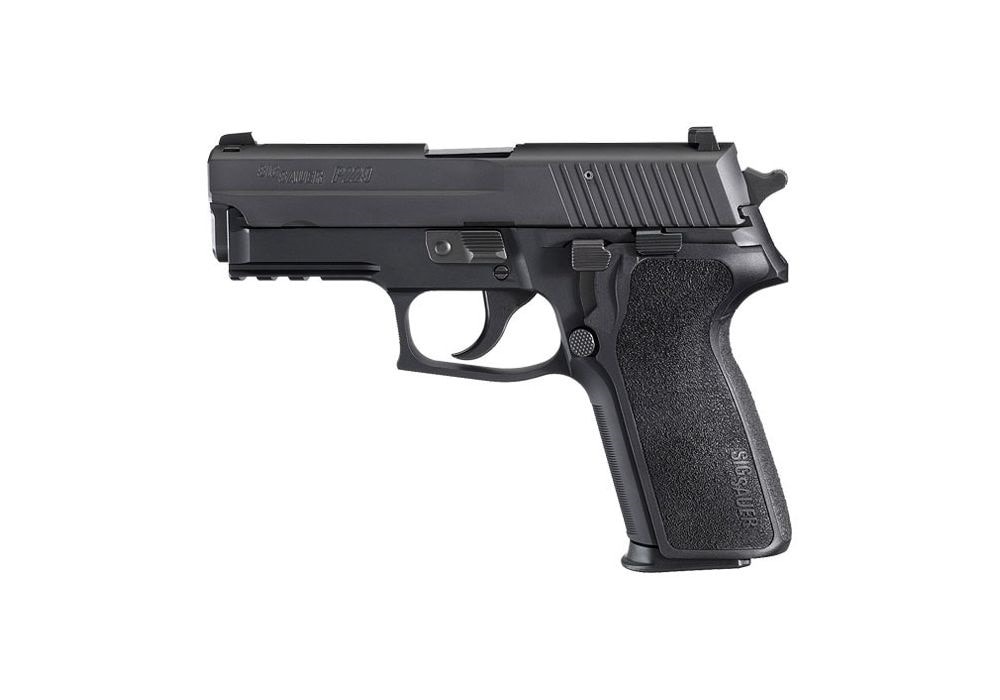
Sig Sauer P229.
SIG developed the P228 from the full-size P226 in 1989, trimming the slide, barrel, and grip to better suit concealed carry, according to Modern Firearms.
As I’ve written before, many already know my affinity for the P226.
The P228 was an excellent 9mm.
The U.S. military eventually adopted it as the M11, a compact personal defense weapon for select personnel, including criminal investigators, pilots, general officers, and naval aviators who needed a smaller, easily concealable sidearm compared to the full-sized Beretta M9.
However, the early 1990s brought the .40 S&W, and American police departments wanted to replace the 9mm with it.
However, the P228’s slide was stamped and formed from sheet steel.
That is fine for a 9mm.
It doesn’t hold up nearly as well to the higher pressures and slide velocity of a .40.
SIG’s fix was simple.
They kept the P228’s frame dimensions and machined the slide from a solid bar of steel.
SIG built the P229 specifically for the American market, and it was the first pistol assembled in SIG’s Exeter, NH plant.
It had the same footprint, with a stronger, heavier slide.
That change opened the door to the .40 S&W and, soon after, to a cartridge SIG helped create.
The Secret Service Weapon
In 1994, SIG teamed with Federal on the .357 SIG.
The idea was to neck a .40 case down to a 9mm bullet and chase the legendary 125-grain .357 Magnum load.
That revolver round ran between 1,300 and 1,450 fps depending on barrel length, as Athlon Outdoors reported in its look at the cartridge.
Getting that out of a compact semi-auto was the whole point.
The Secret Service carried the P228 in 9mm, loaded with 115-grain +P+ hollow points at roughly 1,300 fps.
The agency then moved to the P229 in .357 SIG for both special agents and Uniformed Division officers.
Guns.com reported that the Secret Service adopted it in 1999, shortly before the agency shifted from Treasury to Homeland Security.
The guns had a 12-round capacity.
The Federal Air Marshal Service followed the same path from the P228 to the P229, even using the same 125-grain Speer Gold Dot load.
My late friend Sean, who was an Air Marshal, really liked the pistol.
He spent years in Special Forces and also several years in a SMU, and he had a lot of time shooting pistols.
State agencies adopted it too.
The Delaware State Police was the first major department to adopt the .357 SIG, after growing unhappy with 147-grain subsonic 9mm.
The Virginia State Police and the Texas Highway Patrol soon followed suit.
For those keeping score at home, that’s the president’s security detail, the guys flying commercial flights incognito, and two of the busiest highway patrols in the country. All carrying the same weapon.
The Weight Was The Downside
The P229’s specs tell the story.
The P229 runs about 7.1 inches long with a 3.9-inch barrel, has a height of 5.5 inches, and measures 1.5 inches wide, per Vedder Holsters’ spec sheet.
Unloaded, it weighs roughly 34.4 ounces, and that’s with an aluminum alloy frame. Out of a compact.
That weight is the trade-off. A Backfire breakdown of the Secret Service’s pistols noted the Glock 19 Gen 5 that replaced it comes in 8.6 ounces lighter.
Wear a P229 on your belt through a 14-hour protective shift, and you’ll feel every one of those ounces.
However, the weight cuts both ways.
It eats up recoil, and that matters with a snappy, high-pressure round like the .357 SIG.
Most P229s run SIG’s classic DA/SA system with a decocker and no manual safety.
The first pull is long and heavy; the follow-ups are short and crisp.
Some shooters never felt comfortable with that transition.
Others felt like it was a plus on a duty gun, since that heavy first pull buys a margin of safety when you’re reholstering under stress.
The Secret Service modified it further.
The agency spec’d its guns with SIG’s DAK (Double Action Kellerman) trigger, which gives the same smooth, consistent pull on every shot.
Is The P229 Still Worth Carrying?
The Secret Service replaced the P229 in 2019.
Then-Director James Murray announced the change internally, and the agency joined in on Customs and Border Protection’s $85 million Glock contract.
Agents moved to the 9mm Glock 19 Gen 5 MOS, with special operations personnel adding the Glock 47 and Glock 26, as The Firearm Blog reported.
Modern 9mm hollow points had closed the performance gap, and the FBI had already led the way back to the cartridge.
Athlon Outdoors noted the switch ended more than 28 years of SIG pistols on the detail.
SIG still builds it, and the P229 Legion is the best version of the gun yet.
You get a Cerakote Elite Legion gray finish, G10 grips, X-Ray day/night sights, three 15-round magazines, and a reduced, contoured beavertail that lets you get higher on the gun without printing.
Officer.com also listed a single-action-only Legion for $1,413 at launch. Personally, I’d opt for the 9mm DA/SA version.
It’s the P229 with modern ammunition doing what the .357 SIG once had to.
Yes, it is heavy, and definitely more expensive than a Glock, but it is an excellent all-around pistol that is really nice to shoot
The P229 was built to handle more than its predecessor could. It earned its spot guarding our presidents. It will still protect you if you choose it.
About the Author: Steve Balestrieri
Steve Balestrieri is a National Security Columnist. He served as a US Army Special Forces NCO and Warrant Officer. In addition to writing on defense, he covers the NFL for PatsFans.com and is a member of the Pro Football Writers of America (PFWA). His work was regularly featured in many military publications.