
In 2026, Liaoning and 054B Conduct Training 880 Kilometers Southwest of Okinotorishima, Pressuring Maritime Self-Defense Force Surveillance
 Tanaka Takashi
In 2026, Liaoning and 054B Conduct Training 880 Kilometers Southwest of Okinotorishima, Pressuring JMSDF Surveillance
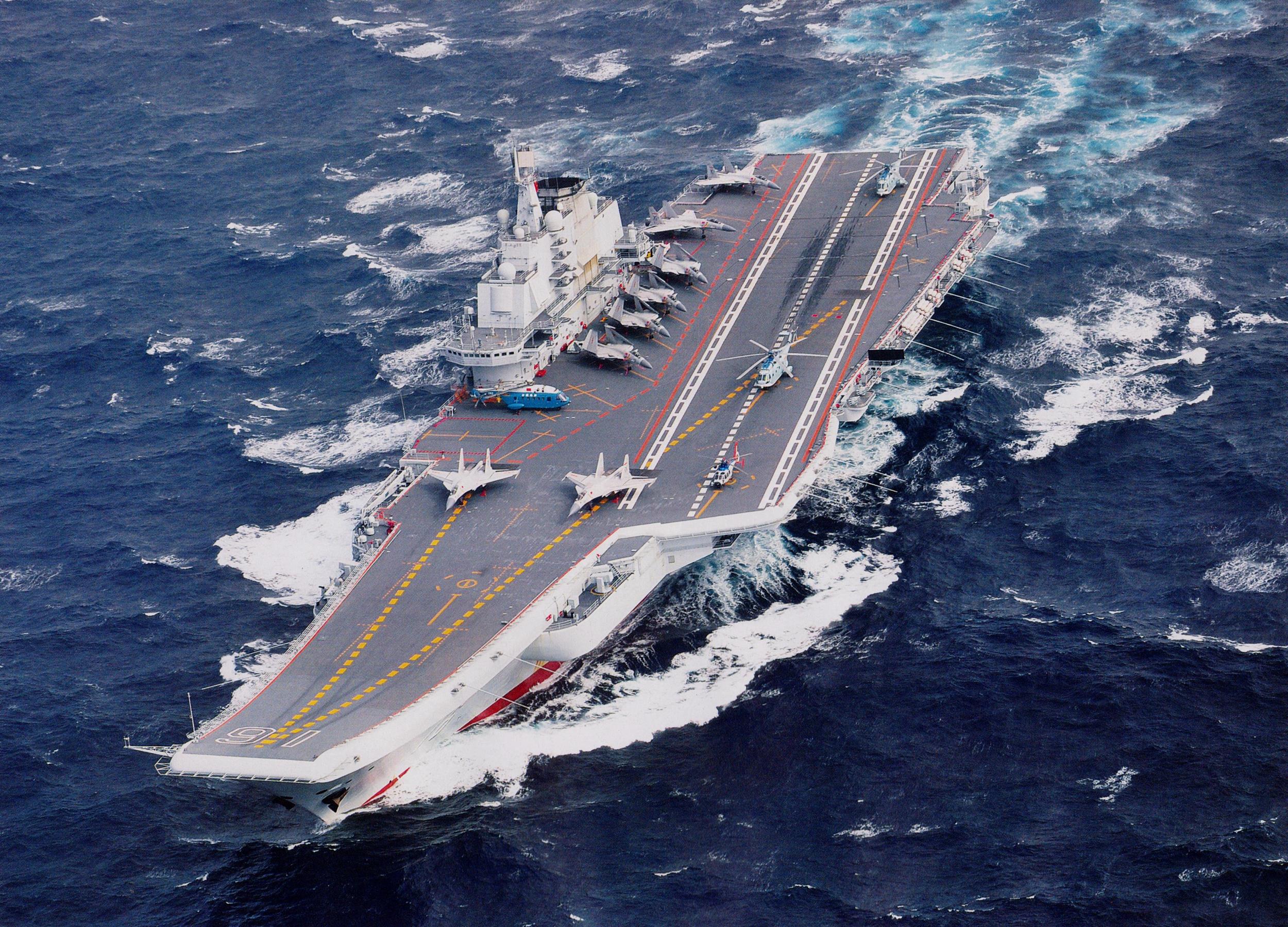
At noon on May 25, the Japan Maritime Self-Defense Force (JMSDF) destroyer "Asahi" confirmed that it was not merely a passage of a Chinese aircraft carrier. According to the Ministry of Defense's Joint Staff Office, a total of five ships, including the Kuznetsov-class aircraft carrier "Liaoning" 16, Renhai-class missile destroyer 104, Luyang III-class missile destroyer 124, Jiangkai III-class frigate 545, and Fuyu-class fast combat support ship 901, were navigating in waters approximately 880 kilometers southwest of Okinotorishima. On the following day, May 26, the launch and recovery of carrier-based fighter jets and helicopters from Liaoning were also confirmed.
This location is far from Japan's territorial waters and contiguous zone. However, within the broad operational space connecting the Nansei Islands, the Philippine Sea, and Guam, it is by no means a peripheral area. Rather, it should be viewed as a point to assess where the Chinese Navy can maintain air operations beyond the first island chain.
Participation of 054B Indicates an Update in Escort Capabilities
One cannot overlook the Jiangkai III-class frigate with hull number 545 in this formation. Overseas reports indicate that this ship is China's new 054B-class frigate "Luohua." Since the Ministry of Defense's materials refer to the ship by class and hull number rather than by name, we will refrain from making a definitive statement here, but it is highly likely that a new air defense and anti-submarine platform has been added to the escort composition of the Chinese aircraft carrier strike group.
Liaoning itself is a training-oriented aircraft carrier with a ski-jump deck and should not be treated on par with U.S. Navy nuclear aircraft carriers. There are constraints on the launch weight of the J-15 carrier-based fighter, and early warning aircraft rely on helicopters rather than fixed-wing platforms. However, the value of an aircraft carrier is not determined solely by its individual performance. It is significant to repeatedly conduct operations at sea that integrate escort ships, supply ships, carrier aircraft operations, and communication control.
The presence of the Fuyu-class fast combat support ship 901 is also noteworthy for those with JMSDF experience. The accompaniment of a supply ship suggests that this is not a short-term show of force but rather anticipates a sustained training period at sea.
The Coordinates 880 Kilometers Southwest of Okinotorishima
Okinotorishima is geographically a small entity. However, from the perspective of Japan's surveillance lines, the area around the island serves as a landmark connecting the northern Philippine Sea and the western Pacific. If the Chinese side conducts launch and recovery operations in this maritime area, the JMSDF and Air Self-Defense Force (ASDF) will need to continuously track fleet positions, the frequency of carrier-based aircraft, and the formations of escort ships by combining surface vessels, P-1 and P-3C aircraft, and warning control systems.
In December of last year, the Japanese side announced that a Chinese J-15 illuminated the fire control radar of an ASDF F-15 that was monitoring Liaoning's launch and recovery training. It has not been confirmed that the same type of tension occurred this time. However, as the frequency of carrier-based aircraft operations increases, there will also be more opportunities for approach, identification, radio communication, and photography. The risk of accidents lies more in the split-second decisions made in the field than in political statements.
China's Actions Filling the Void After Japan-U.S.-Philippines Exercises
In early May during Balikatan 2026, the Japan Ground Self-Defense Force launched Type 88 anti-ship guided missiles in the Philippines, confirming procedures for maritime strikes with U.S. and Philippine forces. The fact that the Chinese Navy sent Liaoning into the western Pacific immediately afterward to showcase carrier air operations is difficult to explain as mere coincidence. Beijing likely wanted to demonstrate that it could also apply air pressure from the ocean side against the Japan-U.S.-Philippines coastal missile network.
However, in my view, the main focus this time is not on direct intimidation regarding a Taiwan contingency, but rather on imposing the cost of continuous peacetime surveillance on Japan. Each time a JMSDF escort ship is deployed, there is a burden of personnel, fuel, maintenance, and information processing. If Chinese naval activities in the southwest become more frequent, Japan's challenge will not be the range of missiles but rather the human resources needed to maintain surveillance without interruption for weeks.
Sources and Evaluation
- Ministry of Defense Joint Staff Office, May 26, 2026 announcement "Regarding the Movements of Chinese Naval Vessels"
- The Japan Times, May 27, 2026, report on the participation of the Chinese 054B-class frigate in the carrier group
- Nippon.com/Jiji Press, May 27, 2026, report on launch and recovery operations in the waters southwest of Okinotorishima
- USNI News, May 26, 2026, report on the movements of the Liaoning carrier group and the U.S. carrier George Washington
Liaoning is still not a "completed aircraft carrier for decisive battles." However, even as an incomplete carrier, it has reached a stage where it can launch carrier-based aircraft 880 kilometers southwest of Okinotorishima, accompanied by escort and supply ships. The real issue for Japan is not the ability to find a Chinese aircraft carrier once. It is the ability to continue to find, record, and still maintain vigilance in other maritime areas without diminishing resources.
The People's Liberation Army Navy conducted training exercises with the Liaoning aircraft carrier and four other ships 880 km southwest of Okinotorishima on May 25-26, 2026. Aircraft operations from the carrier were confirmed, indicating an active military presence in the Philippine Sea. This operation is viewed as a demonstration of China's naval capabilities and a challenge to Japanese maritime surveillance efforts.
- Liaoning and 4 other ships conducted training 880 km southwest of Okinotorishima.
- Aircraft operations from Liaoning were confirmed on May 26.
- The presence of the 054B frigate indicates an upgrade in escort capabilities.
- The operation is seen as a demonstration of China's naval power in the region.
- Japan's Self-Defense Forces are monitoring the situation closely.