
Type 075 Anhui Ship Crosses Miyako Strait in May, PLA Amphibious Ships Begin to Keep Up with Aircraft Carrier's Open Sea Rhythm
 Li Minghui
Type 075 Anhui Ship Crosses Miyako Strait in May, PLA Amphibious Ships Begin to Keep Up with Carrier Operations in the Open Sea
On May 22 at 3 PM, the Japan Maritime Self-Defense Force discovered two Chinese naval vessels sailing southeast about 110 kilometers southwest of Kume Island: the Type 054A frigate Anyang, hull number 599; and the Type 075 amphibious assault ship Anhui, hull number 33. A report released by Japan's Joint Staff Office on May 26 indicated that these two ships subsequently crossed the waters between Okinawa Island and Miyako Island, entering the Western Pacific. This detail is more interesting than simply stating "another military ship passed through Miyako," because this time it was not a destroyer formation or an aircraft carrier group, but a large amphibious assault ship accompanied by a seasoned frigate.
Anhui Ship's Independent Departure from the Island Chain is Not a Minor Move
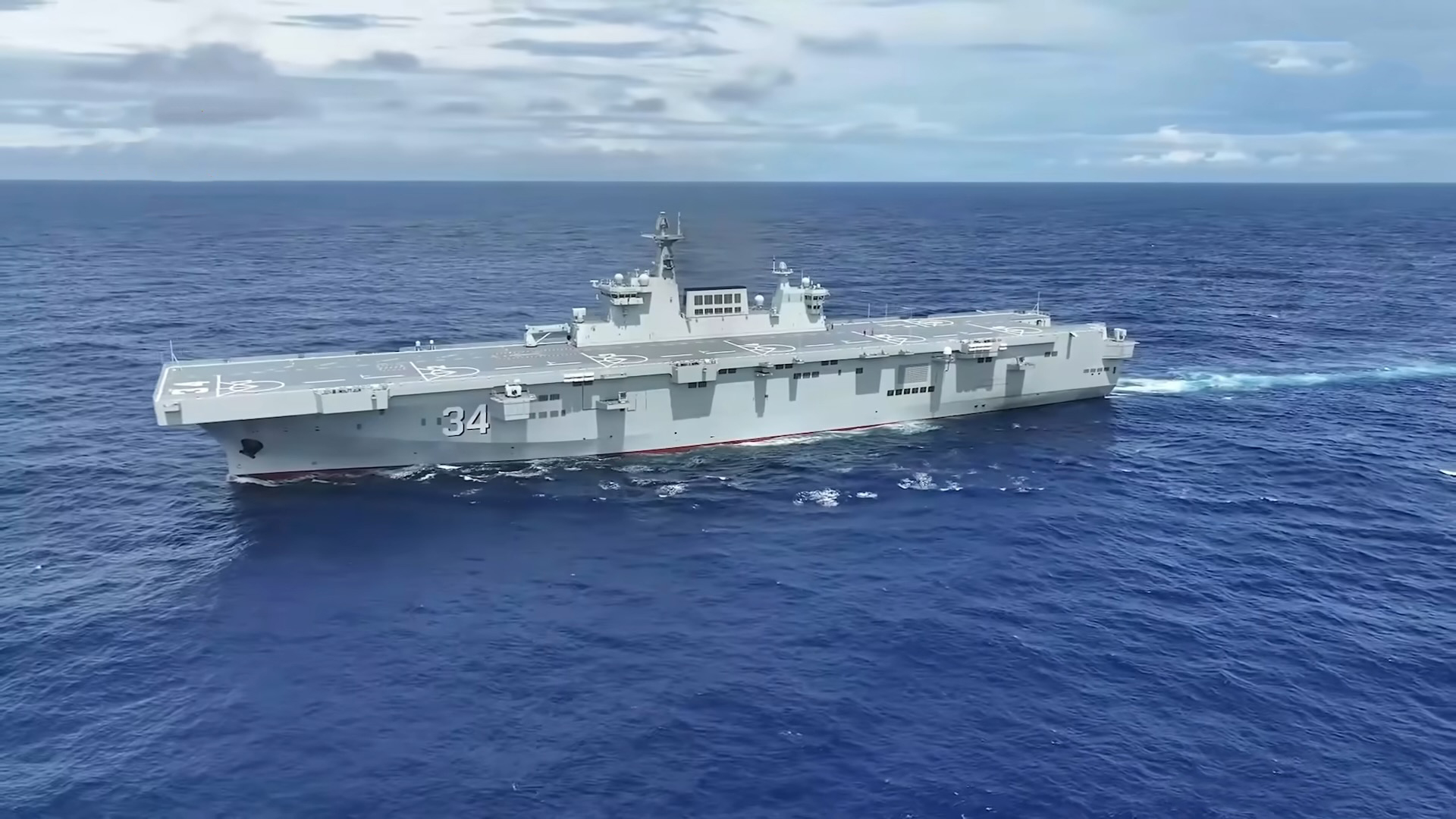
According to the Japanese report, the Anyang and Anhui ships were monitored by the P-3C anti-submarine patrol aircraft from the 5th Air Group based in Naha. The Japanese civilian shipping information website Funeco also confirmed that the two ships were sailing towards the Pacific through the Miyako Strait. Public information indicates that the Anhui is the third Type 075 ship, belonging to the Yushen-class large amphibious assault ships, with a full-load displacement typically estimated between 35,000 to 40,000 tons. Its flight deck can support multiple helicopters taking off and landing, and its dock can carry air-cushion landing craft and amphibious vehicles. It is not an aircraft carrier, but it is also not a traditional landing ship; in simple terms, it combines a maritime mobile airfield, a dock, and a landing command node into one hull.
This configuration is worth pondering. The Anyang is a Type 054A, not the newer Type 054B, nor the Type 055 destroyer. The Type 054A's air defense, anti-submarine, and surveillance capabilities are sufficient to provide close-in protection for the Type 075, but it cannot offer the long-range area air defense umbrella that a carrier battle group provides. This indicates that the Anhui's mission this time is more about open-sea training and system testing, rather than high-intensity confrontation exercises. The author believes that the real focus is not on whether the Anhui can reach the Western Pacific, but whether the PLA Navy is practicing how to operate the Type 075 away from near-shore landing scenarios, entering longer-range operations under more complex reconnaissance pressures.
At the Same Time, the Liaoning Carrier is Also Active in the Western Pacific
Looking at the timeline together makes it clearer. The South China Morning Post reported on May 27 that the Liaoning carrier group has been conducting live-fire training in the waters east of the Philippines in the Western Pacific, mentioning that the carrier entered the South China Sea on April 20 and was active during the US-Philippines "Shoulder-to-Shoulder" exercises, reappearing in more distant waters in late May. This means that around the time the Anhui crossed the Miyako Strait, the PLA Navy was simultaneously pushing both the aircraft carrier and the amphibious assault ship beyond the first island chain.
This does not necessarily mean that the Anhui is to rendezvous with the Liaoning. Public information is still insufficient to prove that they belong to the same training exercise plan. However, from a training design perspective, placing the aircraft carrier, Type 075, Type 054B/054A frigates, and subsequent supply forces in the direction of the Western Pacific is itself a form of stress testing: the frequency of carrier-based aviation operations, anti-submarine vigilance, supply rhythm, communication links, and Japanese Self-Defense Force monitoring responses will all be included in the data. From an engineering perspective, a single ship going to sea is a test run, while a formation operating in the open sea is a road test.
The Shortcomings of the Type 075 Still Lie in the Air Wing
The Chinese Ministry of Defense's English website released a training video of the Anhui in March, stating that the Anhui, Qian Dao Hu comprehensive supply ship, and Siming Mountain dock landing ship formed a task group, focusing on multi-subject maritime training such as shipboard helicopter takeoffs and landings. This indicates that the core training of the Type 075 still revolves around helicopter operations and amphibious delivery. The problem is that the Type 075 does not have fixed-wing carrier-based fighter jets, nor does it have short takeoff and vertical landing aircraft like the US F-35B; thus, long-range air defense still mainly relies on escort vessels and land-based aviation for extended support.
- Delivery Aspect: The Type 075 can transport helicopters, landing craft, amphibious vehicles, and command communication systems to maritime maneuvering positions.
- Protection Aspect: The Type 054A can provide basic anti-submarine and medium-range air defense, but it still appears thin against high-intensity airstrikes.
- Sustainability Aspect: Without a comprehensive supply ship accompanying it, the Type 075's high-frequency flight and landing exercises in the Western Pacific would be difficult to maintain for long periods.
Therefore, the Anhui's departure from the island chain this time seems more like a phased signal: the platform has matured enough to enter regular open-sea training, but the air strike and air defense systems have not yet fully closed the loop. Rather than saying it has become a "small aircraft carrier," it is more accurate to say it is transitioning from a landing ship to a maritime joint node.
Implications for the Taiwan Strait and South China Sea
The most direct scenario for the Type 075 is, of course, related to the Taiwan Strait. It can project helicopters and landing teams along the outer line, and can also undertake tasks such as maritime command, casualty evacuation, and serving as a mothership for unmanned platforms. However, the Anhui's passage through the Miyako Strait this time points towards a larger space in the Western Pacific. This suggests that the PLA may not only be using the Type 075 for near-shore landings, but is also testing whether it can support deterrence, feints, and troop redeployment beyond the first island chain.
For Japan and the United States, the difficulty lies here. Carrier battle groups are easily seen as the main axis, while amphibious assault ships are more ambiguous: they can train, deter, and can also project a small number of troops to key islands or maritime nodes during a crisis. If platforms like the Anhui become routine in crossing the Miyako Strait, the surveillance burden towards the southwestern islands will significantly increase.
The author still retains a question: if the next departure from the island chain is not just the Anhui, but a Type 075 along with a Type 901 supply ship, plus unmanned aerial vehicles or anti-submarine helicopters conducting high-frequency takeoffs and landings, will the Japanese report finally see a grouping of the PLA that truly approaches a "expeditionary amphibious readiness group"? This question is more worthy of attention than the single voyage itself.
On May 22, 2023, two Chinese naval vessels, including the Type 075 amphibious assault ship and Type 054A frigate, were observed sailing southeast through the Miyako Strait into the Western Pacific. This movement is part of a broader exercise involving the People's Liberation Army Navy, which also includes the Liaoning aircraft carrier operating in the same region.
- Two Chinese naval vessels, the Type 075 amphibious assault ship and Type 054A frigate, were spotted sailing southeast through the Miyako Strait.
- The vessels entered the Western Pacific after passing between Okinawa and Miyako Islands.
- The Type 075 ship is capable of supporting helicopter operations and amphibious landings.
- The operation is seen as a test of the PLA Navy's ability to conduct extended operations beyond the first island chain.
- The presence of the Liaoning aircraft carrier in the same region indicates coordinated naval exercises.