
India builds underwater sustained strategic deterrence capability, analysts say: limited technological accumulation, many unknowns remain
[Global Times Special Correspondent Xie Zhao] Indian media revealed that the Indian Navy's third strategic nuclear submarine, "Arihant," has officially entered service in April. This submarine not only has a larger displacement but can also carry more submarine-launched ballistic missiles. The Australian think tank "Strategic Policy Institute" analyzed on the 5th that the commissioning of this submarine marks a strategic milestone in India's development of sea-based nuclear deterrence, indicating that India has achieved a credible underwater continuous strategic deterrent.
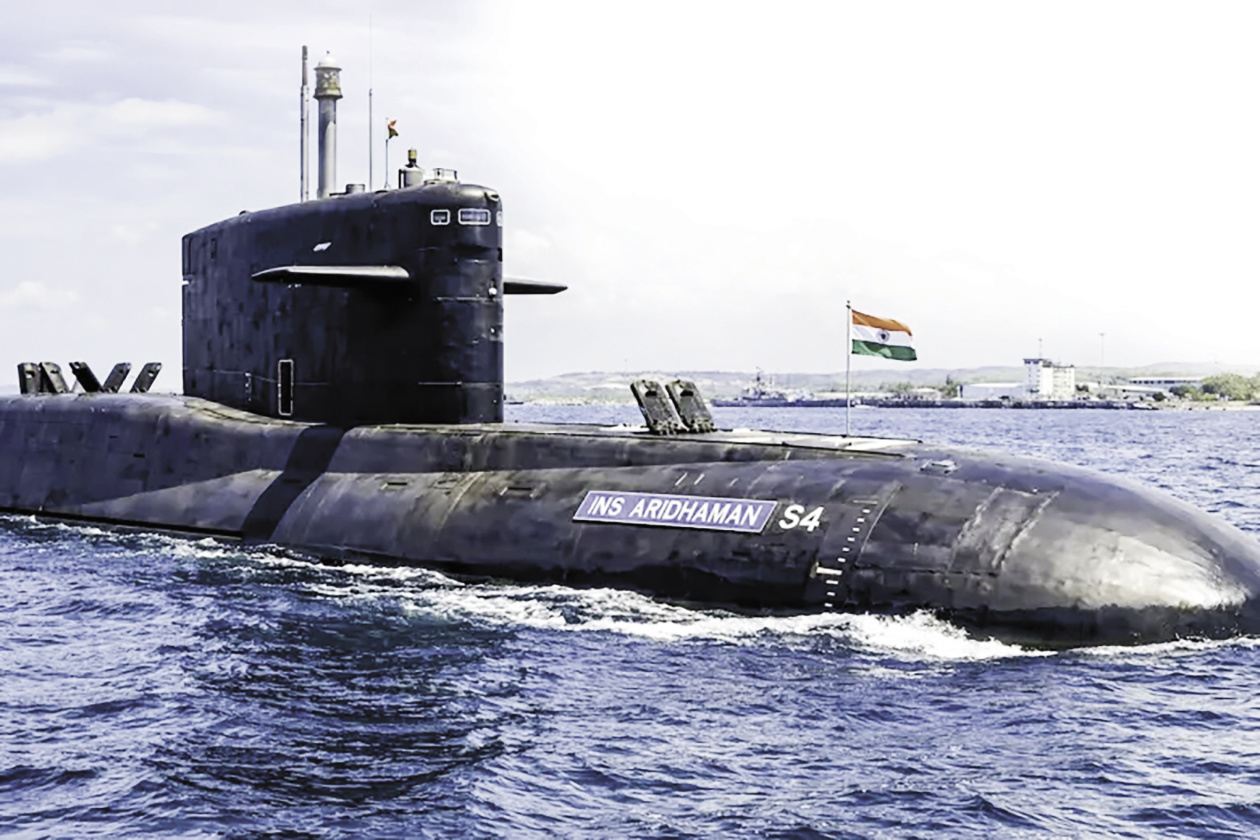
The "Strategic Policy Institute" website stated that India has long been working to build an underwater strategic deterrent force based on strategic nuclear submarines. Previously, the Indian Navy had already commissioned the domestically produced nuclear submarines "Killer" and "Arighat," both of which are 6,000 tons. They are equipped with four vertical launch systems and can carry four K-4 submarine-launched ballistic missiles with a range of 3,500 kilometers or twelve K-15 submarine-launched ballistic missiles with a range of 750 kilometers. According to the Indian Navy's concept, the K-15 missile is limited by its range and needs to be deployed in patrol areas near the target to launch an attack during wartime, while the K-4 has a longer strike range and can deter targets in larger areas from relatively safe patrol zones.
The newly commissioned "Arihant" has an increased displacement of 7,000 tons, providing not only longer endurance but also equipped with eight vertical launch systems, effectively doubling the number of missiles it can carry and offering greater operational flexibility.
The commissioning of the "Arihant" also enhances India's continuous underwater strategic deterrent capability. Reports indicate that to build a credible second-strike nuclear capability, at least one strategic nuclear submarine must always be on patrol underwater to ensure that the country can retaliate at any time after suffering a devastating nuclear strike. Following the international standard of "one submarine on patrol, one in training, and one in maintenance," the Indian Navy needs to have at least three strategic nuclear submarines to truly ensure that one is always on duty. Therefore, with the commissioning of the "Arihant," the Indian Navy has gained a reliable underwater continuous strategic deterrent capability.
However, the "Strategic Policy Institute" website believes that having a third strategic nuclear submarine may not fully guarantee the continuous underwater patrol of the Indian Navy's strategic nuclear deterrent force. This is because submarines must rotate for patrol, maintenance, rearmament, crew changes, and respond to emergency repairs, leaving little margin for error in a fleet of three submarines. If there are extended maintenance periods, system failures, or other unforeseen incidents, it could lead to gaps in underwater deterrence. The experiences of the UK and France indicate that having four strategic nuclear submarines is necessary to truly ensure continuous underwater patrols. Reports suggest that the Indian Navy is testing a fourth strategic nuclear submarine similar to the "Arihant" to build a more reliable underwater nuclear deterrent force.
According to the Indian Navy's plans, future submarines will be built with more powerful nuclear reactors and will be equipped with the K-6 submarine-launched intercontinental missile, providing India with a quieter, longer-range, and more credible maritime deterrent capability, expected to enter service in the mid-2030s and gradually replace earlier nuclear submarines like the "Killer."
However, analysts also warn that India's technological accumulation in domestic nuclear submarines is limited, and the "Killer" has exposed numerous issues during sea trials and service. Additionally, the overall maintenance of India's submarine fleet has been inadequate, leading to several serious incidents. For example, according to the Hindu newspaper, in February 2017, while docked, a crew member of the "Killer" forgot to close the left rear hatch, resulting in a large amount of seawater flooding into the sensitive propulsion compartment, corroding many pipes that supply coolant to the nuclear reactor. Consequently, the submarine was incapacitated for ten months, with many pipes needing to be cut open for cleaning or replacement. Therefore, whether the Indian Navy's ambitious underwater strategic nuclear deterrent plan can be realized on schedule remains uncertain.
India's Navy commissioned its third strategic nuclear submarine, the 'Arihant', in April 2023, enhancing its underwater strategic deterrence. The submarine, with a displacement of 7000 tons, can carry more missiles, doubling the capacity of previous models. This development is part of India's strategy to ensure a credible second-strike capability by maintaining at least one submarine on patrol at all times.
- India has commissioned its third strategic nuclear submarine, the 'Arihant', in April 2023.
- The 'Arihant' has a displacement of 7000 tons and can carry more missiles than previous submarines.
- India's Navy aims to maintain at least one submarine on patrol at all times for credible second-strike capability.