
Indonesia begins building its first own submarine
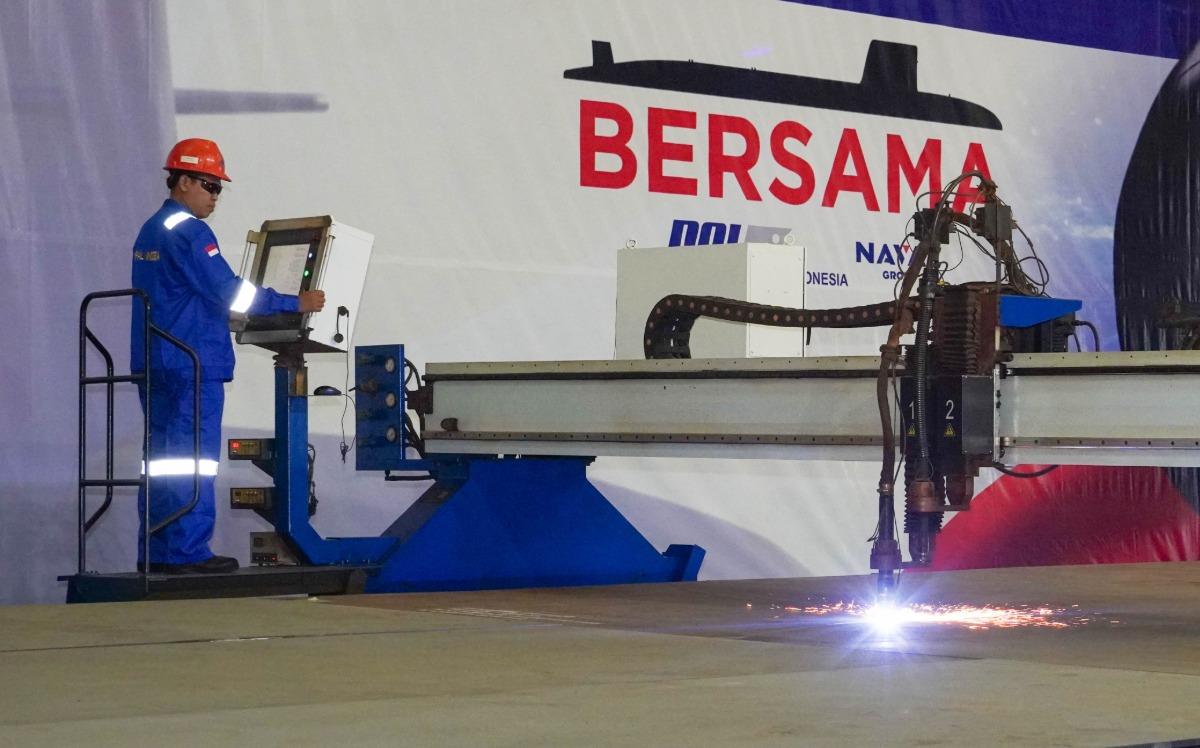
Indonesia cut the first piece of steel for its own submarine on Aug. 7, 2026, marking the moment the Southeast Asian nation moved from training its engineers in France to actually building a warship on home soil.
The steel-cutting ceremony took place at PT PAL’s shipyard in Surabaya, officially launching construction of Indonesia’s first Scorpène submarine under a program called Scorpène for the Republic of Indonesia, or SRI, a joint effort between Indonesia’s state-owned shipbuilder PT PAL and French naval defense company Naval Group. Two Scorpène submarines are being built entirely in Indonesia under the program, made possible through what the companies describe as a comprehensive transfer of shipbuilding capacity from Naval Group to PT PAL, following training sessions Indonesian engineers completed in Cherbourg, France, along with subsequent certification phases meant to bring PT PAL’s workforce up to international submarine-building standards.
The construction milestone caps more than two years of groundwork since Indonesia first selected Naval Group and PT PAL in March 2024 to build two Scorpène Evolved Full LiB submarines, a version of the design equipped with lithium-ion battery propulsion rather than the lead-acid batteries used in older diesel-electric submarines, extending how long the vessel can operate underwater without needing to surface and recharge. The contract formally entered into force in July 2025, and the two companies split responsibilities along clear lines: PT PAL handles hull construction, equipment integration, testing, final assembly, and eventual delivery of the finished submarines to the Indonesian Navy, while Naval Group supplies the submarine’s design, engineering support, and ongoing technical guidance through a dedicated team of experts permanently stationed in Surabaya rather than working remotely from France.
That arrangement reflects a deliberate strategy on Indonesia’s part to build lasting domestic shipbuilding capability rather than simply purchasing finished submarines from a foreign supplier. Indonesia’s maritime territory spans roughly 17,000 islands and covers nearly 6 million square kilometers (2.3 million square miles) of exclusive economic zone, one of the largest ocean areas any single nation controls anywhere in the world, and the country has increasingly framed naval self-sufficiency as essential to defending that vast maritime space rather than remaining dependent on foreign shipyards for a capability as strategically sensitive as submarines. Several specialized Naval Group facilities in France continue contributing components the two companies determined could not yet be produced domestically, including Cherbourg for hull and platform work, Lorient and Nantes-Indret for propulsion systems and the lithium-ion batteries themselves, Ollioules for the combat management system, and Angoulême-Ruelle for masts, weapon launch systems, and shaft lines, meaning the submarines represent a genuinely binational manufacturing effort even as final assembly happens entirely in Surabaya.
The submarines themselves carry serious combat capability once completed. Each vessel will run Naval Group’s SUBTICS combat management system and carry six 533-millimeter (21-inch) torpedo tubes capable of firing heavyweight torpedoes and Exocet anti-ship cruise missiles, a French-designed weapon that has become one of the most widely exported anti-ship missiles in the world since its combat debut during the 1982 Falklands War. Once commissioned, the submarines are expected to operate at ranges exceeding 8,000 nautical miles (14,816 kilometers, or 9,206 miles) and remain at sea for up to 80 days without resupply, endurance figures that would let the Indonesian Navy patrol its sprawling island territory and surrounding waters without constantly returning to port.
Naval Group’s SRI Programme Director, Vincent Vimont, described the collaboration with PT PAL as extending well beyond the immediate task of building two submarines, according to Indonesia’s state news agency Antara.
“This collaboration is not just about building two submarines, but about laying the foundation for sustainable industrial capabilities,” Vimont said.
PT PAL’s leadership has framed the program in similarly long-term terms, with company President Director Kaharuddin Djenod pointing to the broader strategic value a domestic submarine-building capability carries for Indonesia’s position within a region increasingly shaped by competition among larger powers.
“Amid growing rivalry among major world powers in the ASEAN region, a strong defense industry gives Indonesia strategic leverage in maintaining regional stability while strengthening its position as a respected maritime nation in the region,” Djenod said.
Getting to Thursday’s steel-cutting ceremony required PT PAL to build both the physical infrastructure and the trained workforce a submarine construction program demands from essentially nothing, since Indonesia has never previously built a submarine domestically at this scale. Naval Group’s engineering team on the Indonesian program includes personnel who previously supported similar Scorpène technology transfer efforts in India and Brazil, letting PT PAL benefit from lessons those two countries already learned working through their own versions of the same transfer-of-technology process rather than starting entirely from scratch. Fabrication of an early qualification section, a preliminary manufacturing step used to validate that Indonesian workers and equipment can meet the precise welding and structural standards submarine hulls require, was formally marked in Surabaya in December 2025, setting the stage for this week’s start of full construction on the actual lead submarine.
Construction of the second submarine is scheduled to begin in 2027, with the two vessels built in parallel production lines roughly a year apart rather than sequentially, and both companies have indicated the timeline could accelerate if construction proceeds smoothly. Current projections call for the lead submarine to undergo testing and sea trials between 2030 and 2032 ahead of delivery in 2032, with the second submarine following a similar testing period from 2031 to 2033 before its own delivery the following year.
The program is expected to generate approximately 2,250 jobs across construction, support services, and long-term maintenance work once the submarines enter service, positioning PT PAL not just as a one-time builder but as a potential long-term maintenance hub for Scorpène-class submarines operating anywhere in the world.
Content preview only. Full article available at source. View Full Article
Indonesia began building its first Scorpène submarine at PT PAL's shipyard in Surabaya on August 7, 2026. This marks a significant step in Indonesia's efforts to develop domestic shipbuilding capabilities, with two submarines being constructed under a joint program with France's Naval Group. The submarines will feature advanced combat systems and are expected to enhance Indonesia's naval capabilities significantly.
- Indonesia cut the first piece of steel for its own submarine on August 7, 2026.
- Two Scorpène submarines are being built entirely in Indonesia.
- The submarines will carry six 533-millimeter torpedo tubes and Exocet anti-ship cruise missiles.
- The program is expected to generate approximately 2,250 jobs.
- Construction of the second submarine is scheduled to begin in 2027.