
INDOPACOM's 2026 $592 Million QuickSink Ask Shows Taiwan Needs Cheap Ship Killers
 Marcus Chen
INDOPACOM's 2026 $592 Million QuickSink Ask Shows Taiwan Needs Cheap Ship Killers
$592 million is not much money by Pentagon standards. It is less than the price of two new F-35 squadrons, less than a single Virginia-class submarine, and probably less than the cost overrun on one large shipbuilding line. But Adm. Samuel Paparo's reported request for $592 million in QuickSink development, prototyping, and procurement matters because it points to the right problem in the Taiwan fight: the United States does not need a perfect anti-ship weapon for every Chinese hull. It needs enough cheap ship killers to make the Taiwan Strait unusable for an invasion fleet.
That is a different problem from the one Washington usually prefers to discuss. The comfortable version is about carriers, bombers, submarines, and exquisite standoff missiles. The operational version is uglier. If the People's Liberation Army tries to move troops across roughly 80 miles of water, the decisive question will be how many transports, escorts, roll-on/roll-off ships, and landing craft can be killed in the first days, and how quickly the U.S. and Taiwan can reload the kill chain.
QuickSink Changes the Price of a Kill
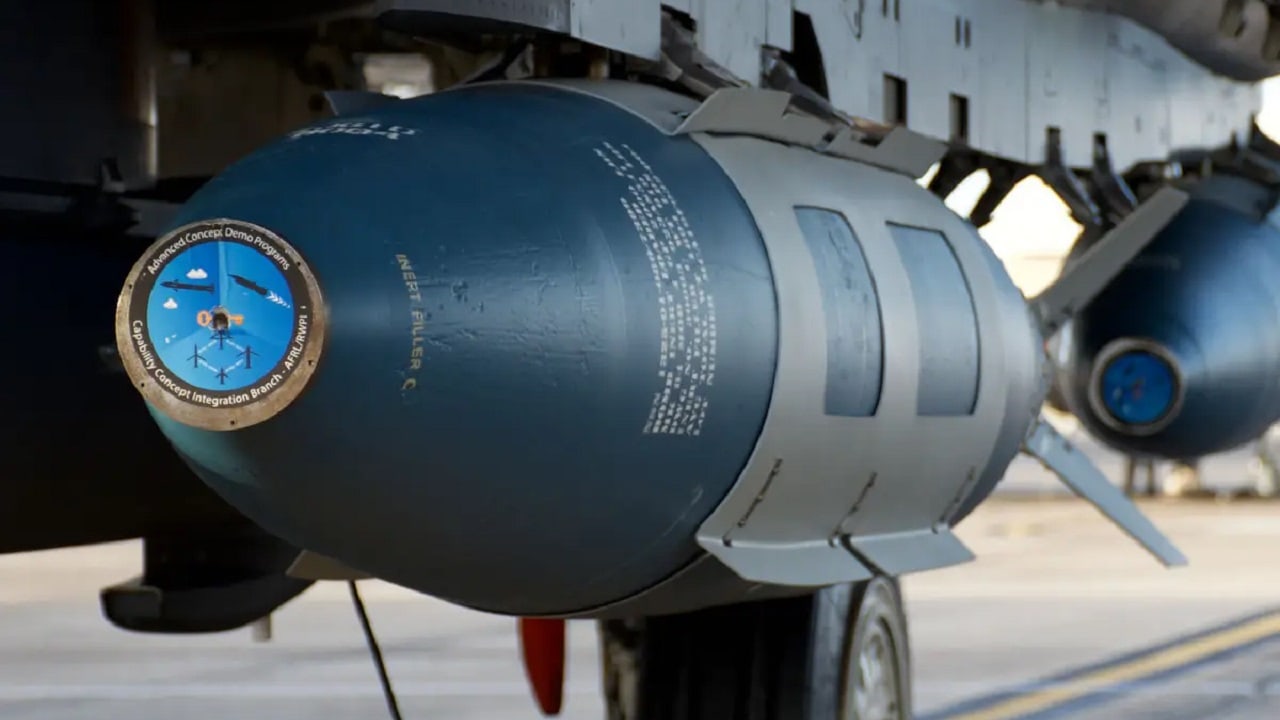
QuickSink is not a missile. The Air Force Research Laboratory describes it as a Joint Capability Technology Demonstration that adds a low-cost seeker to existing air-delivered precision weapons, allowing them to engage stationary or moving maritime targets. AFRL's own materials emphasize the logic: use an existing guidance kit, add a modular maritime seeker, and produce torpedo-like ship-killing effects from the air without spending torpedo or Long Range Anti-Ship Missile money on every target.
The Air Force demonstrated a 2,000-pound QuickSink weapon at RIMPAC 2024 and tested a 500-pound variant from a B-2 Spirit in 2025. That second detail matters. A 500-pound anti-ship option increases loadout flexibility. It also means the U.S. is trying to create a family of weapons, not a boutique munition useful only in one test profile.
The appeal is obvious. A Long Range Anti-Ship Missile is valuable because it can be launched from outside many defensive envelopes and has its own survivability logic. But it is expensive and scarce. A modified Joint Direct Attack Munition is cheaper, easier to produce in bulk, and already familiar to U.S. aircrews and logistics systems. If the seeker works reliably against moving ships in weather, clutter, electronic attack, and wartime confusion, QuickSink changes the cost-exchange ratio.
That last sentence is doing a lot of work. A weapon that sinks a target barge in a range event is not automatically a weapon that can kill a defended amphibious task force under PLA air cover. Anyone who has served on a destroyer knows the ocean looks empty until the sensor picture is saturated, contradictory, and late. Maritime targeting is not just about the bomb. It is about finding the right ship, keeping track of it, passing target-quality data, getting aircraft into release geometry, and doing all of that again after the enemy starts shooting at the network.
The Base Problem Does Not Go Away
QuickSink's weakness is baked into its strength. It is cheap because it is an adapted bomb, not a powered anti-ship missile with hundreds of miles of reach. That means aircraft must get close enough to release it. In a Taiwan contingency, the useful airfields are not abstract dots on a briefing slide. Kadena is about 450 miles from Taiwan. Guam is roughly 1,700 miles away. Whiteman Air Force Base, where B-2s are based, is on the far side of the planet unless bombers forward deploy or rely on a long tanker chain.
Paparo's posture testimony to Congress makes the same point indirectly. USINDOPACOM says it needs distributed posture, access, basing, and overflight, plus hardened logistics and fuel nodes across the Philippines, Palau, Micronesia, Papua New Guinea, Australia, and other points in the theater. That is not bureaucratic language. It is the map of whether QuickSink can arrive in time.
China understands this. Its anti-access force is designed to push U.S. aircraft, ships, tankers, and ISR platforms away from the first island chain. A cheap bomb is only cheap if the aircraft carrying it survives, the runway is open, the tanker is alive, and the targeting network is still passing usable data. Otherwise the United States has bought affordable weapons it cannot deliver at scale.
The hard question is not whether QuickSink can sink a ship. The hard question is whether U.S. forces can generate enough QuickSink sorties while China is trying to close the bases that make those sorties possible.
Mines Are the Other Half of the Math
The reported request also includes major funding for Quickstrike and related mine capabilities. That is the less glamorous but more strategically coherent piece. Mines do not need continuous aircraft presence after they are laid. They can deny channels, slow movement, force minesweeping, and create uncertainty around approach routes. In a Taiwan scenario, delay is not a consolation prize. Delay is combat power.
A Chinese invasion fleet would not be a neat line of gray warships. It would likely include naval escorts, amphibious ships, civilian roll-on/roll-off ferries, logistics vessels, minesweepers, and deception traffic. Killing every ship is not required. Breaking schedule, scattering formations, and forcing commanders to choose between speed and survivability can be enough to damage the plan. Sea denial is often about making movement unreliable.
This is where QuickSink and mines fit together. Mines shape the water space. QuickSink punishes ships that must slow, turn, bunch, or expose themselves. Long-range anti-ship missiles handle higher-value targets and defended formations. Submarines add the most lethal but least numerous layer. Taiwan's own coastal missiles, drones, and naval mines add another. The point is not one silver bullet. The point is a kill web with enough cheap rounds that the first day does not consume the entire magazine.
The Industrial Base Still Decides
CSIS warned in its recent munitions work that even when Congress funds missiles, delivery can take years. For several key weapons, the lead time from appropriation to fielded rounds can stretch beyond four years. QuickSink is attractive because it leans on existing bomb bodies and guidance infrastructure, but seekers, integration kits, testing capacity, software, and aircraft certification are still industrial problems. A $592 million line can start the process. It does not instantly create war stocks in Okinawa, Guam, northern Australia, and the Philippines.
The United States has spent years saying it wants to deter a Taiwan war by 2027. That date is often misunderstood. It is not a prophecy that Beijing will invade. It is a planning marker for when the PLA wants credible options. If Washington takes that timeline seriously, then cheap anti-ship weapons are not optional filler around the expensive systems. They are the only way to make the arithmetic tolerable.
QuickSink is a good idea because it admits a basic truth: Taiwan cannot be defended with prestige platforms alone. But the weapon is only one variable. The United States needs forward stocks, hardened bases, resilient tanking, persistent targeting, and allied political permission to operate from real geography. Without those, QuickSink becomes another clever test program pretending to be a theater answer.
The bomb may be cheap. The delivery problem is not.
Sources
- The Straits Times / Bloomberg reporting on INDOPACOM's QuickSink and mine funding request
- Air Force Research Laboratory QuickSink program description
- Air Force Materiel Command 2025 QuickSink 500-pound variant test release
- Adm. Samuel Paparo posture testimony to Congress
- CSIS Last Rounds report on U.S. munitions inventory and delivery timelines
U.S. Indo-Pacific Command (INDOPACOM) requested $592 million for the development of QuickSink anti-ship weapons and mine capabilities to enhance deterrence in the Taiwan Strait. The QuickSink system aims to provide a low-cost solution for targeting Chinese naval forces, while mine capabilities are intended to disrupt enemy movements. The U.S. military emphasizes the need for effective delivery systems and logistics to support these capabilities in a potential conflict scenario.
- INDOPACOM requested $592 million for QuickSink development and mine capabilities.
- QuickSink is designed to be a low-cost anti-ship weapon using existing bomb technology.
- The U.S. needs to ensure delivery capabilities for QuickSink in a Taiwan contingency.
- Mines are also a critical component for delaying enemy movements in a potential conflict.
- The timeline for effective deterrence against China is set for 2027.