
Insufficient Mine Clearance Capability and Negative Attitude of Allies: U.S. Military Struggles with "Escort" in the Strait of Hormuz
[Global Times Special Correspondent Chen Yang] As the navigation issues in the Strait of Hormuz caused by the attacks from the United States and Israel on Iran become increasingly severe, U.S. President Trump on the 16th once again accused "some American allies of having a negative attitude towards sending troops to participate in the escort cooperation in the Strait of Hormuz." Multiple U.S. media analyses indicate that this move also exposes the significant challenges the U.S. faces in trying to secure the Strait of Hormuz on its own, as it is already overwhelmed.
High Risks of Escorting Oil Tankers
CNN reported on the 16th that since the U.S. and Israel attacked Iran on February 28, commercial shipping through the Strait of Hormuz has effectively stopped. About 20% of the world's oil supply, as well as a comparable or even greater amount of liquefied natural gas and fertilizer products, must pass through this narrow strait to enter the global market. The closure of the strait has led to skyrocketing prices for these bulk commodities. To alleviate the pressure, Trump and U.S. government officials stated that plans are being developed for the U.S. Navy to escort merchant ships through the Strait of Hormuz. Trump has also requested allies such as Japan, South Korea, and NATO member countries to send warships for escort missions, but no commitments have been received so far. U.S. Navy analysts indicate that this situation reflects the enormous risks associated with escort operations.
Reports indicate that naval escort operations are very complex, requiring close coordination of air and naval forces to protect oil tankers, merchant ships, and the naval vessels themselves. Iran has been practicing blocking the Strait of Hormuz with drones, mines, fast attack boats, and suicide boats since the late 1980s. The narrowest part of the strait is only about 10 miles wide, and the navigable channel is even narrower, "with some giant oil tankers being longer than three football fields."
Jennifer Parker, a naval researcher at the University of New South Wales Canberra and a former Australian Navy officer who served in the Persian Gulf, stated that this leaves oil tankers or escorting naval vessels with almost no maneuvering space when under attack. She noted that U.S. Navy destroyers need enough space to maneuver around giant oil tankers to intercept incoming threats (such as drones or missiles), but these giant oil tankers may obstruct the movements of warships.
At the same time, because Iran's such weapons are typically deployed along the Iranian side of the Strait of Hormuz, the response time for escort vessels is extremely limited. Parker said, "The time from detecting a threat to responding is very limited."
CNN reported that analysts stated that destroyers alone cannot complete escort missions. The Iranian forces that could pose a threat to the escort mission are dispersed and mostly in a mobile state, with weapons including suicide drones, anti-ship missiles mounted on trucks, and mines that can be deployed from small fishing boats, sailboats, or even yachts. Especially in the face of close-range attacks from Iranian fast boats, the response capability of U.S. destroyers is limited. CBS News previously revealed that an Iranian fast boat once approached the USS Lincoln carrier strike group in the Arabian Sea, and the escorting U.S. destroyer fired its MK45 127mm naval gun multiple times without hitting the target, ultimately requiring an onboard helicopter to launch Hellfire missiles to hit the Iranian fast boat.
Former U.S. Navy officer and military analyst Carl Schuster stated that this also means helicopters or attack aircraft must hover nearby, ready to intercept aerial drones or unmanned fast boats; at the same time, airborne early warning aircraft and reconnaissance drones must penetrate deep into Iranian territory to search for potential missile launches targeting oil tankers or warships.
"Can the U.S. destroy all these targets to eliminate the threat?" questioned Colin Koch, a researcher at the S. Rajaratnam School of International Studies in Singapore. "In my view, this is not very feasible."
CNN reported that analysts stated that theoretically, U.S. forces could deploy to control the coastal areas of the Strait of Hormuz, thereby reducing the threat of Iranian shore-based fire to escort missions, but this would bring new problems, including significant casualties among U.S. ground forces.
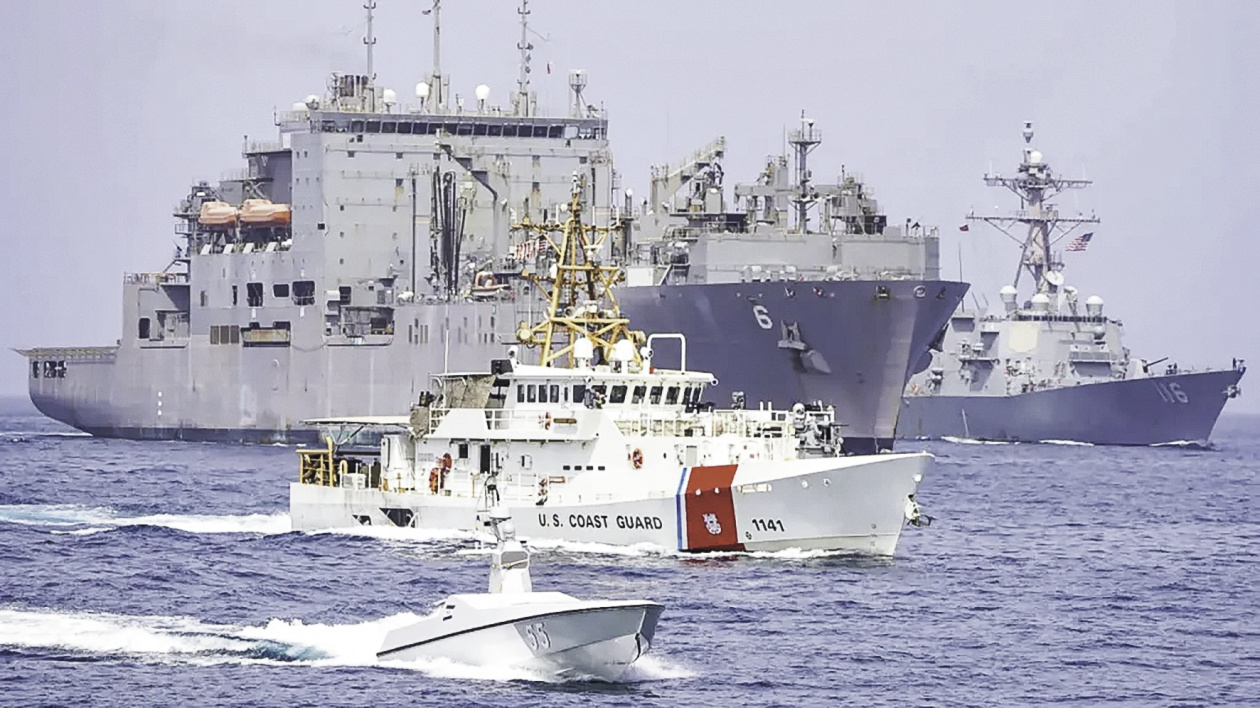
Mines Remain a Huge Threat
CNN reported that detecting and clearing mines in the Strait of Hormuz is another difficult problem for the U.S. to address. Reports indicate that last year, the U.S. Navy retired four Avenger-class mine countermeasure ships stationed in the Persian Gulf. In January of this year, these vessels were returned to the U.S. and began dismantling. Although the U.S. Navy stated that four Independence-class littoral combat ships equipped with mine countermeasure modules would take over the mine countermeasure mission, prior to the outbreak of this conflict, the U.S. Navy had only three littoral combat ships in the Persian Gulf region, and two of them were sent thousands of kilometers away to Malaysia for "brief logistical supply stops." The U.S. Navy admitted that currently only the USS Canberra littoral combat ship is on duty in the Indian Ocean.
According to a recent report released by the U.S. Congress, Iran possesses about 6,000 mines, including typically manually installed adhesive mines, moored mines that float just below the surface and are tethered to the seabed, bottom mines, and drifting mines that float above the surface and explode upon contact with vessels.
Reports indicate that the U.S. Navy's mine countermeasure fleet has significantly decreased, with only four Avenger-class mine countermeasure ships remaining in service with the U.S. military in Japan, and they have been in service for over 30 years. Currently, only a few Independence-class littoral combat ships have mine countermeasure capabilities, but their hulls are made of aluminum alloy and cannot enter minefields like dedicated mine countermeasure ships; they can only operate outside mine threat areas. Littoral combat ships typically remotely control unmanned surface vessels and unmanned underwater vehicles to enter mine-laying areas, using the AN/AQS-20 mine countermeasure sonar system to accurately locate the specific positions of mines, and then directing unmanned mine countermeasure systems to detonate the mines.
Schuster stated that ideally, one or two mine countermeasure ships should pass through the strait ahead of oil tankers to ensure the channel is clear. "Identifying mines is always a challenge." Koch stated that compared to destroyers, mine countermeasure ships are less well-armed and are easily susceptible to attacks from Iran when operating alone. "You can't just send out mine countermeasure forces; you also need to send out defensive forces, which may mean greater investment."
Severe Shortage of Escort Vessels
In addition, the number of warships that the U.S. can deploy is far from sufficient for the escort needs in the Strait of Hormuz. Since the U.S. Navy has retired all Perry-class frigates, the littoral combat ships that replaced them have weaker firepower and cannot undertake escort missions, thus the expensive Arleigh Burke-class destroyers are responsible for this task. Parker believes that a destroyer may be able to escort one or two oil tankers through the strait at a time, but Richard Meade, editor of the specialized shipping media Lloyd's List, believes that "a basic escort operation requires the deployment of 8 to 10 destroyers to protect a convoy of 5 to 10 merchant ships."
The U.S. Naval Institute's website reported on the 16th that the current number of destroyers deployed by the U.S. Navy in the Middle East is very limited, including two destroyers under the USS Ford carrier strike group in the Red Sea, one destroyer under the USS Lincoln carrier strike group in the Arabian Sea, and five destroyers independently deployed in the region.
CNN reported that according to the latest report from the U.S. Congressional Research Service, the U.S. currently has 73 Arleigh Burke-class destroyers in service, but considering training and maintenance, only about 68% are operational, meaning around 50 destroyers can be deployed, but they are scattered around the globe. "If just one escort mission through the Strait of Hormuz requires 10 destroyers, one can imagine how many resources the U.S. would need to invest to maintain escort missions over the long term."
Therefore, U.S. media believe that the inadequacy of the U.S. military's own capabilities is the fundamental reason for Trump's request for allies to send vessels to participate in the escort in the Strait of Hormuz. The Japanese news agency Kyodo reported on the 17th that Trump on the 16th at the White House accused "countries that refuse or respond coldly to his calls for escort." Although Trump did not name names, he complained that "those countries ensure their immunity from external forces by having U.S. troops stationed, yet they are not proactive in cooperating with the U.S.," likely referring to Japan, South Korea, and NATO member countries.
In fact, these U.S. allies face various political and other factors that hinder their ability to send vessels to participate in the escort operation in the Strait of Hormuz, and the capabilities they can provide to the U.S. are also quite limited. Alessio Patalano, a professor of war and strategy at King's College London, believes that "the relevant capabilities of various countries are far less than they were in the 1980s."
The naval research-focused website "Naval Outlook" reported on the 16th that British Prime Minister Starmer has not yet decided whether to send troops to assist the U.S., but he has clearly stated that the UK does not wish to be drawn into direct conflict with Iran, "more importantly, the size of the British Navy's surface fleet is at a historical low." The report cited that among the six active Type 45 destroyers in the UK, only the HMS Dragon is capable of going to sea; among the seven older Type 23 frigates, only the HMS Somerset is ready for deployment; in addition, the British Navy has retired most of its manned mine countermeasure vessels, and the technology for the new generation of unmanned mine countermeasure vessels is still immature.
CNN quoted Yoo Ji-hoon, a researcher at the Korea Defense Analysis Institute, as saying that the South Korean Navy's mine countermeasure ships are not suitable for such tasks. "Considering endurance, self-defense capabilities, and logistical support, there are limitations to the long-term ocean deployment of these vessels in high-threat areas like the Strait of Hormuz." The South Korean newspaper JoongAng Ilbo stated in an editorial on the 17th that the South Korean constitution explicitly stipulates that sending troops overseas requires the consent of the National Assembly. "The Middle East is not only the core hub of South Korea's energy security but also a pillar market for overseas infrastructure and complete equipment exports. If we rashly get involved in military actions, it will inevitably deal a heavy blow to South Korea's diplomatic relations and economic interests with Middle Eastern countries like Iran."
The U.S. Navy is preparing to escort commercial vessels through the Strait of Hormuz due to heightened tensions with Iran following attacks since February 28, 2023. President Trump criticized U.S. allies for their lack of commitment to participate in these escort missions, revealing challenges in U.S. military capabilities. The situation is complicated by Iran's deployment of various threats, including mines and fast attack boats.
- U.S. Navy plans to escort commercial vessels through the Strait of Hormuz due to increased risks from Iran.
- Iran has deployed various weapons systems to threaten shipping in the Strait.
- U.S. allies have shown reluctance to commit naval forces for escort missions.
- The U.S. Navy's minesweeping capabilities have diminished significantly.
- The complexity of naval escort operations in the Strait poses significant risks.