
Intercontinental Missile Test Launches, Most by the United States
[Global Times Special Correspondent Chen Yang, Global Times Reporter Ma Jun] Editor's Note: Recently, at the disarmament negotiation meeting in Geneva, the United States and other countries issued a so-called joint statement on "ballistic missile launch notifications," unjustly accusing China of conducting a submarine-launched intercontinental ballistic missile test in July, which was sternly rebutted by China's disarmament ambassador Li Chijiang. In fact, the United States is the country with the highest and most frequent number of intercontinental missile tests, and in recent years, it has invested heavily in nuclear force construction, engaging in "nuclear sharing" and "extended deterrence," which has drawn widespread criticism globally.
The frequency of launches far exceeds the "reliability testing" requirements
Public data shows that in the U.S. military's "triad" nuclear deterrent system, intercontinental missiles are mainly concentrated in the sea-based "Ohio" class strategic nuclear submarines equipped with "Trident II" submarine-launched intercontinental ballistic missiles and land-based fixed launch silos housing "Minuteman III" intercontinental missiles. The "Trident II" submarine-launched intercontinental missile is the U.S. Navy's third-generation submarine-launched ballistic missile, serving as the backbone of the U.S. second-strike nuclear force, with a maximum range exceeding 12,000 kilometers and capable of carrying 12 multiple independently targetable reentry vehicles (MIRVs). The "Minuteman III" intercontinental missile uses a fixed launch silo mode, with a maximum range of 13,000 kilometers, and can also carry multiple independently targetable nuclear warheads, which, according to previous U.S.-Russia nuclear disarmament agreements, have all been converted to single-warhead configurations.
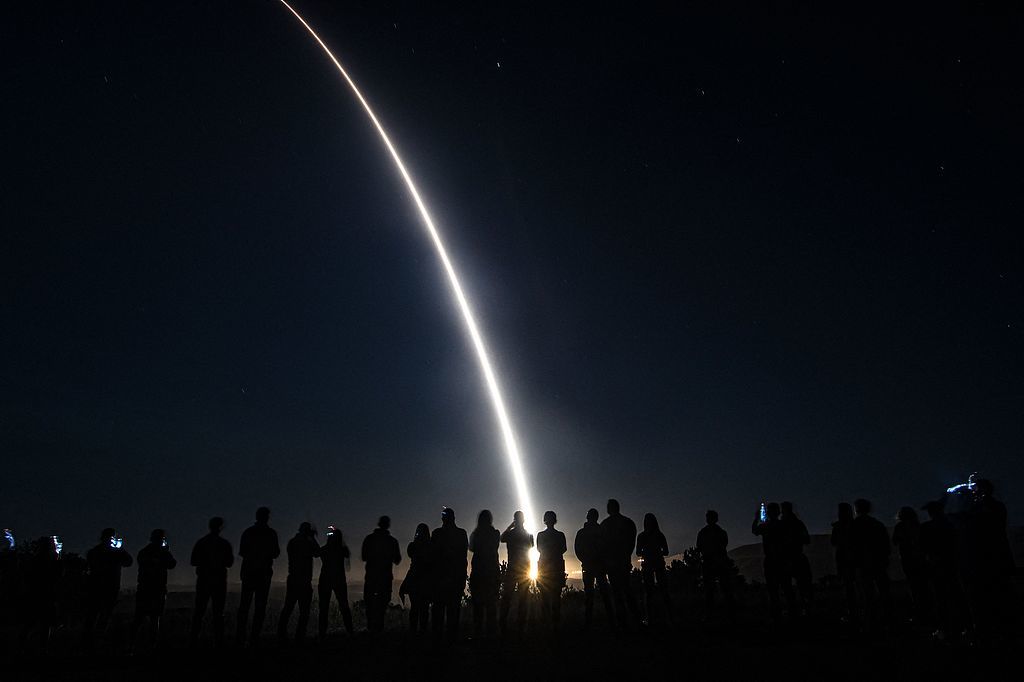
In recent years, the United States has conducted multiple long-range launch tests of intercontinental missiles each year, far exceeding the launch frequency of other nuclear powers. For example, shortly after the Biden administration took office in 2021, on February 23 at 11:49 PM, a "Minuteman III" intercontinental missile was launched from Vandenberg Air Force Base, hitting a target near the Kwajalein Atoll in the Marshall Islands after flying approximately 6,700 kilometers. The U.S. Air Force publicly stated that the reason for this intercontinental missile test was that the "Minuteman III" had been in service for a long time and needed regular testing to ensure its reliability. The missile was randomly selected from Malmstrom Air Force Base in Montana and reassembled at Vandenberg Air Force Base. The U.S. Air Force Global Strike Command stated, "The purpose of the intercontinental ballistic missile test launch program is to verify the safety, effectiveness, and readiness of the weapon system." However, the U.S. Air Force Times acknowledged that the purpose of this test launch was "to demonstrate that the U.S. still has sufficient nuclear deterrent capability to reassure allies."
In May 2021, when the U.S. Air Force planned to launch another "Minuteman III" intercontinental missile, it encountered a failure, and the missile malfunctioned during the countdown, forcing the launch procedure to be aborted. Three months later, the U.S. Air Force conducted another test launch of a "Minuteman III" intercontinental missile from Vandenberg Air Force Base, successfully hitting a target near the Kwajalein Atoll.
In 2022, the U.S. also conducted two "Minuteman III" intercontinental missile launches, but due to the outbreak of the Russia-Ukraine conflict earlier that year, the launches were postponed to August and September "to avoid misunderstandings." However, against the backdrop of the Russia-Ukraine conflict, the Pentagon, in order to demonstrate that the U.S. strategic nuclear deterrent capability "remains solid," launched four "Trident II" submarine-launched intercontinental missiles from a U.S. Navy "Ohio" class strategic nuclear submarine in June 2022 in waters west of California, with the missiles flying nearly across the entire Pacific Ocean to hit targets near Guam. In other words, the U.S. conducted as many as six intercontinental missile launches in 2022.
In 2023, the U.S. conducted four "Minuteman III" intercontinental missile launches in February, April, September, and November, with the November launch encountering an anomaly, resulting in the missile self-destructing over the Pacific Ocean; in 2024, the U.S. conducted two more "Minuteman III" missile launch tests.
In 2025, the number of intercontinental missile launches by the U.S. set a "new record" in recent years. Among them, the "Minuteman III" intercontinental missile was launched three times, and the "Trident II" submarine-launched intercontinental missile was launched "four times in quick succession." In the first half of 2026, the U.S. conducted two more "Minuteman III" intercontinental missile launch tests in March and May.
This data is sufficient to prove the conclusion of China's disarmament ambassador Li Chijiang: the United States is the country with the highest and most frequent number of intercontinental missile test launches in the world. In comparison, China has only conducted three intercontinental missile test launches to date, the fewest among the five nuclear powers. France recently conducted two launches of the M51 submarine-launched intercontinental ballistic missile in November 2023 and March 2024. The United Kingdom's most recent intercontinental missile launch tests were conducted in 2016 and 2024, both of which ended in failure, with successful launch records dating back to 2012. Russia also conducts intercontinental missile test launches periodically, with its missile flight trajectories primarily within Russian territory.
Chinese military expert Zhang Xuefeng stated in an interview with Global Times reporters on the 13th that the frequency of intercontinental missile launches by the United States in recent years far exceeds that of other countries and far exceeds the so-called "reliability testing" requirements for missiles.
U.S. media also acknowledge that many U.S. intercontinental missile launch tests are closely related to the international situation. For example, the March 2023 "Minuteman III" intercontinental missile launch was believed to be linked to the special context of the expiration of the U.S.-Russia New START treaty.
Spending heavily to continuously update the nuclear arsenal
In addition to frequently conducting intercontinental missile test launches, the United States has also spent heavily to continuously advance the modernization of its nuclear arsenal while withdrawing from and violating various treaties. In recent years, the U.S. has withdrawn from several key arms control and confidence-building mechanisms, dismantling the U.S.-Russia nuclear arms control system that has been gradually established since the Cold War. For example, the U.S. officially withdrew from the Intermediate-Range Nuclear Forces Treaty in 2019, which was signed in 1987 and required the U.S. and the Soviet Union to eliminate all land-based ballistic and cruise missiles with ranges between 500 and 5,500 kilometers. Now, with the treaty's expiration, the U.S. has begun deploying land-based intermediate-range missile systems such as "Tomahawk" in Europe and Asia, leading to increasing regional tensions. In 2020, the U.S. also withdrew from the Open Skies Treaty, which aimed to allow signatories to conduct unarmed reconnaissance flights over each other's territories to increase military transparency. In February of this year, with the expiration of the New START treaty, the last remaining nuclear arms control treaty between the U.S. and Russia also came to an end. This also means that there are no longer any numerical limits or verification mechanisms between the U.S. and Russia's nuclear arsenals.
What is even more concerning to the outside world is that the U.S. is investing unprecedented amounts of money to comprehensively update its nuclear arsenal. According to statistics from the Union of Concerned Scientists, the U.S. is expected to spend as much as $56.8 billion on nuclear weapons in 2024, exceeding the total of all other nuclear-armed countries.
China's disarmament ambassador Shen Jian previously pointed out at a United Nations disarmament negotiation meeting that the U.S. budget for the 2026 fiscal year allocates $98.6 billion for nuclear force construction, setting a historical high.
The U.S. Congressional Budget Office estimates that between 2025 and 2034, the total cost of operating and modernizing U.S. nuclear forces will reach $946 billion. The total cost over the next 30 years is expected to be between $1.5 trillion and $2 trillion.
According to the Pentagon's plans, in terms of land-based nuclear deterrence, the new generation "Sentinel" intercontinental missile will completely replace the current "Minuteman III" intercontinental missile. The "Sentinel" intercontinental missile also uses a silo launch mode, with a maximum range of about 10,000 kilometers, providing stronger penetration capabilities than the "Minuteman III."
In terms of sea-based nuclear deterrence, the Cold War-era "Ohio" class strategic nuclear submarines are nearing the end of their service life, and the new generation "Columbia" class strategic nuclear submarines are under construction to replace them. At the same time, the W93 nuclear warhead to be equipped with this submarine is also under development, with the second phase feasibility study expected to be completed in March 2025, and production planned to begin in the mid-2030s.
In terms of air-based nuclear deterrence, the new generation B-21 "Raider" stealth bomber is undergoing intensive flight testing, with procurement numbers expected to exceed 100 aircraft, replacing the current B-2 stealth bombers and B-1B supersonic strategic bombers. In addition, the Pentagon is also developing a new "Long-Range Stand-Off" (LRSO) air-launched cruise missile, which will become the "long arm" of the U.S. air-based nuclear strike force.
Chinese military expert Zhang Xuefeng noted that it is particularly noteworthy that the U.S. government intends to lower the threshold for the use of nuclear weapons. The U.S. Navy has previously deployed 5,000-ton W76-2 low-yield nuclear warheads on some "Trident II" submarine-launched intercontinental missiles, blurring the lines between strategic and tactical nuclear weapons, making them "appear more usable" in actual combat.
Recent reports from U.S. media also revealed that the Pentagon is drafting a new strategy that plans to place greater emphasis on the use of short-range tactical nuclear weapons in regional conflicts, raising widespread concerns. At the same time, former President Trump has even stated several times that he is considering "resuming nuclear tests."
These new generation nuclear weapon projects in the U.S. are generally facing severe cost overruns, leading to criticism from U.S. public opinion. Organizations such as the Arms Control Association are calling on the U.S. Congress to cut related expenditures, while think tanks and organizations like the Union of Concerned Scientists warn that the U.S.'s comprehensive update of its nuclear arsenal will "ultimately undermine stability and fuel Cold War thinking," leading potential adversaries to "retaliate in kind" and fall into an unwinnable arms race. Despite strong opposition, the Pentagon continues to push forward with related plans, indicating that the U.S. is very stubborn in strengthening its nuclear capabilities, and the advancement of these projects will bring new risks to the world.
"Nuclear sharing" and "extended deterrence" disrupt regional stability
China's disarmament ambassador Li Chijiang mentioned the U.S. "nuclear sharing" and "extended deterrence" policies in his rebuttal of the relevant statements, which are further drivers of regional instability and threats to global security. The "European Union Defense Industry" website states that the so-called "extended deterrence" policy refers to the security assurance commitments provided by the U.S. to its allies: if allies suffer (or are about to suffer) a nuclear strike or serious military aggression, the U.S. will use all means, including nuclear weapons, for retaliation or defense. Through this policy, the U.S. provides a "nuclear umbrella" to more than 30 allies and partners, with the core targets being NATO European member countries and Asian allies such as Japan and South Korea. The website criticizes that this policy is essentially a form of special nuclear proliferation, allowing non-nuclear countries to indirectly acquire nuclear war capabilities, blurring the lines between legitimate security cooperation and illegal nuclear proliferation.
According to NATO official documents, "nuclear sharing" is a specific operational mechanism to achieve "extended deterrence," with the most typical example being NATO's "nuclear sharing" program—approximately 100 B61 series tactical nuclear bombs are deployed in NATO member countries such as Belgium, Germany, Italy, the Netherlands, Turkey, and the United Kingdom, which are fully controlled by the U.S. military during peacetime, but the aircraft of these countries can participate in nuclear strike training and, with U.S. authorization during wartime, can carry and drop U.S. nuclear warheads.
What is particularly alarming is that since 2010, Japan and the U.S. have been conducting diplomatic and defense-level consultations on strengthening "extended deterrence," and in 2024, they established an independent ministerial framework to confirm the importance of sharing the U.S. "nuclear umbrella." This move by Japan violates the obligations of non-nuclear weapon states under the Treaty on the Non-Proliferation of Nuclear Weapons, exacerbating the risks of nuclear proliferation and nuclear conflict, and further stimulating regional tensions. This year, the Japanese Liberal Democratic Party also passed a draft proposal to revise the "three security documents," emphasizing the need to ensure the credibility of U.S. nuclear weapon-centric "extended deterrence" and to hold bilateral "extended deterrence" dialogues, stating that it will further strengthen Japan-U.S. cooperation. Senior members of the Japanese Liberal Democratic Party have also repeatedly publicly proposed or discussed the possibility of emulating NATO's "nuclear sharing" model.
Chinese Ministry of Defense spokesperson Zhang Xiaogang criticized at a previous press conference that "extended deterrence" is a product of the Cold War, and that certain countries, for geopolitical purposes, are strengthening nuclear deterrence cooperation, exacerbating the risks of nuclear proliferation and nuclear conflict. We urge Japan to earnestly fulfill its obligations under the Treaty on the Non-Proliferation of Nuclear Weapons and not to seek nuclear weapons in any form; we advise the U.S. to abandon Cold War thinking, stop taking provocative policies and actions, and avoid undermining regional peace and security and global strategic stability.
The U.S. conducted multiple intercontinental ballistic missile (ICBM) tests from 2021 to 2026, including launches from Vandenberg Air Force Base and submarines off California. These tests, involving Minuteman III and Trident II missiles, are part of the U.S. strategy to maintain nuclear deterrence and respond to global security dynamics. The frequency of these tests has drawn criticism and highlighted the U.S.'s significant investment in its nuclear arsenal.
- U.S. conducted the most ICBM tests globally, far exceeding other nuclear powers.
- The Minuteman III and Trident II missiles are central to U.S. nuclear deterrence.
- U.S. missile tests are often linked to international tensions and strategic signaling.