
International Observation: Japan's New Version of the "Defense White Paper" is Actually a Roadmap for Expanding Military Power
Xinhua News Agency, Tokyo, August 4 (Reporters Li Ziyue, Chen Ze'an, Liang Chen) - On August 4, the Japanese Ministry of Defense released the 2026 edition of the "Defense White Paper." The new version of the white paper further sensationalizes the so-called "security threats," adding content such as "new types of combat methods" and "strengthening defense production and technological foundations," with policy focuses adjusted compared to previous years.
Analysts believe that the new version of the white paper reveals the Kishi government’s attempt to pave the way for Japan's continued military expansion through the transformation of combat systems and the expansion of the military-industrial complex, sending a dangerous signal of Japan's further breach of the post-war system and acceleration towards becoming a "military nation."
Fully Reflecting the "Kishi Stamp"
The new version of the white paper for the first time includes a separate chapter on "Trends in New Types of Combat Methods." The related content involves case experiences from the Russia-Ukraine battlefield, promoting "enhanced use of unmanned equipment and artificial intelligence technology" and "maintaining sustained combat capabilities," claiming to further extend "military capability construction" into new fields such as space, cyberspace, and electromagnetic domains.
In the new version of the white paper, "Strengthening Defense Production and Technological Foundations" is listed as a separate fourth part, with a significantly increased length compared to last year's white paper. It argues that developing the military-industrial sector can "drive economic development" and "promote technological innovation to benefit people's livelihoods," thereby cloaking dangerous trends such as expanding joint development of weaponry, promoting the export of lethal weapons, and blurring the lines between military and civilian dual-use technologies in a guise of rationalization.
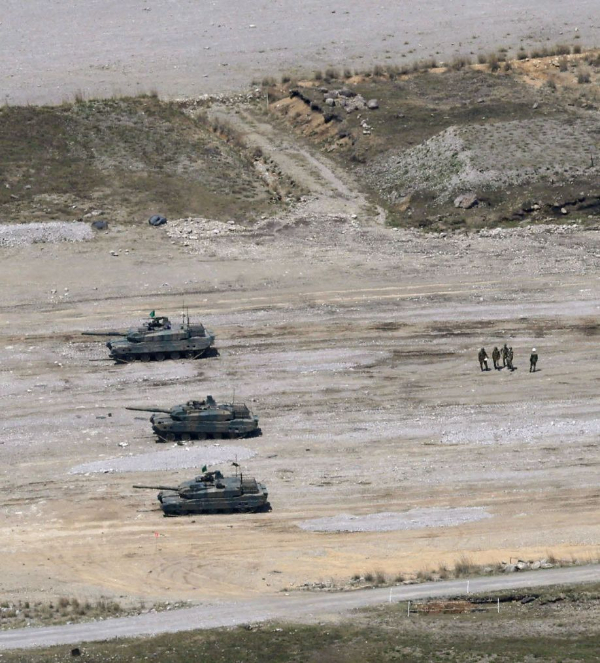
This photo, taken on April 21 in Oita Prefecture, Japan, shows the Japan Ground Self-Defense Force's "Nichibutsu Tai Exercise Ground." Xinhua News Agency/Kyodo News
The new version of the white paper continues to sensationalize the so-called "external threats," inciting camp opposition, and claims to strengthen cooperation with so-called "like-minded countries."
Chen Yang, a visiting researcher at the Japan Research Center of Liaoning University, believes that as the first "Defense White Paper" released by the Kishi Cabinet, the new version is heavily marked by "Kishi characteristics," and its content is highly consistent with the series of military expansion policies implemented since Kishi took office.
For example, the Kishi government has allocated huge funds in the 2026 fiscal year defense budget to procure various unmanned equipment, satellite electromagnetic interference and monitoring devices, etc., promoting AI-assisted combat. The Kishi government also pushed for the National Diet to pass a bill in June this year to reclassify the Air Self-Defense Force as the "Aerospace Self-Defense Force," officially incorporating space into the Self-Defense Forces' operational domain. This series of trends corresponds to the "new types of combat methods" content in the white paper.
Additionally, in April this year, the Kishi government revised the "Three Principles on Transfer of Defense Equipment" and its application guidelines, in principle allowing the export of lethal weapons, opening up the market for Japan's military-industrial sector. This move is an important part of what the white paper refers to as "strengthening defense production and technological foundations."
Aiming for a "Military Nation"
Analysts believe that the adjustments in content of the new version of the "Defense White Paper" fully expose the strategic intentions of the Kishi government: relying on the transformation of combat systems, expansion of the military-industrial sector, relaxation of weapon exports, and external defense cooperation to create a long-term military expansion policy system.
Chen Yang points out that the Japanese government plans to revise the "Three Security Documents" by the end of this year, and the new version of the "Defense White Paper" is an important barometer for observing the direction of this revision, which may indicate the policy direction that Japan will focus on in the defense field over the next 5 to 10 years.
In terms of content, many statements in the new version of the white paper have commonalities with the "Three Security Documents" amendment proposal submitted by the Liberal Democratic Party to the government in June. For example, the proposal exaggerates the so-called "security threats" from neighboring countries, calls for enhancing the reserves and production capacity of ammunition, fuel, and components, and ensuring that the Self-Defense Forces have "sustained combat capabilities." This aligns closely with the new content in the white paper.
Regarding defense spending, although the proposal does not set specific targets, it intentionally references NATO countries that aim to significantly increase the proportion of defense spending in GDP, making its intentions clear. The white paper similarly uses comparative narratives with other countries, aiming to provide a basis for the continuous increase in defense spending.
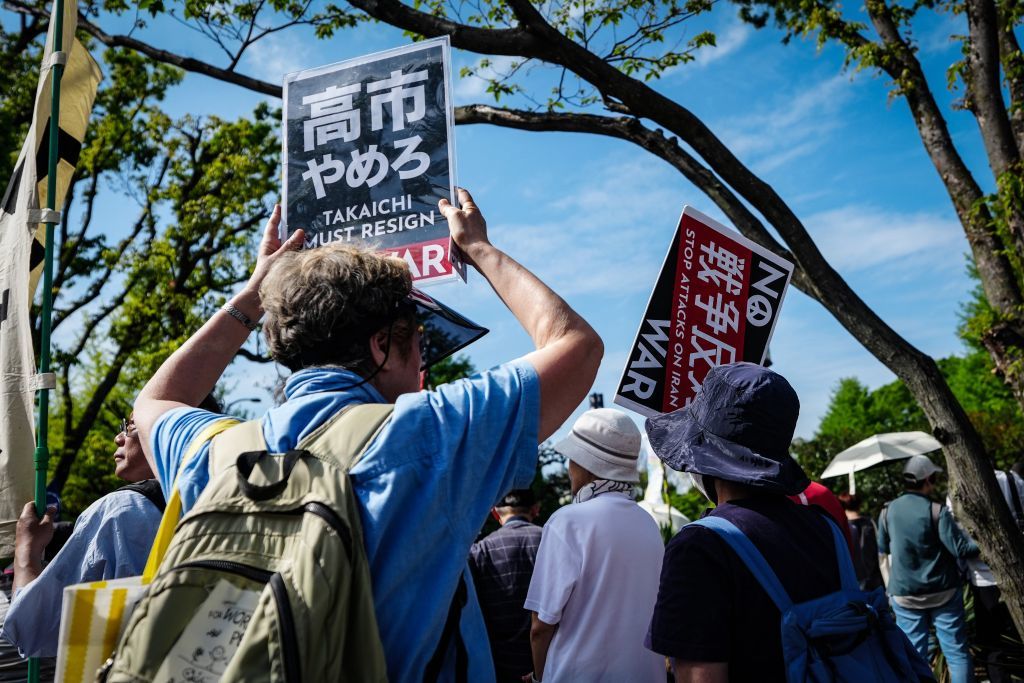
On April 19, people participated in a protest around the National Diet in Tokyo, Japan, calling for the protection of the peace constitution. Xinhua News Agency reporter Jia Haocheng took this photo.
There are many concerns within Japan regarding the aforementioned policy trends. Many insightful individuals point out that the Japanese government's continuous military expansion and breach of restrictions not only do not contribute to regional peace and stability but instead make Japan a creator of regional tensions. A recent editorial in the Asahi Shimbun questioned: "What kind of signal will Japan send to neighboring countries by fundamentally strengthening its defense capabilities under the banner of seeking to possess the ability to attack enemy bases, lifting the ban on the export of lethal weapons, and pushing for a shift in post-war defense policy?"
Japanese constitutional scholar Ito Makoto stated that from former Prime Minister Shinzo Abe's strong push for the new security law over a decade ago, to the Japanese government's passage of the new "Three Security Documents" in 2022, and now the Kishi government's implementation of a series of military expansion policies, Japan has deviated from the development path established by the peace constitution. He believes that Japan is seeking to establish a "wartime system" that can mobilize the overall strength of the nation, essentially transforming Japan from the "peaceful nation" it has claimed since the post-war period into a "military nation."
For months, protests against the Kishi government's security policies have frequently taken place around the Japanese National Diet, with large numbers of citizens taking to the streets to call for peace and resist military expansion. As one protester said in an interview, the Kishi government "has always been lying; everything they do is gradually pushing Japan towards war."
Japan's Ministry of Defense published the 2026 Defense White Paper, emphasizing the need for enhanced military capabilities and the expansion of the defense industry. The document outlines plans for increased procurement of unmanned systems and AI-assisted combat technologies. Analysts warn that these developments signal Japan's intent to transition towards a more militarized state, raising concerns about regional security dynamics.
- Japan's 2026 Defense White Paper emphasizes new combat methods and defense production.
- The government plans to expand military capabilities, including unmanned systems and AI technology.
- There is a push to redefine the Japan Air Self-Defense Force into a Space Self-Defense Force.
- Concerns are raised about Japan's shift towards becoming a 'military nation' and the implications for regional stability.