
Interview: Stratonex wants to bring Ukraine’s innovation loop to Britain
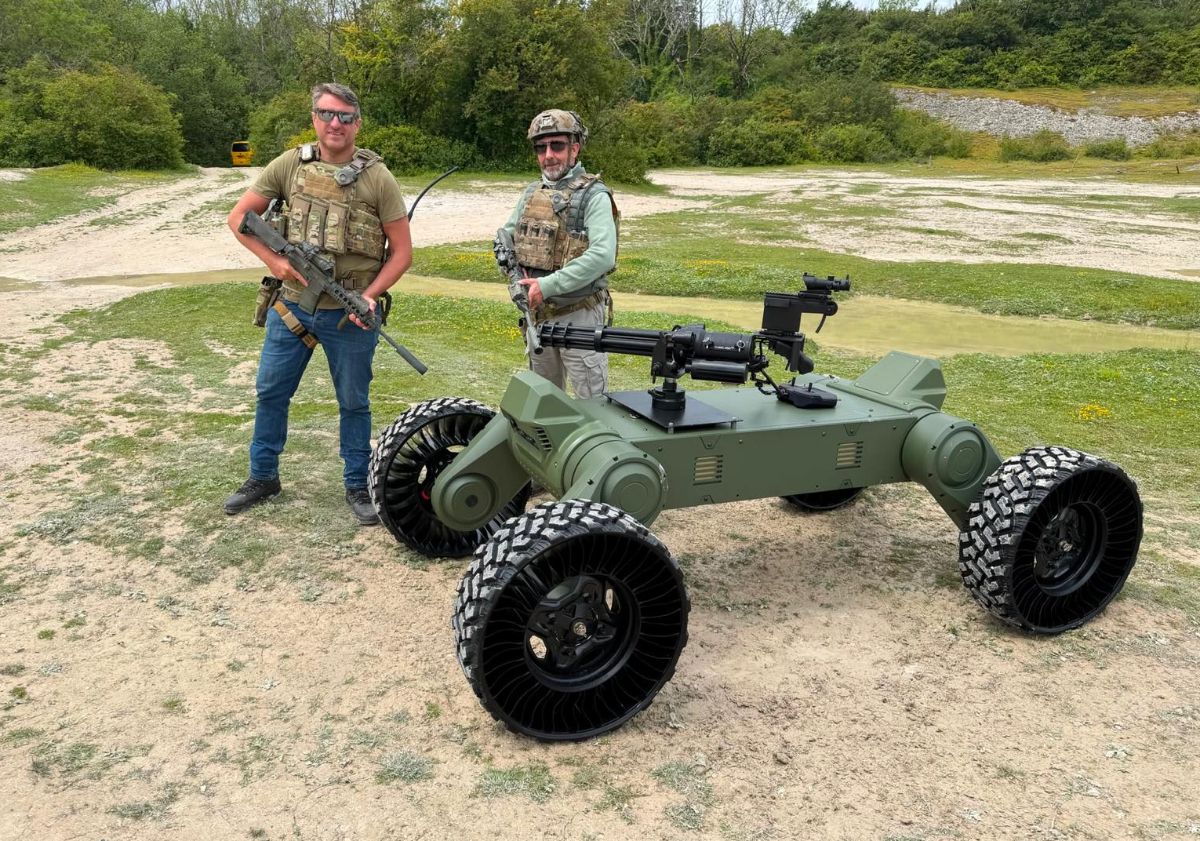
British defense technology company Stratonex Defence Technologies is developing a range of unmanned ground vehicles, tactical drones, counter-drone systems and military mobility platforms, with a focus on reducing the exposure of personnel to battlefield threats.
The company’s VARAN unmanned ground vehicle is among its central projects. The platform has undergone initial mobility and remote-control testing, but further engineering and integration work is required before it can be considered ready for operational deployment.
In an interview with The Defence Blog, Stratonex co-founder Ben Everitt discussed the development of VARAN, the company’s relationship with technology partners, its approach to manufacturing and the challenges of moving military hardware from prototypes into serial production.
Everitt also outlined the company’s plans for 2027, including closer cooperation with British manufacturers, universities and military operators. He described lessons drawn from Ukrainian battlefield innovation and explained why Stratonex is placing increasing emphasis on connecting ground vehicles, aerial drones, sensors and other technologies into integrated mission systems.
The following interview is presented in full, with the interviewee’s answers reproduced without editorial changes.
Q: Stratonex Defence Technologies is entering a market where established defense contractors and smaller technology companies are competing to develop autonomous military systems. What specific technological or industrial gaps are you seeking to address, and how does your business model differ from that of traditional defense manufacturers?
A: I think you have to start with what’s actually happening on the battlefield, because it’s changing incredibly quickly.
The traditional idea of a frontline is becoming increasingly meaningless. What you’ve really got is a contested kill zone, potentially 20 kilometres or more either side of the line, where drones, sensors and precision weapons mean that if you can be seen, you can potentially be targeted.
So that’s the problem we’re building Stratonex around. How do you operate in that environment without unnecessarily putting people in it?
That’s where the product set starts to make sense. We’ve got unmanned systems that can move equipment, sensors and other capabilities into that space. Then we’ve got fast, stealthy, relatively inexpensive mobility platforms for those occasions when people do need to go into it and need to get back out again quickly.
The phrase we’ve started using is: keep the humans in the kill chain, but out of the kill zone. I really like it because it sums up what we’re trying to do.
The other thing that’s really struck me is the speed at which all of this is changing. I was recently out in eastern Ukraine, near the frontline, in a car with the manager of a UGV factory. His phone goes and it’s a battalion commander on the frontline who is using his vehicles. He’s basically saying, “This works, this doesn’t, and this is what I want the next batch to do.”
I remember thinking: this is extraordinary. You’re watching the innovation loop happening in real time. The customer is on the battlefield and the factory manager is taking the next requirement directly from him.
Obviously we’re operating in a very different environment in Britain, but that sense of pace and urgency is something we really want to capture at Stratonex. We’re not trying to recreate a traditional defence prime. We want to be agile, work with really good technology partners and get really, really cool technology integrated and into the hands of operators quickly.
Q: Stratonex has presented a portfolio spanning unmanned ground vehicles, tactical aerial systems and counter-UAS technologies. How much of this portfolio is being developed internally, and what role do technology partnerships, licensing arrangements and third-party integration play in bringing these products to market?
A: It’s deliberately a mixture. I don’t think there’s any great virtue in saying that every nut, bolt, sensor and line of code has to have been invented inside the same building.
There are technologies and IP that sit within Stratonex, and then there are areas where we work with partners, licence technology or integrate specialist systems developed by other people.
And that’s exciting, because there is some really, really cool technology being developed by smaller companies in Britain and elsewhere. The problem is often not the technology. It’s getting it integrated, tested, manufactured and ultimately bought.
That’s where I think Stratonex can add a lot of value. We can start with the operational problem and ask: what’s the best combination of platform, sensor, communications, autonomy and payload to solve it?
We’re quite deliberately technology-agnostic about that. If somebody has already invented a brilliant sensor, I don’t want to spend three years and a fortune inventing another one just so we can put our badge on it. I’d rather work with them, integrate it and get the capability out there.
Q: VARAN is presented as a modular unmanned ground vehicle capable of operating in GNSS-denied environments using passive 3D sensing and onboard autonomous navigation. How mature is this technology today, what capabilities have been demonstrated during physical testing, and what engineering challenges remain before the platform can be considered operationally ready?
A: VARAN is a real vehicle. We’ve built it, driven it, tested it and spent quite a lot of time getting it muddy, which is the fun bit.
But we’re also careful not to pretend that having a really good prototype is the same thing as having a fully operationally proven military system. There is still engineering, integration and testing to do.
We’ve demonstrated the fundamental mobility of the platform, remote operation and elements of the sensing and navigation architecture. The next phase is about making all of that increasingly robust across different terrain, payloads, communications environments and operational conditions.
What’s been particularly interesting is the feedback we’ve had from Ukraine. We started out, naturally enough, being really enthusiastic about the autonomy. It’s technically fascinating and there are some really cool things you can do with it.
But the Ukrainians keep bringing us back to something much simpler: the really important thing is that it’s unmanned.
If you can remotely drive ammunition, water, batteries or other equipment those last few kilometres instead of putting people in a vehicle and sending them into the kill zone, you’ve already achieved something incredibly valuable.
So we’re still developing the autonomy, absolutely. But we’re not developing autonomy because autonomy happens to be fashionable. We’re developing the capabilities operators actually want.
Q: Published information describes VARAN as a multi-mission platform capable of carrying reconnaissance, electronic warfare and counter-UAS payloads. How does the vehicle’s modular architecture accommodate different power, communications and payload requirements, and which mission configurations have progressed beyond the design stage?
A: This is one of my favourite things about VARAN because you can get terribly technical about modularity, power, data and payload integration, and I have a tendency to do exactly that.
We took VARAN away for a weekend of testing and filming with a group of former Special Forces guys who our Chairman, Major General John Holmes, knows.
I’m there waving my arms around getting incredibly enthusiastic about all the clever things we can do with it. We can forward-deploy surveillance drones on it. We can remotely recharge them. We can put different sensors and payloads on it. We can use it as part of a much wider unmanned system. All really, really cool stuff.
And the former SAS guys basically looked at it and said: “Yeah, but we can chuck all our kit on that and it’ll carry it for us.”
And they’re absolutely right.
Sometimes the simplest use case is the best one. Logistics is the backbone of successful warfighting. If VARAN can carry the heavy stuff while the operator concentrates on doing his job, that’s incredibly useful.
It also goes back to what the Ukrainians have been telling us. Sometimes we get very excited about the word “autonomy” when the thing the soldier really values is the word “unmanned”.
That’s why modularity matters. VARAN isn’t supposed to be one exquisite vehicle designed around one exquisite mission. The base platform gives you mobility, power and communications and then we can configure it around what the operator actually needs, whether that’s logistics, surveillance, EW, counter-UAS or something we haven’t thought of yet.
Q: VisionWave announced a conditional $20 million purchase order for 200 STRATUM VARAN vehicles in September 2026. What role does Stratonex play in the development, integration and potential production of these vehicles, and what milestones must be achieved before the programme moves into manufacturing and customer deliveries?
A: VisionWave is an important partner of ours and we have a distribution agreement with them, but they are a completely separate company, so I don’t really want to speak for them or get into the detail of their commercial announcements.
What I can talk about is what we’re doing with VARAN.
Our focus is on continuing to develop the platform, testing it, integrating different capabilities and getting it ready for manufacture at scale. And that’s a really exciting challenge in itself.
As I said earlier, the defence technology world is actually pretty good at producing prototypes. The difficult bit is getting from prototype to procurement and then into repeatable, affordable production.
That’s what we’re concentrating on. Making VARAN faster, tougher and more useful, testing it properly, listening to operators and making sure that when demand comes we can actually build the thing at meaningful volume.
Ultimately, I’d much rather be judged on the vehicles we build and deliver than the numbers in a press release.
Q: Moving from prototypes and technology demonstrations to serial production remains a major challenge for emerging defense companies. How is Stratonex addressing manufacturing scalability, supply-chain resilience, unit costs and long-term maintenance, and what production capacity do you realistically expect to achieve?
A: Price really matters to us, particularly with VARAN.
Its three big advantages are its price point, speed and durability. It’s more cost-effective than the heavier platforms in this space, it’s fast and agile, and it’s designed to take punishment.
And you have to be realistic about why the price point matters. These things are going into war zones. At some point some of them are going to get blown up.
One Ukrainian battalion commander put it brilliantly when we were talking about equipment: “If you can make it out of wood, make it out of wood.”
That’s obviously an exaggeration, but there’s a really important philosophy behind it. Don’t add cost and complexity unless they actually give the operator something useful.
There’s a tendency in defence to make everything exquisite. But if making something twice as expensive only makes it ten per cent more capable, and you’re operating in an environment where you’re going to lose platforms anyway, that’s not necessarily a good trade.
So we’re designing around manufacturability, modular components, repairability and supply-chain resilience from the start. We don’t want to build a vast Stratonex factory and manufacture every component ourselves. We’d much rather work with established manufacturing partners and scale production as demand develops.
That’s also why durability and field repair matter. Make it tough. Make it repairable. Make it affordable enough that commanders are actually prepared to use it.
Q: Beyond VARAN, your portfolio includes the D-FLY counter-UAS interceptor and TALON tactical unmanned aircraft. What technical or operational capabilities are you prioritising in these programmes, and can you share any previously undisclosed details concerning prototypes, testing results, new configurations or upcoming product introductions?
A: Again, I think it makes more sense if you look at the portfolio through the kill-zone problem rather than looking at each product individually.
You’ve got this 20-kilometre-plus contested space. So how do I see into it? How do I move equipment through it? How do I operate inside it without unnecessarily exposing people? How do I counter the drones that are creating part of the threat?
VARAN answers part of that. TALON answers another part through tactical aerial capability. D-FLY tackles the counter-UAS problem, including the really important question of cost exchange.
And then you’ve got the mobility platforms, which I think are fascinating. E-bikes and e-scooters might look slightly odd sitting next to drones and UGVs until you think about the operational problem. If somebody does have to enter that kill zone, you want them moving quickly and quietly with as little signature as possible.
That’s the common thread.
What gets me really excited now is joining those things together. A UGV shouldn’t just be a UGV and a drone shouldn’t just be a drone. How do the platforms, sensors, communications and effectors start working together as one mission system?
That’s where I think some of the really, really cool stuff is going to happen.
Q: Looking ahead to 2027, which developments do you expect to define Stratonex’s next phase of growth? Are there any new programmes, industrial partnerships, customer agreements or technological milestones that you are prepared to announce or discuss in greater detail with The Defence Blog readers?
A: There’s loads going on and I’m genuinely really excited about 2027.
Obviously there’s the product side. VARAN will continue developing, we’ve got other products coming through, and we’re increasingly interested in what happens when you connect all these different capabilities together rather than thinking about a UGV, a drone or a sensor in isolation.
But the bigger idea we’re working on is what I’d describe as on-shoring the innovation loop.
That comes directly from what I’ve seen in Ukraine. I keep going back to that phone call in the car between the battalion commander and the factory manager. Operator feedback, engineering, testing and production are happening incredibly close together. That’s one of the reasons they are innovating at such extraordinary speed.
We’re obviously not going to recreate the circumstances that have driven that in Ukraine, but we absolutely can learn from it.
So how do we build our own version of that loop here in Britain? How do we bring operators, engineers, SMEs, manufacturers and academia much closer together, so that an operational problem can become an engineering problem, become a prototype, get tested, generate feedback and go around the loop again quickly?
That’s why we’re looking at academic partnerships as well as product-development partnerships. Universities bring extraordinary engineering expertise, research capability, testing facilities and, importantly, really bright people. Industry brings products, manufacturing and commercial pace. Then you need the operator constantly feeding reality back into the process.
For me, that’s potentially much bigger than any individual product.
Britain doesn’t have an innovation problem. There is some really, really cool technology being developed here. The challenge is connecting it, testing it against real requirements, iterating quickly and then actually manufacturing it.
If we can help build that ecosystem around Stratonex, shorten the distance between the operator saying “I need this” and somebody putting a working solution in their hands, then I think we’ve got something genuinely exciting.
That’s a big part of where I want us to go in 2027: on-shore the innovation loop, build sovereign capability and keep turning really good British technology into things that operators can actually use.
And all of it still comes back to the same mission: keep the humans in the kill chain, but out of the kill zone.
Content preview only. Full article available at source. View Full Article
Stratonex Defence Technologies is developing unmanned ground vehicles and tactical drones, focusing on reducing personnel exposure to battlefield threats. The VARAN unmanned ground vehicle is central to their efforts, undergoing testing and requiring further engineering before operational deployment. The company plans to enhance collaboration with British manufacturers and universities by 2027, aiming to integrate various technologies into cohesive mission systems. VisionWave has placed a conditional order for 200 VARAN vehicles, highlighting market interest.
- Stratonex is developing unmanned ground vehicles and tactical drones.
- The VARAN unmanned ground vehicle is undergoing testing and development.
- Stratonex aims to integrate various technologies into mission systems.
- The company plans to enhance cooperation with British manufacturers and universities by 2027.
- VisionWave announced a conditional purchase order for 200 VARAN vehicles.