
Iran announces it hit a US F-35 fighter jet, US military admits the jet made an emergency landing, incident under investigation
[Global Times Special Correspondent in the U.S. Li Yong, Global Times Reporter Xian Yifan, Wang Tianmi] On the 19th, the Islamic Revolutionary Guard Corps of Iran announced that its air defense system had hit a U.S. F-35 stealth fighter jet, causing severe damage. Earlier, CNN reported that an F-35 fighter jet was forced to make an emergency landing at a U.S. military base in the Middle East after being hit by Iranian fire. On the 20th, Iranian Parliament Speaker Ghalibaf stated that the F-35 fighter jet, as a "symbol of U.S. arrogance," was "hit for the first time in the world." The Iranian Mehr News Agency reported that this incident demonstrated Iran's deterrent capabilities. As the costly F-35 fighter jet was "severely damaged," the White House was seeking an additional $200 billion in funding for military operations against Iran. The high costs of the war that the U.S. is incurring have once again become a focal point of public opinion.
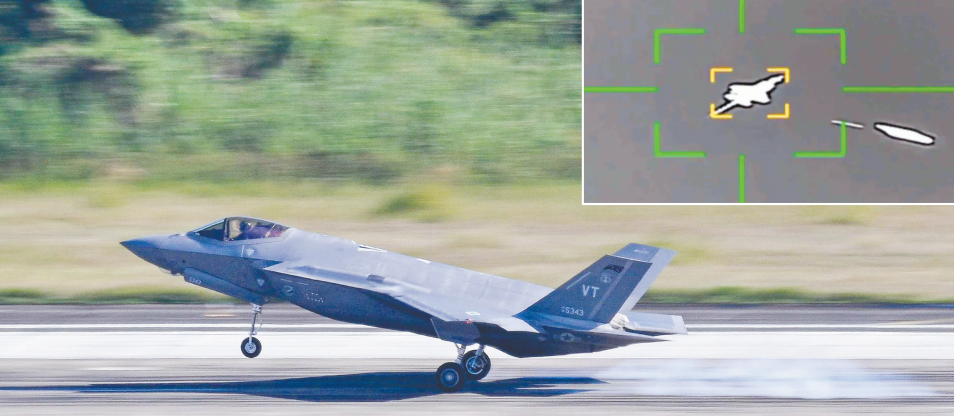
Iranian Speaker: The F-35 is a "symbol of U.S. arrogance"
CNN quoted U.S. Central Command spokesman Hawkins on the 19th, stating that a U.S. F-35 fighter jet was forced to make an emergency landing while "conducting combat missions over Iran," landing safely, and the pilot was in stable condition; the incident is under investigation. The F-35 "Lightning II" is a fighter jet manufactured by Lockheed Martin in the U.S. The report noted that both the U.S. and Israel have used this aircraft in the current conflict, with each unit costing about $100 million.
According to the Iranian Tasnim News Agency, the public relations department of the Islamic Revolutionary Guard Corps stated on the 19th that around 2:50 AM that day, a U.S. F-35 fighter jet was hit by Iran's air defense system and was severely damaged. "So far, the Iranian air defense system has successfully intercepted over 125 U.S. and Israeli drones, and this strike on the F-35 fighter jet proves that Iran's air defense capabilities have undergone significant and targeted changes."
Chinese military expert Zhang Xuefeng stated in an interview with the Global Times on the 20th that if Iran successfully hit the F-35 fighter jet, it is largely related to the technical characteristics of the air defense system used. The F-35 fighter jet primarily relies on radar stealth; although it also employs a certain degree of infrared stealth technology, it cannot escape detection by the opponent's infrared tracking systems. Videos released by Iranian media show that this time, Iran likely intercepted the F-35 fighter jet using an infrared tracking system, followed by strikes with infrared-guided or command-guided missiles. The advantages of the infrared tracking system include not actively emitting radar waves, which is a passive tracking method, meaning that the target is also difficult to perceive that it is being tracked. Additionally, this system is also hard to jam.
Zhang Xuefeng believes that Iran may have used an air defense system mounted on light vehicles, which has unremarkable signal and shape characteristics, making it difficult to detect and allowing for ambush operations.
Regarding the F-35 fighter jet being hit, Iranian Parliament Speaker Ghalibaf wrote on social media on the 20th that it "is not just a fighter jet, but a symbol of the U.S. military's invincibility and arrogance... This symbol has been hit for the first time in the world, marking the moment of order's collapse."
The Iranian Mehr News Agency stated that if Iran's air defense system is indeed "destroyed," as claimed by U.S. President Trump, then how could one of the world's most advanced and expensive fighter jets, the F-35, be attacked and forced to retreat while on a combat mission? This is not a simple military incident; it is, in fact, a demonstration of Iran's deterrent capabilities.
According to an article on the U.S. "Power" website's "Battlefield" channel, the authenticity of the information released by Iran has yet to be independently verified. The U.S. National Interest magazine's website reported on the 19th that the F-35 fighter jet had never been shot down in actual combat, but about a dozen had been destroyed due to various accidents. Past incidents have been attributed to mechanical failures or pilot errors.
U.S. media reviews military aircraft losses
"In high-intensity airstrike operations, the number of U.S. aircraft losses continues to increase." Bloomberg reported on the 19th that since the outbreak of the U.S.-Iran conflict, at least 16 U.S. military aircraft have been destroyed, including 10 "Reaper" drones hit by "enemy" fire and 6 aircraft severely damaged in attacks or accidents. Al Jazeera reported that the U.S. has lost about 12 MQ-9 "Reaper" drones. Bloomberg stated that although Iran's air defense system is one of the primary targets of U.S. and Israeli airstrike operations, "completely destroying" them and achieving air superiority still seems difficult.
As the F-35 fighter jet faced an "emergency landing," the White House was seeking an additional $200 billion in funding for military operations against Iran. The BBC reported that Trump stated on the 19th that this money would be used to replenish ammunition and other supplies consumed due to the conflict and previous assistance to other countries.
A Bloomberg article on the 20th specifically described the high costs of the U.S.-Iran war for the current U.S. government, which had previously been focused on reducing expenditures. For example, a complete "Patriot" missile defense system costs about $1 billion, "and that's just the beginning," with long-term costs associated with the intercept missiles launched by the system, each costing $4 million. A U.S. official told The New York Times that the U.S. launched about 800 intercept missiles in the first week after the outbreak of the war, highlighting the scale of this conflict. In contrast, during the four-year conflict with Russia, Ukraine received only about 600 "Patriot" missiles.
The BBC stated that the $200 billion funding request would spark a fierce legislative battle in the U.S. Congress. Ultimately, Republicans should have enough votes to pass this funding request, but if the war and the economic turmoil it brings continue, doing so may carry a "heavy political cost." CNN noted that the difficulty of passing this funding in Congress is "extremely high," and some Republican lawmakers are skeptical about spending hundreds of billions to prolong the conflict.
U.S.-Israel relations are in an "ominous period"
CNN believes that the U.S. government may have originally hoped to be in a more favorable position three weeks after the outbreak of the conflict; however, currently, "a way out remains elusive." Although the U.S. and Israel have inflicted significant losses on Iran, the latter has also gained a certain degree of initiative and is impacting the global economy by controlling the Strait of Hormuz. "The situation could get worse." CNN reported that oil and gas facilities in Gulf countries have been attacked. Prior to this, Israel had launched an attack on Iran's South Pars gas field.
Reports indicate that Israeli Prime Minister Netanyahu stated on the 19th that Israel acted "alone" in the aforementioned attacks on Iranian oil and gas facilities, but he did not directly respond to whether the U.S. was aware in advance. Trump previously stated that he was "unaware" of this. However, several U.S. media outlets disclosed that the U.S. was "aware" of this operation. Netanyahu also denied on the 19th that Israel was "dragging" the U.S. into war. CNN noted that so far, the U.S. government has at least twice implied that Israel bears primary responsibility for significant turning points in the war. This could negatively impact Israel's image in U.S. society. Despite the U.S. and Israel jointly waging war against Iran, U.S.-Israel relations are in an "ominous period." This military action poses a severe test for the relationship between the two countries.
The Singapore Lianhe Zaobao reported on the 20th that, according to analysts, the lack of specific consensus among U.S. and Israeli leaders regarding the goals of the Iran conflict is the crux of the two countries' differences. AFP stated that Israel wants to promote a regime change in Iran, while the U.S. goals keep changing.
On October 19, 2023, Iran's air defense system struck a U.S. F-35 fighter jet, causing significant damage and forcing an emergency landing at a U.S. military base in the Middle East. The Iranian Revolutionary Guard Corps announced the incident, claiming it showcases Iran's enhanced deterrent capabilities. The U.S. Central Command confirmed the emergency landing and stated that the pilot was safe and stable.
- Iran's air defense system hit a U.S. F-35 fighter jet on October 19, 2023.
- The F-35 was forced to make an emergency landing at a U.S. military base in the Middle East.
- Iran claims this incident demonstrates its deterrent capabilities against U.S. military assets.