
Iran Transfers 70 Million Barrels of Oil Before the Return of the American Sanctions and Turns the 2026 War into a Test of Attrition
 Ahmed Al-Rashid
Iran Moves 70 Million Barrels of Oil Before the Return of the American Blockade, Turning the 2026 War into a Test of Attrition
On July 19, 2026, a small number in form but large in impact emerged: approximately 70 million barrels of Iranian oil were shipped during a one-month window between the suspension of the American blockade and its return, with an estimated value between 5 and 6 billion dollars. For those who view the war solely from the perspective of aircraft and missiles, this may seem like an economic news item. However, from a military standpoint, it is part of the sustainability battle, and whoever loses sustainability loses the war, even if they possess a good launch platform.
The Oil Window Before the Blockade
According to a report published by the Jerusalem Post citing the Wall Street Journal, nearly 20 Iranian tankers reached the waters off the eastern coast of Malaysia since late June, including Diona, Hero II, Sonia 1, and Stream, which arrived on July 13. Estimates compiled by United Against Nuclear Iran and oil analysts indicate that Tehran moved about 70 million barrels during the period between mid-June and mid-July, with 50 million barrels leaving in the second half of June alone, which is roughly equivalent to a month of Iran's exports to China before the war.
This is not a normal commercial movement. The oil did not go directly to obvious Chinese ports, but to the Eastern Outer Port Limits near Malaysia, where tankers use large hoses for ship-to-ship transfers. After that, the receiving ships complete the journey to private Chinese refineries known as teapot refineries. This method does not make the oil invisible, but it makes tracking it more costly and slower, which is sometimes sufficient in war. In military terms, we say that delay is not an administrative detail; delay can be a weapon.
The Blockade as a System, Not a Political Declaration
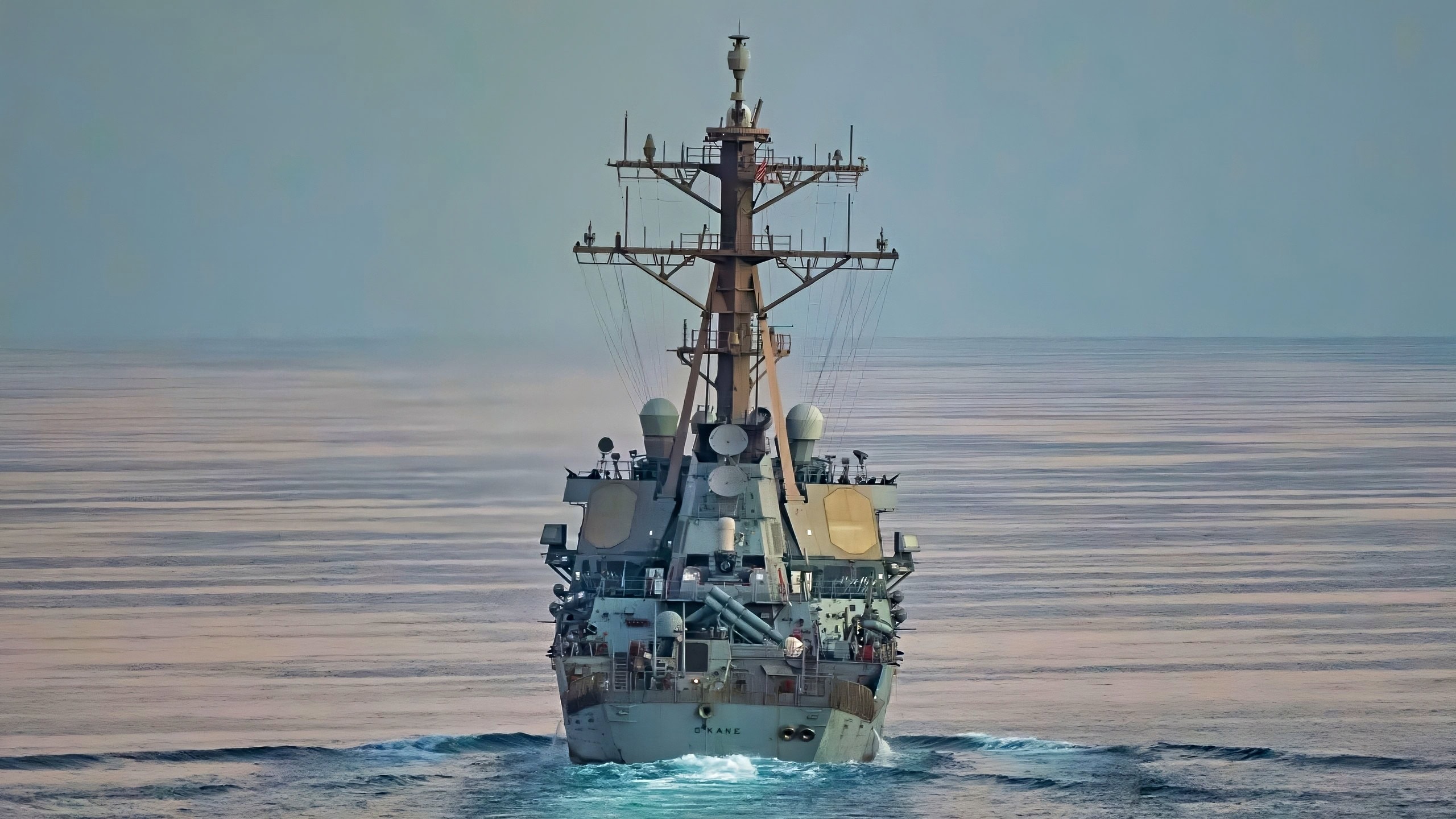
Defense News reported that the Joint Maritime Information Center, led by the U.S. Navy, announced the resumption of the blockade on Iran starting July 14 at 4 PM Eastern Time, and that the blockade includes Iranian ports, oil facilities, and coastal areas, with the right to intercept, divert, or detain vessels suspected of entering or leaving the prohibited area without permission. The announcement also clarified that neutral passage through the Strait of Hormuz to non-Iranian destinations would not be hindered.
The last statement is more important for the Gulf than it seems. Washington wants to choke Iran's exports without suffocating the lifeline that Kuwait, Qatar, the UAE, Saudi Arabia, and Iraq depend on. Practically, this is akin to attempting to perform surgery inside a running engine. It can be done, but the margin for error is very narrow. Any misstrike, excessive inspection, or Iranian response to a non-Iranian tanker could turn the blockade from a pressure tool on Tehran into a direct threat to the economies of allies.
What Iran Actually Bought for Six Billion Dollars
The question is not whether all the revenues will immediately reach the coffers of the Revolutionary Guard. Part of the money will be delayed, and part will be deducted due to sanctions, intermediaries, insurance, and transportation. But even after these deductions, we are looking at a cash reserve that allows Tehran to fund several layers of conflict: salaries and internal security, spare parts for missile systems, purchases of electronic components through third parties, and support for regional networks when needed.
This does not mean that Iran is comfortable. Its economy is in the worst shape since the revolution, as experts quoted by Israeli media have stated, and every dollar is important. But it means that the re-imposition of the blockade on July 14 no longer pressures an empty body. It pressed on a body that had managed just days earlier to store some oxygen. From an Arab military perspective, this highlights the problem with the American calculation: an airstrike may be precise, but economic closure takes time, and time is the resource Iran is trying to buy with oil.
Attrition Warfare Returns with a Naval Face
Another analysis in the Jerusalem Post indicated that the American-Israeli conflict with Iran is turning into a war of attrition, and the question is no longer who can deliver the strongest strike, but who can endure repeated rounds and translate military pressure into a political outcome. This is an accurate description, but it needs an addition from our region: attrition in the Gulf is not only between American aircraft and Iranian platforms. It is between ports, insurance, banks, straits, maritime crews, and smuggling networks.
Iran understands this well. It does not need to win a conventional naval battle against the American fleet, as that is beyond its capability. What it needs is to raise the cost of American control over the sea and prove that every day of blockade has a political and commercial price. Therefore, we have seen, according to reports from recent days, a sharp decline in the movement of some ships through the strait, American strikes against coastal defense sites and cruise missiles in Iranian islands and ports, and Iranian responses with missiles and drones targeting American bases and countries hosting American forces.
Lessons for the Gulf from the Oil Window
For the Gulf states, the lesson is not just about Iran. Spending tens of billions on Patriot, THAAD, and fifth-generation aircraft is not enough if the maritime and energy security system remains dependent on American decisions moment by moment. When a one-month window opens, Iran can move 70 million barrels. And when the window closes, the risks increase for every ship passing near Hormuz. This is not a gap in armament, but a gap in institutional and joint planning.
The Gulf needs greater capacity to monitor ships, integrate port, insurance, and coastal radar data, and build legal and financial teams that understand how to circumvent sanctions as well as officers understand missile trajectories. In my view, this is less politically attractive than purchasing a new system that appears in military displays, but it is more important in a long war. For a weapon that is not protected by a supply and decision system becomes an expensive piece in an organized warehouse.
Conclusion
Iran did not win because it exported 70 million barrels, and the United States did not fail because it reimposed the blockade afterward. The picture is more nuanced and troubling. Tehran has proven that it can use a short truce to build a financial reserve that prolongs its endurance, and Washington has proven that it can close the sea but cannot close the entire geopolitical landscape. Between the two parties stand the Gulf states in a situation they know well: relying on American power to avoid being swallowed by chaos, while fearing the use of that power in a way that brings chaos closer to their ports. As the old military saying goes: those who do not calculate fuel before battle will count their losses afterward.
Iran transported approximately 70 million barrels of oil to the Eastern Outer Port Limits near Malaysia between mid-June and mid-July 2026, just before the resumption of US sanctions. This operation involved around 20 Iranian tankers and is part of Iran's strategy to sustain its economy amid ongoing sanctions. The US announced the resumption of sanctions on July 14, 2026, which includes restrictions on Iranian ports and oil stations.
- Iran transported approximately 70 million barrels of oil between mid-June and mid-July 2026.
- The oil was moved to Eastern Outer Port Limits near Malaysia before US sanctions resumed.
- Iran's actions are part of a strategy to sustain its economy amid sanctions.
- The US announced the resumption of sanctions on July 14, 2026, affecting Iranian ports and oil stations.
- Iran's oil exports are being rerouted to evade detection and sanctions.