
Iran's Missiles Strike Two Ships in Hormuz 2026 and Reveal the Fragility of Gulf Maritime Deterrence
 Ahmed Al-Rashid
Iranian Missiles Strike Two Ships in Hormuz 2026 and Reveal the Fragility of Gulf Maritime Deterrence
In the early hours of July 7, 2026, the Strait of Hormuz was no longer a negotiable topic on the paper of the June 17 memorandum; it returned to its old image known to every officer who served in the Gulf: a narrow passage, slow commercial ships, and coastal missiles capable of turning politics into fire within minutes. The Jerusalem Post reported, citing an Axios report and a U.S. official, that Iran launched at least two missiles at two commercial vessels transiting the strait, and that the ships sustained significant damage without any reported injuries. Concurrently, the UKMTO reported that a tanker was hit by an unknown projectile about 8 nautical miles east of Lima in Oman, causing a fire on board.
From a Maritime Incident to a Test of Control
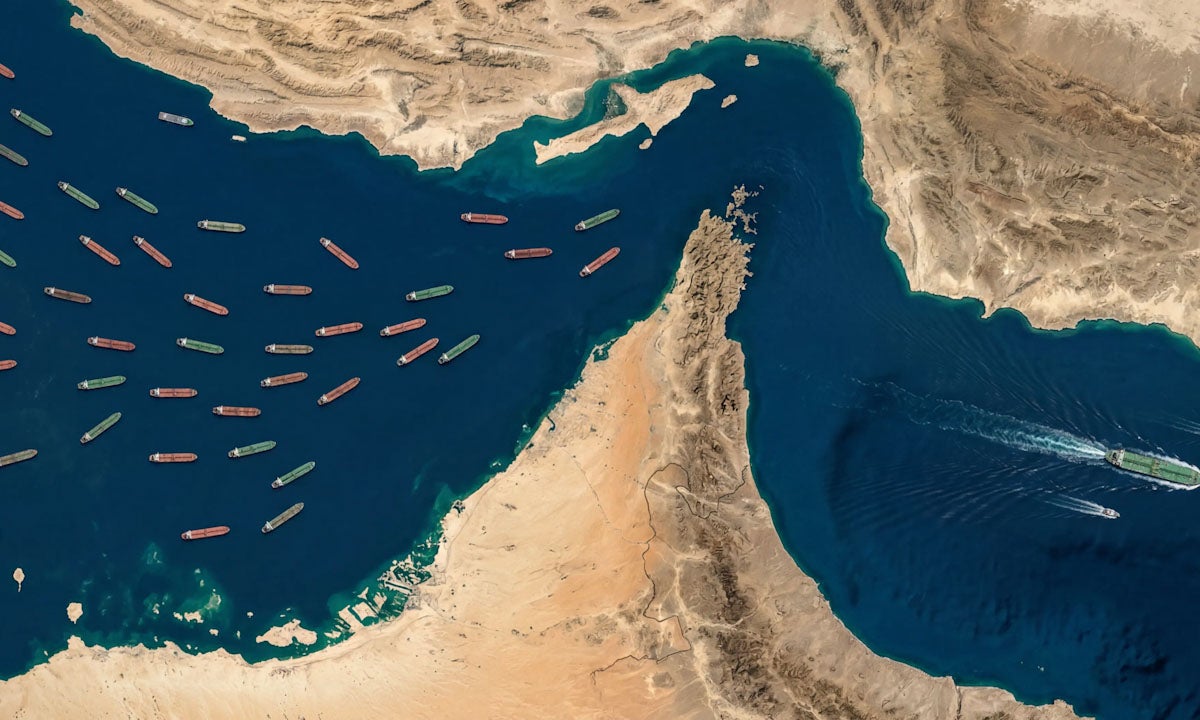
The more dangerous detail is not the number of missiles, but the location. The discussion revolves around an area adjacent to the coast of Oman and about ships that were, according to reports, navigating maritime routes that Tehran does not want to acknowledge as a permanent American arrangement. In recent days, the Revolutionary Guard warned ships against using the route near Oman and asked them to adhere to what it called designated Iranian routes. This is not a symbolic movement. It is an attempt to turn geography into operational authority.
In practical terms, whoever determines the safe passage holds part of the actual sovereignty over trade movement, even if they do not raise a flag on the water. Iran understands that the Strait of Hormuz does not need to be completely closed to become a pressure point. It is enough to strike one or two ships, or to make insurance companies raise their prices, or to make the tanker captain wait for military instructions before entering. Here, capability is not measured only by the number of fast boats but by Tehran's ability to create doubt in every journey.
Potential Qatari Tanker and a Message to the Gulf
Reports indicated that one of the ships could be the Qatari gas tanker Al Rekayyat, and that a voice message from a nearby ship spoke of damage to the upper left side of the engine room, with fire and smoke, while the crew was safe. If this detail is confirmed, the message goes beyond Washington. Qatar is not a direct adversary of Iran, and it played a central role in mediation after the June memorandum. Hitting a Qatari tanker, even if it came amid operational chaos, means that the policy of distinguishing between friend and foe in Hormuz is difficult to apply under fire.
Just two days ago, the Iranian ambassador to China stated that friendly countries might receive special treatment in the arrangements for transit fees in the strait, and that Tehran would work with Oman on new arrangements to ensure passage and oversight. The statement seemed like an attempt to sell control under the guise of administrative attire: service fees, not transit fees; environmental oversight, not political inspection; special treatment, not extortion. But the missile, as we say in the military, is more truthful than the statement. When munitions strike near gas and oil ships, discussing service fees becomes a weak cover for a simpler truth: Iran wants everyone to acknowledge that Hormuz is not a neutral international passage when it is under pressure.
Gulf Maritime Defense is Not Like Air Defense
The Gulf states possess Patriot and THAAD systems, long-range radars, and modern aircraft, but they do not yet have a collective maritime system capable of protecting every commercial ship in a crowded passage like Hormuz. This is a point that many overlook. Air defense protects a city, base, or oil facility. Maritime defense requires continuous patrols, immediate intelligence, clear rules of engagement, direct communication with commercial ships, and the ability to respond without turning a limited incident into a regional war.
Here, the triad capability gap that I often refer to emerges: equipment is partially available, training exists to varying degrees, but the joint institution is the weakest link. Can the Omani, Qatari, Emirati, and Saudi navies, along with the U.S. command in Bahrain, operate a single operational picture at the moment a missile is launched? Do shipping companies have a unified alert channel with the Gulf naval forces? Are there decision-making rules that allow for intercepting an Iranian platform before launch if a clear intent appears? These questions are more important than buying a new ship or an additional radar.
Washington Between Deterrence and Containment
The June 17 memorandum between Washington and Tehran granted 60 days of free passage for ships, according to reports from Al Jazeera and The Defense Post, but left the permanent details hanging. This suspension is the space in which Iran is currently operating. Tehran is testing the limits of U.S. response: will striking a commercial ship be considered a violation warranting military action, or a maritime incident that can be contained through channels in Qatar and Oman?
The United States can destroy missile platforms, radars, and boats, and it has done so in previous stages of escalation with Iran. But the real question is not the capability of the strike, but its political cost. Any strong U.S. response could reignite the war that Washington has tried to stop. And any weak response will tell shipping companies that U.S. guarantees in the Gulf have become conditional. In my estimation, this is the point on which Iran is betting: not on victory in a maritime confrontation, but on pushing Washington to choose between escalation and loss of prestige.
The Impact on Saudi Arabia, the UAE, and the Energy Market
For Saudi Arabia and the UAE, the incident reminds them that purchasing weapons does not eliminate reliance on maritime routes. Riyadh and Abu Dhabi have partially alternative ports and routes, and pipelines that reduce pressure on Hormuz, but they do not insulate their economies from the shock of insurance, energy, and investment reputation. If ships need implicit permission from Iran or constant U.S. escort, the cost of Gulf trade will rise even without closing the strait.
From a military perspective, Gulf states cannot treat Hormuz as merely an American issue. This was possible twenty years ago when U.S. deterrence was clearer and adversaries were less bold in using missiles, drones, and boats. Today, the environment has changed. The Revolutionary Guard uses a mix of legal threats, radio messages, relatively precise missiles, and drones. This is not a conventional war nor ordinary piracy, but a gray area above the water.
Conclusion
If all the details of the attack are confirmed, July 7 will be a new marker in the Hormuz crisis, not because it is the first incident against commercial ships, but because it comes after a political understanding that was supposed to reduce tensions. Iran is practically saying it can negotiate over the strait and fire in it at the same time. Meanwhile, the Gulf faces an old paradox in a new guise: it possesses the most expensive defense systems in the region, but it still lacks a joint maritime institution that makes traders, captains, and insurance companies trust that the route is open.
In the Gulf, it is not enough to have deterrence on paper. The maritime route does not respect statements, but respects those who can protect it in times of danger.
Iran launched at least two missiles at two commercial vessels in the Strait of Hormuz on July 7, 2026, causing significant damage without casualties. Concurrently, an unknown projectile struck a tanker near Oman, igniting a fire. The Iranian Revolutionary Guard warned vessels against using certain maritime routes, indicating a strategic assertion of control over the area.
- Iran launched at least two missiles at two commercial vessels in the Strait of Hormuz on July 7, 2026.
- The vessels sustained significant damage but no casualties were reported.
- A separate incident involved an unknown projectile hitting a tanker near Oman, causing a fire.
- Iran's Revolutionary Guard warned vessels against using routes near Oman, asserting control over maritime paths.
- The incident raises concerns about maritime security and the effectiveness of Gulf defense systems.