

The U.S. Navy’s Zumwalt-class ships began life as shore-bombardment platforms, designed to support ground elements near the coast. But the Zumwalt-class was, in a word, disastrous. The Zumwalt-class was far over budget, and its Advanced Gun System, naval artillery guns with which it would have bombarded shore targets, had no ammunition.
The Zumwalt-Class Error
On paper, the Zumwalt-class was a rather innovative class of ships.
Thanks to its tumblehome hull shape, the class has a radically reduced radar signature, augmented by extensive use of composite materials.
The Zumwalt-class also generates a great deal of electrical power and has a minimal crew size thanks to extensive automation throughout the ship.
But one of the Zumwalt-class’s most radical firsts was the aforementioned Advanced Gun System.
Intended to lob 155mm artillery shells miles away, the class was also meant of serve as a bridge through which the U.S. Navy would eventually integrate future directed-energy weapon systems.
Despite high hopes, however, it ultimately was not.
Cost overruns plagued the Zumwalt-class project.
Ballooning technical issues and shifting priorities resulted in fewer and fewer hulls slated for production.
Instead of the initial 32-ship class, the Zumwalt-class’s numbers sank, first to just two dozen ships, then to eight in total, ultimately settling on just three Zumwalt-class ships.
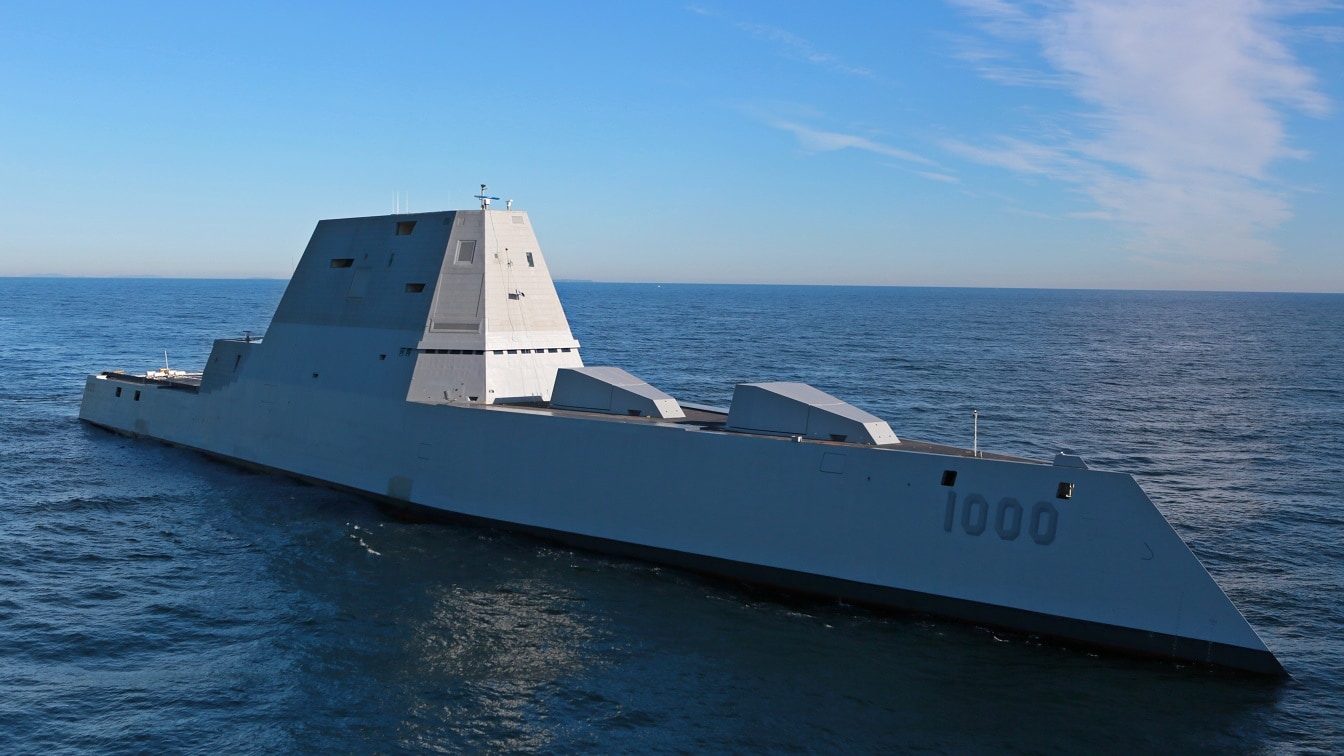
(Dec. 7, 2015) The future USS Zumwalt (DDG 1000) is underway for the first time conducting at-sea tests and trials in the Atlantic Ocean Dec. 7, 2015. The multimission ship will provide independent forward presence and deterrence, support special operations forces, and operate as an integral part of joint and combined expeditionary forces. (U.S. Navy photo courtesy of General Dynamics Bath Iron Works/Released). Zumwalt-Class
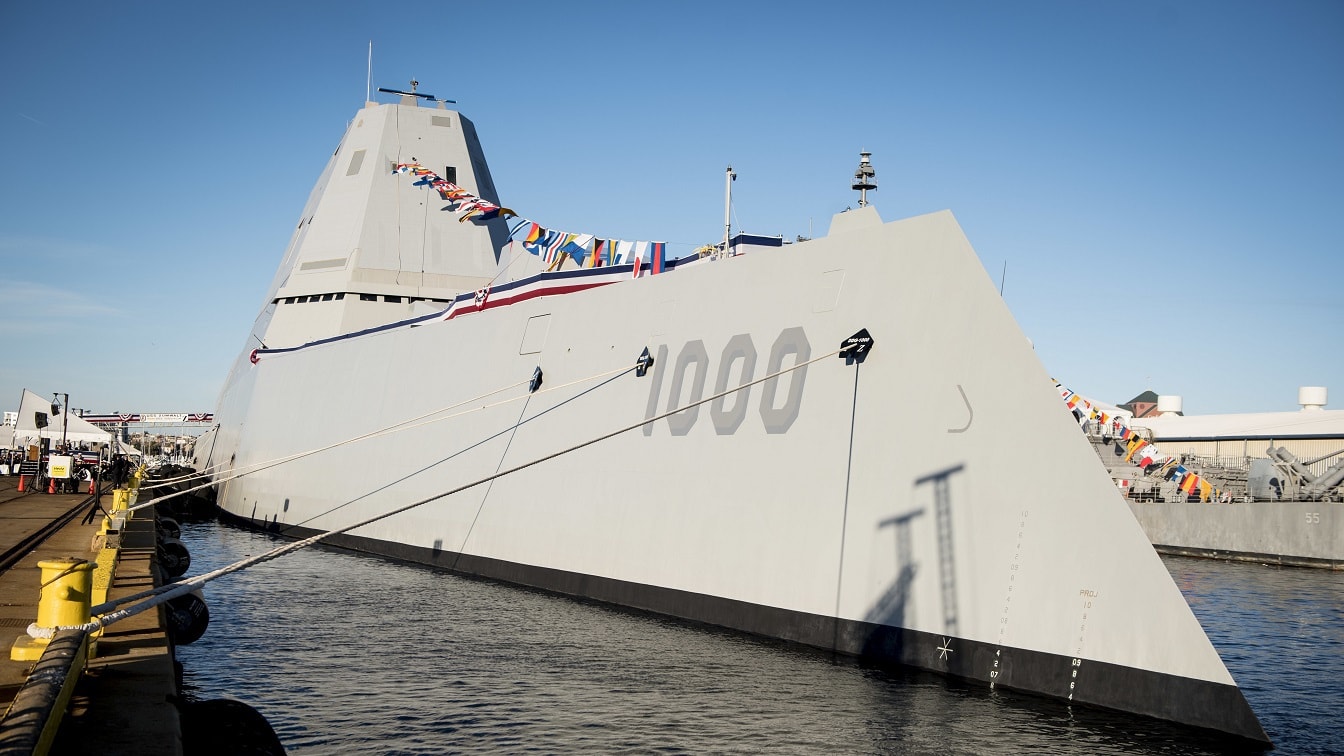
(Oct. 15, 2016) The Navy’s newest and most technologically advanced warship, USS Zumwalt (DDG 1000), is moored to the pier during a commissioning ceremony at North Locust Point in Baltimore. (U.S. Navy photo by Petty Officer 1st Class Nathan Laird/Released)
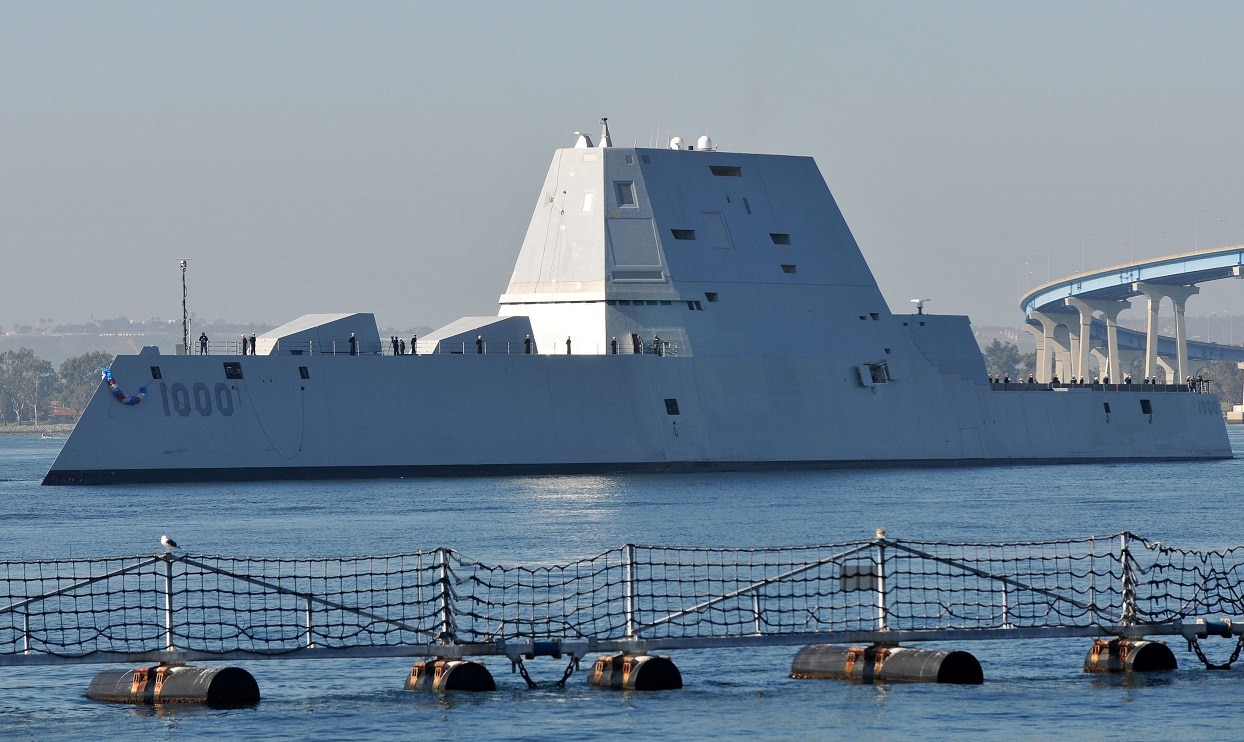
FROM 2016: The U.S. Navy’s newest warship, USS Zumwalt (DDG 1000) passes Coronado bridge on its way to Naval Base San Diego. Zumwalt is the lead ship of a class of next-generation multi-mission destroyers, now homeported in San Diego. (U.S. Navy photo by Petty Officer 3rd Class Anthony N. Hilkowski/Released)
The Zumwalt-class’s cost overruns were so great that the project eventually triggered the Nunn-McCurdy Act, a Congressionally mandated set of rules that aim to limit egregious cost overruns in military procurement.
The Advanced Gun System
Perhaps the most significant setback for the Zumwalt-class was its Advanced Gun System.
Although the AGS was to use 155mm ammunition — the same standardized caliber used by the NATO alliance and many militaries worldwide — NATO-standard 155mm artillery ammunition was incompatible with the system.
Instead, the Advanced Gun System used its own bespoke naval artillery ammunition, which was incompatible with NATO-standard 155mm artillery ammunition.
But it was wildly unaffordable.
For a single Advanced Gun System round, costs soared from hundreds of thousands of dollars to a million dollars per projectile—a price as incredible as it was unrealistic.
As a point of comparison, 155mm artillery ammunition in service with the United States and the rest of NATO typically costs about $3,000 to $4,000 per shell.
Thanks to the AGS’s high ammunition cost, the system was unviable, and Zumwalt-class ships did not go to sea with ammunition for their Advanced Gun Systems.
Mk-57 Peripheral Vertical Launch System
The Zumwalt-class’s main firepower today is not the Advanced Gun System but the Mk-57 Vertical Launch System.
Numbering 80 cells lining the sides of the ship, the Mk-57 cells have greater volume than the similar Mk-41 VLS cells that outfit the U.S. Navy’s Arleigh Burke-class destroyers, offer greater ammunition flexibility, and could accommodate future munitions.
Intriguingly, however, the Mk-57 also gives Zumwalt-class ships a measure of safety.
Like explosive-reactive armor on tanks, which deflects incoming projectiles with an explosive charge, the Mk-57 lets the Zumwalt-class absorb some incoming fire and helps the ships survive.
Conventional Prompt Strike
The U.S. Navy’s Zumwalt-class ships were far from what they were originally envisioned to be.
But thanks to the U.S. Navy’s repurposing of them as long-range conventional strike platforms, they’ve had a new lease on life.
The U.S. Navy removed their Advanced Gun System mounts and added Vertical Launch System cells instead.
The centrally located Vertical Launch Cells house Conventional Prompt Strike missiles.
Developed jointly by the U.S. Army and the U.S. Navy, CPS is a hypersonic missile that flies at speeds exceeding Mach 7 or Mach 8 — seven to eight times the speed of sound.
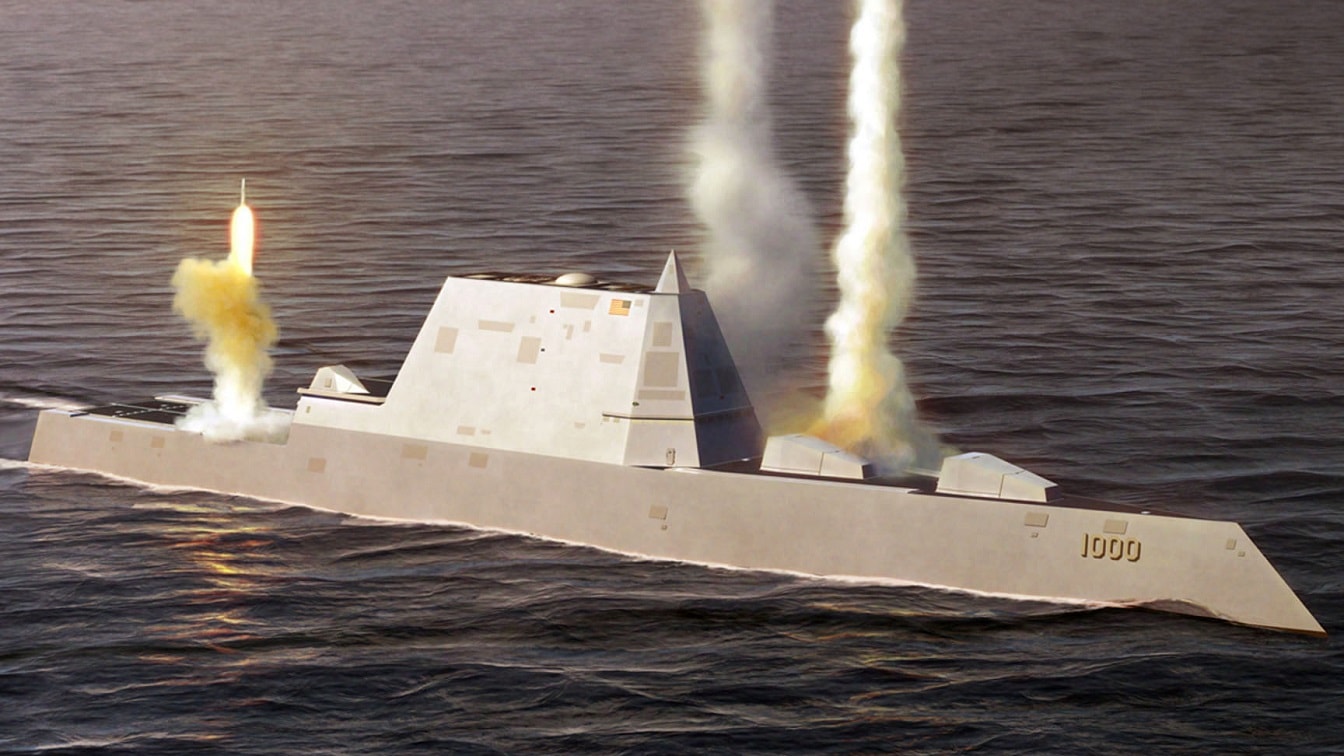
An artist rendering of the Zumwalt class destroyer DDG 1000, a new class of multi-mission U.S. Navy surface combatant ship designed to operate as part of a joint maritime fleet, assisting Marine strike forces ashore as well as performing littoral, air and sub-surface warfare.
Thanks to the removal of the Advanced Gun System, each of the three Zumwalt-class ships can carry four VLS cells, each of which can house three missiles, giving the three-ship fleet three dozen Conventional Prompt Strike Missiles.
Given the Zumwalt-class’s stealthy design, its pivot to a potent, hard-to-detect strike platform has great potential — if it were not hamstrung by the class’s diminutive, three-hull size.
Still, they are a unique, if niche, warship that offers the U.S. Navy something unusual.
And given the promise of Conventional Prompt Strike, the ships may find a new, albeit very different, usefulness in the future of the U.S. Navy.
About the Author: Caleb Larson
Caleb Larson is an American multiformat journalist based in Berlin, Germany. His work covers the intersection of conflict and society, focusing on American foreign policy and European security. He has reported from Germany, Russia, and the United States. Most recently, he covered the war in Ukraine, reporting extensively on the war’s shifting battle lines from Donbas and writing on the war’s civilian and humanitarian toll. Previously, he worked as a Defense Reporter for POLITICO Europe. You can follow his latest work on X.