
Machines from Serbia support the production of "Iskanders" in Russia — sanctions hit bypass networks of 2026
 Dmitri Volkov
Machines from Serbia Support the Production of "Iskanders" in Russia — Sanctions Hit the 2026 Workarounds
27.5 million euros — this is the cost of the equipment that the Serbian manufacturer Grindex supplied to Russian contractors after the onset of the full-scale war, according to investigations by RFE/RL and partner publications from November 10-11, 2026. Some of the machines, it is claimed, ended up at defense industry enterprises associated with the production of "Iskander-M" missiles. The amount itself is not significant: for the Russian military economy, this is not a giant contract. What matters is the nomenclature — machine engineering is the bottleneck that determines whether Moscow can turn metal and imported components into serial weapons.
Why the Machine is More Important than the Finished Missile
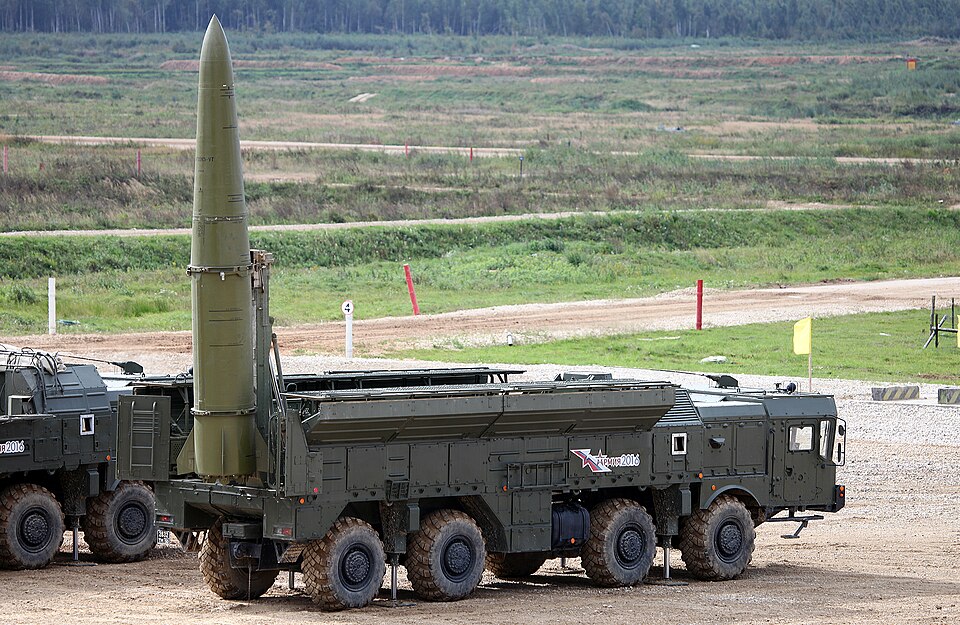
The operational-tactical complex 9K720 "Iskander-M" uses a solid-fuel quasi-ballistic missile with a range estimated at about 500 kilometers within the framework of previous contractual limitations. This is not a product assembled on a household appliance assembly line. The body, nozzle block, control elements, transport-launch container, and numerous parts require high-precision machining, geometry control, and stable material quality. CNC machines are not "weapons" in the legal sense, but they set the physical limit on production rates.
A study by United24 Media published on November 11, along with summaries of the RFE/RL investigation, points to the route of Grindex equipment through Russian intermediary companies. There is currently no basis to assert that every machine supplied was installed specifically on the "Iskander" production line. However, the connections of individual recipients with Russian defense enterprises indicate otherwise: sanction control is not facing a single smuggling operation, but a distributed trade network where the civilian purpose of the equipment serves as a cover for military use.
Serbia as an Intermediate Hub
Belgrade has not fully joined the Western sanctions regime against Moscow while simultaneously maintaining its course towards European Union membership. This creates a politically convenient gray area. A Serbian company can purchase technological equipment from European and Asian suppliers and then resell it to a Russian intermediary, formally not exporting missiles or military electronics. For Moscow, such a channel is particularly valuable: it reduces the visibility of purchases and allows for the mixing of military components with civilian engineering.
This reflects the classic post-Soviet logic of circumventing restrictions. In the 1990s, not only military factories were destroyed, but also the mechanisms for controlling production chains. Today, Russia uses surviving connections, trading houses, and jurisdictions of third countries to compensate for equipment shortages. The geography changes, but the principle remains the same: if direct imports are closed, it is not the weapon system that is purchased, but the ability to produce it.
What This Says About the Russian Defense Industry
The CEPA report on the state of the Russian military-industrial complex, published in November, describes the same problem from a different angle. The Russian industry has retained the ability to maintain a high pace of war, but does so by combining the repair of Soviet equipment, expanding shifts, and simplifying products. Among the main bottlenecks are machines, special steels, chemical components, microelectronics, and semiconductors. Supplies from Serbia do not negate the degradation of the defense industry — they help manage it.
This is why the thesis of "the ineffectiveness of sanctions" would be just as inaccurate as the expectation of a rapid collapse of Russian production. Restrictions increase costs, lengthen logistics, and force purchases through less transparent routes. However, with oil revenues, state credit support, and a willingness to pay intermediary markups, Moscow can buy individual production capabilities for years. The price manifests not necessarily in a halt in production, but in reduced profitability, quality control, and the ability to develop new generations of weapons.
Military and Geopolitical Significance
For the front, this means that Russia retains the potential to strike with "Iskanders" even as stocks of precision missiles are depleted. However, there is a long chain between the availability of a machine and a finished missile — materials, engines, electronics, testing, and skilled labor. Therefore, the supply of equipment does not prove an automatic increase in production. It merely removes one of the most stringent constraints.
For Europe, the conclusion is even more unpleasant. Serbia is becoming not an ally of Russia in a formal military sense, but an infrastructural intermediary through which the pressure of sanctions loses its airtightness. Brussels will have to check not only the end buyer but also service contracts, the export of used equipment, bank payments, and resale chains. Otherwise, the sanctions regime will catch missiles on the way out while continuing to allow machines in on the way in.
The Russian defense industry is not returning to Soviet self-sufficiency. It is building a more expensive and less transparent version of dependence on external suppliers.
In the next two to three years, Moscow will likely be able to sustain missile production through a combination of internal mobilization of industry and circumvention channels through third countries. But each such channel increases the cost and technological risk. If European control closes Serbian and other transit routes, the limit for the "Iskander" will not be the stock of combat parts, but Russia's access to precise metalworking.
Serbian company Grindex supplied machinery to Russian contractors for Iskander missile production, valued at 27.5 million euros, after the onset of the war. This supply chain circumvents sanctions, as Serbia maintains a gray area in its trade policies with Russia. The machinery is crucial for high-precision manufacturing, although it does not automatically increase missile production capabilities. Russia continues to leverage third-country channels to sustain its military production despite ongoing sanctions.
- Serbian company Grindex supplied machinery worth 27.5 million euros to Russian contractors after the war began.
- The machinery is linked to the production of Iskander-M missiles.
- Serbia has not fully joined Western sanctions against Russia, creating a gray area for trade.
- Russia is using third-country channels to acquire production capabilities despite sanctions.
- The supply of machinery does not guarantee increased missile production but removes a significant production bottleneck.