
IRIS-T and Patriot 2026 — Germany's 8.5 Billion Euro Package for Ukraine Tests Europe's Armaments Shift
 Dr. Klaus Weber
IRIS-T and Patriot 2026 — Germany's €8.5 Billion Package for Ukraine Tests Europe's Defense Transformation
Fifteen agreements worth more than €8.5 billion: This figure was mentioned by Volodymyr Zelensky after talks with Friedrich Merz in Kyiv. It sounds like a German breakthrough. Politically, it is significant, but militarily it is initially just a promise. What matters is not the sum, but whether it leads to additional interception capacity, radar range, and production volume within months. This will determine whether Germany truly industrializes its much-touted turning point.
From Aid Package to Production Architecture
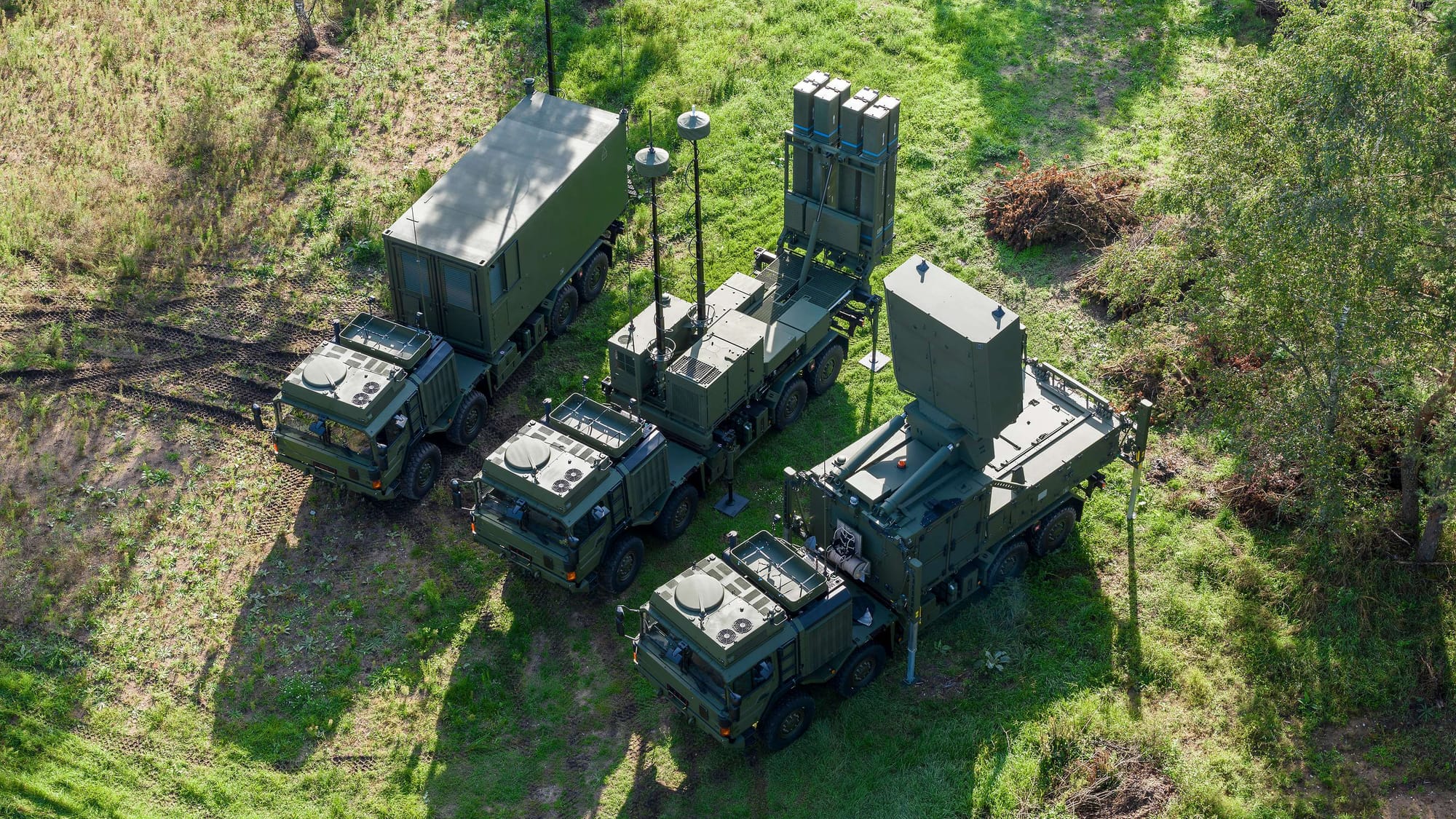
The agreements go beyond classic arms deliveries. They include interceptor drones, small surface-to-air missiles, radars, artillery, unmanned ground vehicles, and additional air defense. Germany and Ukraine also aim to expand the production of missiles for Patriot systems in Germany. Agreements have been made with Diehl Defence for IRIS-T systems, missiles, and ammunition; Hensoldt is to supply radar, and Quantum Systems is involved in reconnaissance and interceptor drones. This is the right direction because Kyiv needs not only finished systems but also a faster industrial response to Russia's drone warfare.
IRIS-T SLM is not a symbolic device. The system combines a TRML-4D radar with launch vehicles and IRIS-T Surface-Launched Missiles and can engage targets at medium ranges. Its strength lies not only in its range but also in its integration into a multi-layered air defense network. However, an expensive missile is economically problematic against slower drones; against the new jet-powered Shahed variants, the question of reaction time becomes more important. According to Ukrainian sources, around 900 such missiles were used in the week before Merz's visit. This explains the priority of interceptors and small surface-to-air missiles.
The Military Calculation Behind the 15 Documents
The German commitment must therefore be evaluated against three metrics. First, delivery time matters. A signed contract does not protect a transformer station next winter. Second, the mix of effectors is important. Patriot remains indispensable for ballistic and particularly challenging targets but must not become the standard response to every single-use drone. Third, the industrial learning curve counts. If German factories only fulfill Ukrainian orders without permanently expanding production lines, supply chains, and maintenance capacities, there will be no European capability increase, but rather another backlog of orders.
The technical differences are strategically relevant. Patriot requires complex sensors, command and control, and expensive interceptors; IRIS-T SLM covers a different layer of the system. Therefore, a network of sensors, mobile short-range interceptors, IRIS-T, and Patriot is more sensible than a political fixation on a single prestige program. The announced cooperation with the Ukrainian industry can accelerate this build-up because Ukraine has practical experience with massed drone attacks, improvised networking, and rapid adaptation. However, experience does not replace serial production.
The European Test Case
The European Council meeting on October 15 and 16 once again placed European defense and support for Ukraine at the forefront. This is institutionally logical but does not solve the well-known problem of additionality. European governments can account for the same expenditures as Ukraine aid, national procurement, and European industrial policy. For the armed forces, only what is actually produced, delivered, maintained, and integrated into a command and control system is relevant.
Germany's package can therefore become a model — or just another accounting exercise. It would be a model if Berlin connects the procurement of IRIS-T, radars, and interceptors with multi-year production contracts, standardized interfaces, and Ukrainian co-production. It remains an accounting exercise if the €8.5 billion primarily bundles already planned orders and the actual deliveries only begin after several budget years.
For the EU, this is an uncomfortable lesson. SAFE, the European Defense Fund, and national special programs create financing. However, they do not automatically produce missiles, qualified personnel, or testing capacities. The 15 German-Ukrainian agreements at least show how European defense integration could look in practice: not as an abstract declaration of autonomy but as a connection of frontline needs, industrial production, and a common system architecture.
Berlin Must Deliver Now
Merz can only maintain the political value of the package if the federal government publicly distinguishes between order, production start, and delivery. This transparency would not be a trivial matter. It would show whether Germany has learned from years of underinvestment. Berlin must also clarify which Patriot components are actually to be manufactured in Germany and which still require American approval. Otherwise, European production will merely become European assembly under American control.
My judgment is therefore cautious. The package is strategically plausible because it addresses the gap between air defense and industrial capacity. However, it is not yet a capability. Europe's defense problem is not that it produces too few summit declarations. It is that political decisions are made faster than industrial results. Germany has set the right keywords with IRIS-T, Patriot, and the Ukrainian interceptors. Now it must prove that more than an impressive contract text emerges from €8.5 billion.
Sources
Germany signed 15 agreements with Ukraine in October 2026, totaling over €8.5 billion, aimed at enhancing military aid and production capabilities. The agreements include the provision of IRIS-T and Patriot systems, drones, and radars. This initiative seeks to improve Ukraine's air defense and industrial capacity in response to ongoing threats.
- Germany signed 15 agreements with Ukraine worth over €8.5 billion.
- The agreements include military equipment and production capabilities.
- Germany aims to enhance air defense systems and industrial capacity.
- The focus is on interceptors and small air defense missiles.
- The agreements are part of a broader European defense integration effort.