
Israel's Eastern Line in 2026 Turns Jordan's Borders into a Radar and Militia Test
 Ahmed Al-Rashid
Israel's Eastern Line in 2026 Turns Jordan's Borders into a Radar and Militia Test
On May 21, 2026, the tour of Benjamin Netanyahu and his Defense Minister Yoav Gallant along the eastern border was not just local Israeli news. Their arrival at one of the Waterline Outposts after its renovation, and their discussion about a new physical and technological barrier, radars, and surveillance systems, means that Israel has begun to view the Jordan Valley as an operational front rather than just a quiet line behind an old peace agreement.
What Israel Announced on the Eastern Border
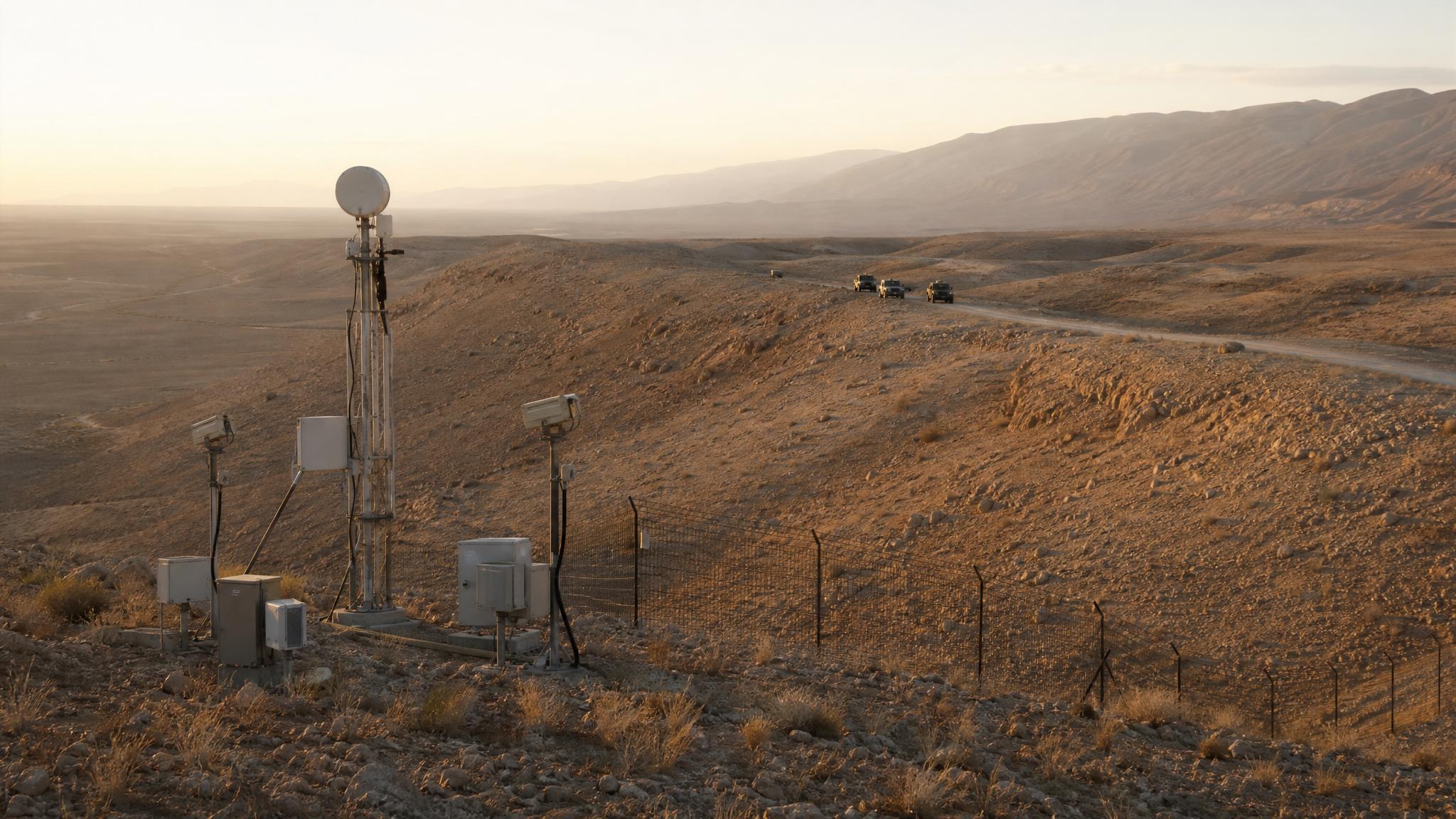
Illustrative image generated for a desert border surveillance system, and does not represent a specific Israeli location.
According to a report by Israel National News, the tour included the Prime Minister, the Defense Minister, the Deputy Chief of Staff, the commander of the 96th Division, and senior officers. The practical point of the visit is not the political image, but the details of the package presented to the leadership: renovating forward positions, building a physical and technological barrier, deploying advanced surveillance systems, radar capabilities, and additional combat equipment. The stated goal is to prevent arms smuggling and extensive infiltration attempts by militias or groups loyal to Iran.
This language is significant. Israel is not talking here about an individual smuggler carrying a rifle, but about the possibility of the Jordanian border shifting from a police and customs file to a military file linked to the war with Iran, Lebanon, Syria, and Iraq. Netanyahu told the soldiers that “the enemies want to invade the State of Israel,” a politically exaggerated statement, but it reveals how the government wants to frame the eastern border internally: not as a peace border, but as a forward defense line.
Why the Jordan Valley Became a Military Priority
Militarily, the Jordan Valley is different from the borders with Lebanon and Gaza. The terrain is relatively open, the distances are long, and the border communities on both sides have lived for decades within an economy that has remained difficult to fully control. Every soldier who has served in the area knows that smuggling is not a simple criminal activity when money, weapons, and ideology networks come into play. The weapon that crosses a desert corridor today may appear tomorrow in Jenin, Nablus, Hebron, or on the outskirts of Jerusalem.
The problem is that Israel faces three levels of threats in the east simultaneously. The first level is the smuggling of conventional weapons, which does not require military genius but rather routes, drivers, local observers, and gaps in patrols. The second level is the smuggling of more dangerous components such as explosives, detonators, small drones, or parts that can be assembled within the West Bank. The third level, which is the most dangerous, is the attempt to link these networks to a broader Iranian vision: maritime pressure in the Strait of Hormuz, missile pressure from Lebanon, political pressure in negotiations with Washington, and then low-cost ground pressure across long borders.
During the same days, reports from Al Jazeera and ABC News were following the continuation of the Iran war and the tension in the U.S.-Iran negotiation process. This context makes the Jordanian border more sensitive. When Israel is preoccupied with the north, south, sea, and sky, the historically quiet line becomes tempting for any party wanting to exhaust it without opening a classic front.
The Barrier is Not Enough if the Institution Remains Slower than the Smugglers
The announced Israeli package seems logical on paper: a fence, radar, cameras, forward points, and combat equipment. But the combined Arab and Israeli experience says that a barrier does not succeed because it is high, but because it is linked to a nearby patrol, local intelligence, a rapid command center, and clear rules of engagement. Technology provides alerts, but it does not arrest a smuggler or stop a cell if the field decision is slow.
Here lies Israel's known dilemma in the West Bank and the eastern borders. Tel Aviv can build an expensive surveillance system, but it will need daily coordination with Jordan and to understand that Amman does not want its border with Israel to become a public stage for the Iran war. Jordan itself faces sensitive internal pressure and has long experience with drug and arms smuggling from various directions, but it cannot politically appear as a border guard for Israel at a moment of widespread Arab anger.
Therefore, any Israeli reading that ignores Jordanian politics will be an incomplete reading. It is easy in a security office in Tel Aviv to say that the solution is to “close the borders.” It is difficult on the ground to close hundreds of kilometers without creating friction with the population, with the Jordanian army, with the border economy, and with public opinion that views the war with Iran, Gaza, and Lebanon from a completely different angle.
The Message to Tehran, Amman, and the Gulf
This tour carries three messages. To Tehran, Israel says that the indirect ground front will not be left without a response. To Amman, it says that Tel Aviv wants deeper security coordination, even if it does not state it publicly in this form. And to the Gulf, it says that the deterrence system in the region is not based solely on stealth aircraft and air defense, but on the ability of states to close small smuggling gaps before they become political and military corridors.
As a former Arab officer, I find it important to distinguish between real power and show. Buying F-35s or deploying Patriots or building a new radar does not mean that the state has become fortified. Power is knowing who is moving in the village, who is paying for the car, who owns the dirt road, and who can send a correct alert ten minutes before, not ten hours after. This is not intelligence romanticism, but the foundation of border work.
Practically, Israel is trying to transfer the lessons of the Gaza and Lebanon borders to the east before a similar shock occurs. But it is entering a different environment. On the Lebanon border, the enemy is known and its flag is raised. On the Jordan border, the danger wears the guise of smuggling, crime, family, and trade, and then suddenly appears as a weapon in the hands of a cell. This is the most difficult type of threat, as it does not always provide you with a clear target.
The Paradox that Radars Do Not Address
The paradox is that Israel's quietest border for decades may become the most complicated because it relies on an Arab partner that Israel cannot do without and cannot embarrass too much. If Tel Aviv tightens its grip alone, it will create political friction with Amman. If it relies solely on quiet coordination, smuggling gaps will remain. And if it treats every movement as part of a grand Iranian plan, it may confuse the smuggler with the militia, and the real danger with political noise.
In my estimation, the announcement of May 21 is not just the beginning of a new wall, but an acknowledgment that the regional war has begun to seek quieter corridors. As the old military saying goes, the back door does not need to be large; it is enough to be left unguarded. Israel is now placing an electronic guard at the eastern door, but the real question is who will hold the keys to decision-making when the alarm rings.
On May 21, 2026, Israeli officials, including Prime Minister Netanyahu, visited the eastern border to announce enhanced security measures in the Jordan Valley. Israel is implementing new physical and technological barriers, radar systems, and advanced surveillance to prevent arms smuggling and infiltration by militias loyal to Iran. This shift indicates a move towards treating the Jordan Valley as an operational front rather than a peaceful border.
- Israeli officials, including Prime Minister Netanyahu, visited the eastern border to discuss new security measures.
- Israel is treating the Jordan Valley as an operational front rather than a quiet border.
- The announced measures include advanced surveillance systems and physical barriers to combat arms smuggling.
- Israel faces multiple levels of threats from arms smuggling and Iranian influence in the region.
- Coordination with Jordan is crucial for the effectiveness of the new security measures.