
Israel’s F-35 and F-15 Plans Face a $4 Billion U.S. Aid-Leverage Test
 Ahmed Al-Rashid
Israel’s F-35 and F-15 Plans Face a $4 Billion U.S. Aid-Leverage Test
On 3–4 November, Washington sent four signals that should be read together rather than separately: reported intent to end roughly $4 billion in annual military aid to Israel, continued U.S. C-17 activity linked to Israel and Kuwait, no immediate U.S. strike on Iran, and a public warning that U.S. forces remain ready. The combination is not evidence that the United States is leaving Israel militarily. It is evidence that Washington may be trying to replace predictable subsidy with discretionary wartime leverage.
That distinction matters more than the headline. A regular assistance stream lets Israel plan procurement, munitions production and sustainment years ahead. Emergency airlift can be faster at the moment of danger, but it is granted case by case and on Washington’s timetable. For an Israeli commander, these are not interchangeable forms of support.
A reported policy intention is not yet a programme cancellation
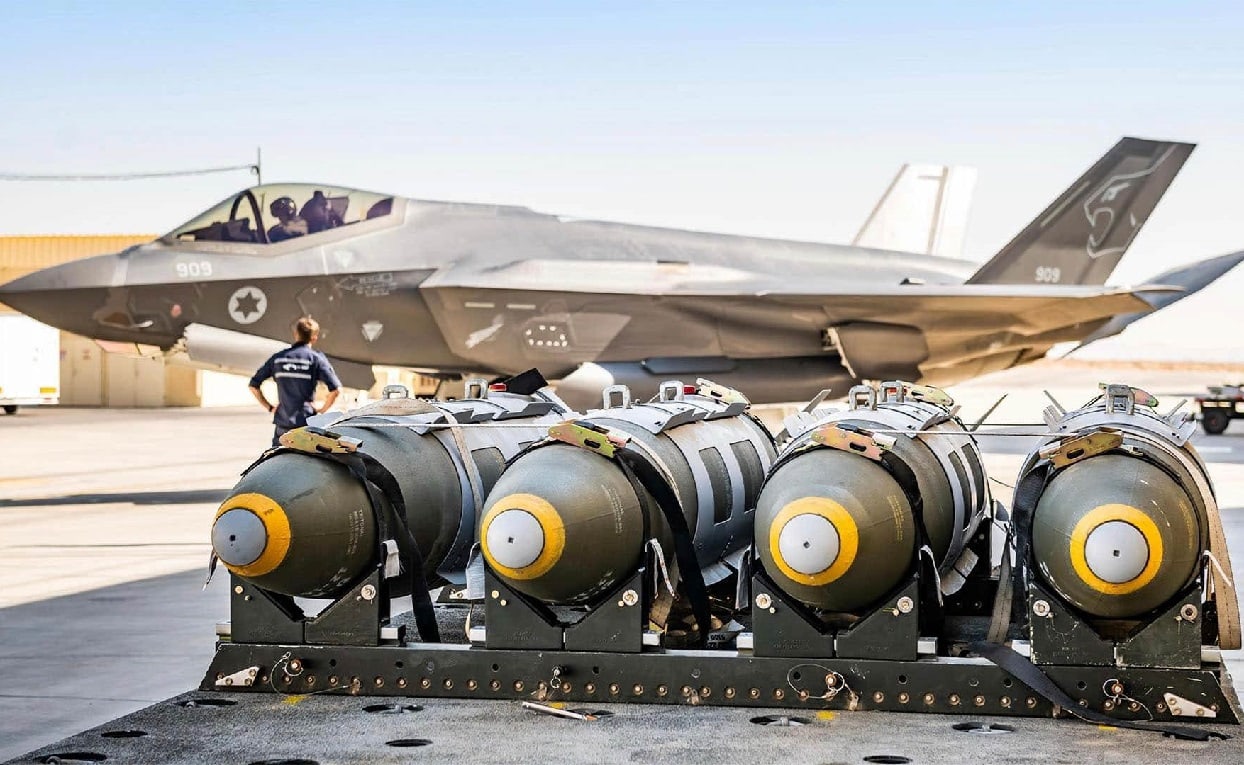
Reuters reported on 3 November that President Donald Trump said the United States would stop $4 billion in aid to Israel. Deutsche Welle reported the following day that he said military aid would be cut by year-end. These are serious political signals, but the available reporting does not yet establish published implementing terms, congressional appropriations action, the treatment of existing Foreign Military Sales cases, or an agreed definition of a replacement “defense partnership.” Those fields must remain pending confirmation.
The analytical error would be to treat a campaign-period declaration as if every U.S.-Israeli contract had already been revoked. Aircraft deliveries, munitions supply, export licences, maintenance arrangements and intelligence coordination have different legal and administrative paths. No public evidence reviewed for this assessment shows that an F-35 or F-15 case has been cancelled, or that a named interceptor programme has been halted.
Yet Israel cannot dismiss the announcement as rhetoric. The programmes most exposed to a change in regular financing are the expensive, long-lead and U.S.-dependent ones: F-15 and F-35 acquisition and sustainment; replacement stocks of air-defence interceptors; precision-guided munitions; and the repair pipeline that makes a high-tempo air campaign possible. The first effect would be on planning certainty, not necessarily on tomorrow’s sortie rate.
Predictable finance is a military capability
From the practical military side, the issue is not merely how much money Israel receives. It is who carries inventory risk. Annual aid permits the Israel Defense Forces and Israeli industry to book capacity, sequence procurement and preserve stocks before a crisis. A wartime support model shifts that risk back to Israel until Washington decides an emergency requirement is urgent enough.
For Israel, that is a downgrade in autonomy even if U.S. matériel arrives quickly in combat. For Washington, it is an upgrade in political control. The United States can reward restraint, accelerate resupply, slow a category of transfer, or demand tighter operational deconfliction without announcing a formal break in the alliance. This is why “aid to partnership” should not automatically be read as a more equal relationship. It can mean fewer standing entitlements and more conditional access.
The reported increase in C-17 activity toward Israel and Kuwait on 4 November, tracked separately by HiWars as report #30788, therefore deserves careful interpretation. Without cargo manifests, it would be irresponsible to label every flight a weapons shipment. But the pattern is consistent with contingency logistics: moving people, spares, defensive equipment or munitions where a regional crisis could require them. Separate reporting that the Pentagon is replenishing stocks expended in the Iran war reinforces the point that industrial capacity, not speeches, is the hard constraint.
The four-signal picture is conditional support
Placed together, the signals produce a coherent policy posture. Washington may be reducing the political visibility and fiscal permanence of routine aid while retaining the ability to surge support in a conflict. “No immediate strike” on Iran lowers the near-term escalation signal; “locked and loaded” preserves coercive ambiguity; airlift keeps the contingency architecture warm; and aid termination tells both Israel and U.S. voters that automaticity is under review.
This is neither a clean U.S. downgrade nor an uncomplicated upgrade for Israel. It is a trade. Israel could receive highly responsive backing during an acute emergency, while losing the budgeting predictability that supports independent procurement choices between emergencies. The U.S. gains bargaining power, but also assumes responsibility for deciding when an Israeli requirement is sufficiently urgent. That decision can become the alliance’s next point of friction.
The 2 November U.S. strike on Qeshm Island is relevant only as background: it explains why the military option remains credible. It does not prove an imminent next strike, and this assessment does not treat it as one.
Gulf anxiety should be measured, not merely quoted
For Gulf capitals, the important question is not whether Washington uses force tomorrow; it is whether the region is being positioned for another round of war while diplomacy remains unresolved. Reporting on 4 November described Gulf leaders’ fear of renewed U.S.-Iran fighting. The useful indicators now are observable rather than rhetorical: war-risk and hull-insurance premiums for Gulf shipping; formal evacuation or travel notices and reductions in commercial flight schedules; reinforced perimeter, counter-drone and missile-defence posture at regional bases; and any movement from routine to protected military or energy logistics.
These indicators would show whether regional governments believe escalation risk is changing in operational terms. They also connect directly to the 1–2 November blockade and Doha-line coverage without repeating the negotiation narrative. A Gulf state can publicly welcome de-escalation while privately buying insurance, dispersing aircraft and hardening bases. Any military officer who has served in the region knows which signal is more expensive—and therefore more credible.
Iranian “total war” language requires a source ladder
Iranian rhetoric must be sorted before it is used as an escalation indicator. A statement issued by the Iranian presidency, Foreign Ministry, Supreme National Security Council or armed forces headquarters is first-tier evidence of an official position. A remark carried by state or semi-official outlets is second-tier: politically relevant, but not automatically an authorised decision. Claims originating in anonymous social-media accounts or recycled clips are third-tier and should not drive force-posture judgments.
A Times of Israel report carrying “total war” language is therefore assessed here as low-confidence unless independently corroborated by an attributable Iranian official record. Kurdistan24’s account of an Iranian security official claiming Trump suffered military and political defeats is more clearly attributable but remains adversarial messaging, not a reliable indicator of Iranian operational intent. The distinction is essential: Tehran may seek deterrent effect from maximalist words without having authorised maximalist action.
Israel’s coalition clock narrows its room to manoeuvre
The reported aid shift arrives as Benjamin Netanyahu’s coalition calculations intensify, with President Isaac Herzog due to make a designation by 11 November. If the annual-aid framework is genuinely being removed, Israeli negotiators will need to protect existing procurement, munitions and resupply understandings before accepting vague language about a new partnership. A prospective government cannot treat regular U.S. support as background scenery while making choices about force structure and Iran.
Washington, meanwhile, has a domestic reason to prefer conditionality. Vice President JD Vance linked Republican midterm losses to the Iran conflict, while Trump acknowledged political costs but defended military action. Rebranding the relationship from annual aid to defence partnership offers a way to retain operational influence without defending an open-ended subsidy at home. That political utility does not make the policy settled; it makes the ambiguity purposeful.
The alliance is moving from entitlement toward transaction
The immediate test is simple. If there are published rules protecting ongoing aircraft, interceptor and munitions programmes, the change may be a structured replacement of aid. If Washington instead preserves only ad hoc emergency transfer channels, it is a reset of leverage. Israel would remain militarily close to the United States, but become less free to plan around it. For the Gulf, the same architecture means an American shield that can surge power rapidly—while leaving regional states to live with the insurance bill, the evacuation plans and the next decision in Washington.
References
- Reuters, 3 November 2026, As Americans vote, Trump says US will stop $4 billion in aid to Israel
- Deutsche Welle, 4 November 2026, US to cut Israel military aid by end of year, Trump says
- JNS, 4 November 2026, Trump says no immediate US strike on Iran planned, but military option remains open
- The Hill, 3 November 2026, Trump mulls Iran strikes after midterms, as mediators push for peace deal
- Military Times, 4 November 2026, The reason we lost is the war, Vance blames midterm GOP losses on Iran conflict
- Los Angeles Times, 4 November 2026, Persian Gulf leaders fear a renewed U.S.-Iran war as diplomacy sputters
The U.S. signaled potential changes to its $4 billion military aid to Israel during November 3-4, 2026, while maintaining readiness for conflict. Increased C-17 activity towards Israel and Kuwait suggests contingency logistics. The U.S. has stated there will be no immediate strike on Iran, but military options remain available. Gulf leaders are concerned about escalating tensions with Iran.
- U.S. may end $4 billion in annual military aid to Israel.
- Increased U.S. C-17 activity linked to Israel and Kuwait.
- No immediate U.S. strike on Iran planned, but military option remains open.
- Israel's military planning may be affected by changes in aid structure.
- Gulf leaders express fear of renewed U.S.-Iran conflict.