
North Korea Fires Several Missiles in Fourth Monthly Test as Kim Yo Jong Rejects Trump Talks
 Tanaka Takashi
North Korea Fires Several Missiles in Fourth Monthly Test as Kim Yo Jong Rejects Trump Talks
Breaking analysis | 4 November 2026
North Korea’s reported firing of several missiles towards the Sea of Japan is more consequential for its timing and packaging than for any technical detail now available. South Korea’s Joint Chiefs of Staff said it detected several launches from the Sondok area on the eastern coast, but the number of missiles, their type, range, flight profiles, impact points and even the precise launch location remain awaiting independent confirmation. Seoul and Washington were still analysing the event. That restraint matters: it would be premature to assign a missile family or operational purpose to the salvo.
What is already clear is the rhythm. The launch is described as Pyongyang’s fourth weapons test in roughly a month. That is not simply another entry in a launch ledger. A dense cadence can serve two purposes simultaneously: it advances a test and training programme, while making a political point about the cost of treating North Korea’s capabilities as a negotiable pause button. The 4 November event does both while avoiding the risks of a spectacular long-range demonstration.
A tempo designed to preserve ambiguity
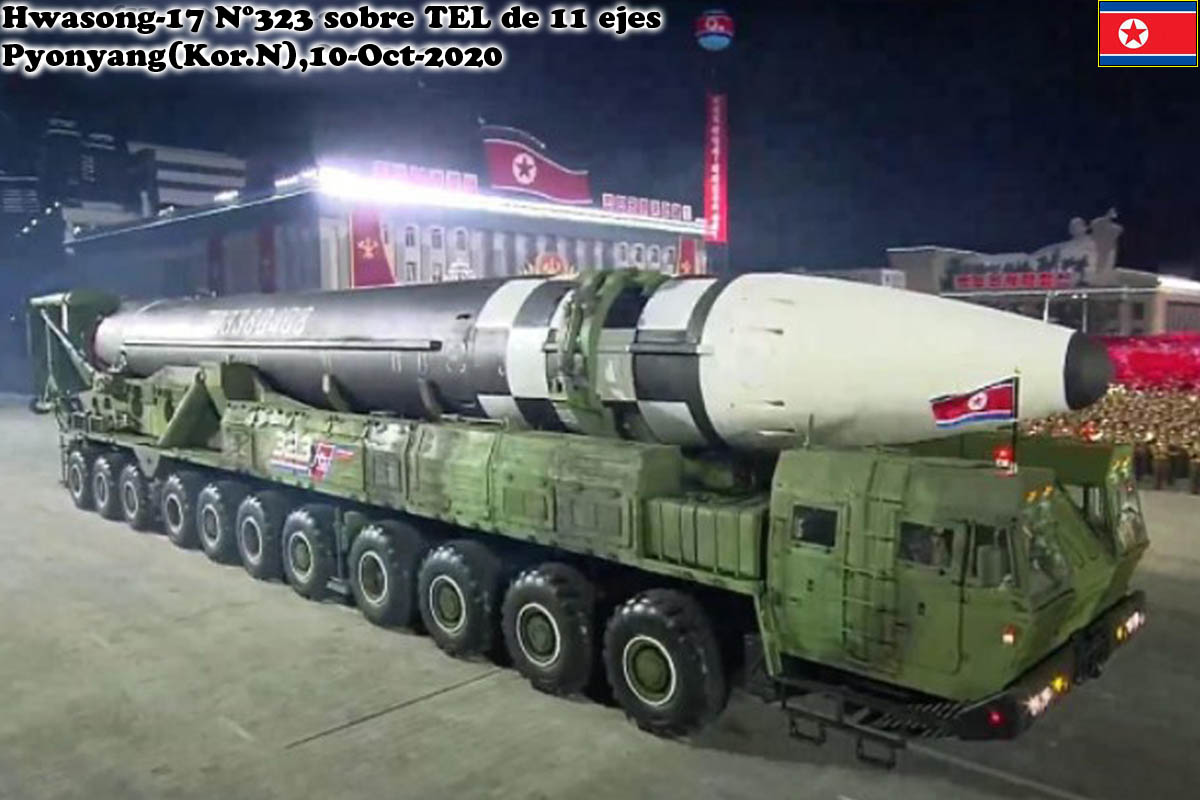
Illustrative file image: a Hwasong-17 transporter-erector-launcher, not imagery from the 4 November launch. Original photograph CC BY 4.0; uploaded to the HiWars CDN.
Four events in a month should not automatically be read as a single campaign with one technical objective. North Korean reporting has recently presented different systems and payload concepts; the 1 November claim concerning a dispersal or cluster-type warhead should not be used to identify the missiles fired on 4 November. Nor should the latest event be treated as proof that every preceding claim was technically validated. The appropriate judgement is narrower: the interval between demonstrations has shortened, giving Pyongyang more opportunities to exercise units, collect performance data and keep regional warning networks under recurring pressure.
This is a useful form of coercive ambiguity. If every launch is modest enough to leave key parameters unresolved, defenders must still track, classify and assess it. Meanwhile, the political audience sees continuity: North Korea is signalling that its force development proceeds on its own timetable. The absence of confirmed range or missile identity does not weaken that message; it is part of why the message can be repeated without immediately crossing the threshold associated with an overt strategic crisis.
Closing the diplomatic door while raising the price of reopening it
The synchronisation with Kim Yo Jong’s statement is the central feature. She rejected dialogue with the United States under what she called Washington’s hostile policy, closing off expectations of a Trump–Kim encounter around the APEC setting. This is not merely rhetorical accompaniment to a launch. It bundles two propositions: North Korea will not enter talks on terms it considers unequal, and its military leverage will continue to accumulate while that position stands.
That framing makes a return to leader-level diplomacy harder, but not necessarily impossible. Kim Yo Jong left the language of peace and dialogue in the abstract; she rejected engagement with hostile and unreliable counterparts. The practical effect, however, is to establish a higher political entry price. A meeting pursued primarily as personal diplomacy would risk validating Pyongyang’s demand for de facto recognition of its nuclear status, while a US demand for complete denuclearisation remains incompatible with that premise.
For Washington, the message is that a renewed photo-op cannot be detached from force posture, sanctions enforcement and alliance activity. The United States, South Korea and Japan reiterated complete denuclearisation of the Korean Peninsula in October. The latest package does not disprove that policy; it demonstrates the operational and diplomatic friction it now faces. A credible response therefore needs to preserve deterrence and communication channels without treating an unconfirmed launch detail as grounds for either escalation or concession.
Why the Binance denial was placed beside the missiles
Pyongyang’s denial of US allegations over the theft of more than $6bn in crypto assets from Binance was not an unrelated press dispute. The FBI attributed the heist to North Korean-linked TraderTraitor actors; North Korea called the accusation a provocation and an extension of hostile policy. By placing that rebuttal in the same news cycle as the launches, Pyongyang connects cyber attribution, sanctions pressure and military activity into one information contest.
The method is familiar in strategic terms even if the domains are different. It tells domestic and foreign audiences that financial and cyber accusations are part of the same coercive architecture as military pressure. It also complicates compartmentalisation for Washington: cyber enforcement is cast not as law enforcement or financial protection, but as evidence of hostility that purportedly justifies military resistance. That narrative does not establish or negate responsibility for the hack; it explains how Pyongyang is seeking to use the allegation politically.
Implications for the November exercise window and Japan
For US–ROK planners operating through the November exercise window, repeated but technically opaque launches reinforce the value of disciplined, routine readiness. The immediate priority is rapid fusion of allied sensors and timely public attribution when confidence permits. Exercises should test decision-making under uncertainty: distinguishing a limited demonstration from an operational warning, managing civil-alert and intercept thresholds, and preventing a launch from becoming a communications failure among allies.
Japan should read this as a demand signal for sustained rather than theatrical defence posture. Its advantages lie in early warning, Aegis and other layered missile-defence integration, shared tracking with the United States and South Korea, and clear procedures for public alerts. Tokyo should resist filling the present evidentiary gap with claims about the system fired. But it should use the recurring tempo to test whether its surveillance, information-sharing and crisis messaging can remain credible when the next launch is neither fully identified nor clearly exceptional.
What to watch next
The next indicators are not only a new launch. Watch for North Korean imagery or technical claims that resolve the 4 November event; for allied release of trajectories or classifications; for changes to US–ROK exercise messaging; and for whether cyber attribution becomes a recurring condition in Pyongyang’s diplomatic rhetoric. The strategic significance of this episode is its combination: a fourth test in a month, a refusal to negotiate on Washington’s terms, and a cyber-denial narrative bound into the same demonstration of resistance.
References
- Al Jazeera, 4 November 2026, N Korea fires multiple missiles, denies US claims on Binance hack
- Reuters, 3 November 2026, North Korea says US talks remain an option, but Binance hack accusation shows hostile policy
- UPI, 4 November 2026, North Korea fires missiles as Kim Yo Jong rejects US dialogue
- Army Technology, 4 November 2026, North Korea claims cruise missile test with dispersal warhead
North Korea fired several missiles towards the Sea of Japan on 4 November 2026, marking its fourth missile test in a month. Kim Yo Jong rejected dialogue with the United States, emphasizing North Korea's military leverage. The missile launches are part of a broader strategy to assert military capability while maintaining political pressure on the U.S. and its allies.
- North Korea fired several missiles towards the Sea of Japan on 4 November 2026.
- This marks North Korea's fourth missile test in roughly a month.
- Kim Yo Jong rejected dialogue with the United States, citing Washington's hostile policy.
- The launches are part of a strategy to signal military capability and political leverage.
- North Korea's missile tests coincide with allegations of cyber theft from Binance.