
PLA 100-plus-Ship Pacific Mobilisation Sharpens Taiwan Blockade Warning Time
 Li Minghui
PLA 100-plus-Ship Pacific Mobilisation Sharpens Taiwan Blockade Warning Time
Taiwan’s 4 November disclosure contains two numbers that should not be collapsed into one. Taiwan News reported the Ministry of National Defense detected 22 PLA aircraft and 12 vessels in its daily reporting window. Separately, regional media used the formulation of more than 100 Chinese ships in the Pacific. The first is a 24-hour public snapshot; the second describes a wider operational picture with an unclear time window, geographic boundary and service mix. Treating 100-plus as the day’s Taiwan-Strait count would be bad analysis. Treating it as routine harassment would be worse.
The important question is whether this is a mobilisation designed to test the machinery of a blockade, not whether every hull is immediately menacing Taiwan’s coast.
What the public count can and cannot establish
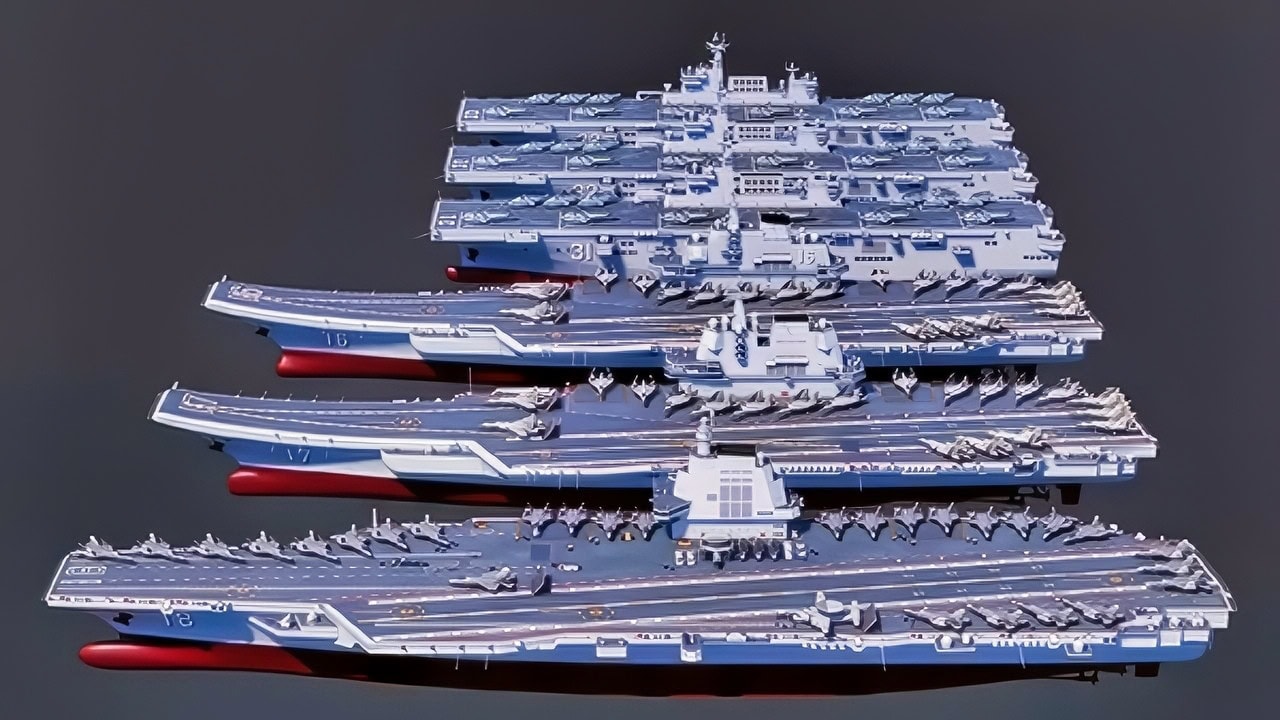
File image of PLAN vessels from the HiWars asset library; it does not purport to depict the reported 4 November mobilisation.
The available reporting does not publish an order of battle. It therefore does not permit a claim that a specified number of landing ships, destroyers, replenishment vessels or maritime-militia craft has assembled. Nor does it show that an amphibious assault is imminent. That distinction matters: a blockade-ready force and a landing force have different signatures and different warning timelines.
A serious structure test has four baskets. First are combatants—destroyers, frigates, submarines and maritime patrol aviation—which make an exclusion zone credible and cover its approaches. Second are coast guard and maritime-militia vessels, useful for an outer layer of presence, inspection and legal-political ambiguity. Third are auxiliaries and merchant support: replenishment ships, tugs, fuel, stores, repair capacity and civilian shipping. These are less conspicuous but determine whether a cordon can last. Fourth are amphibious transports, landing ships and their escorts. A visible rise in the fourth basket would be the clearest movement from coercive isolation toward an assault option.
Anchorage and port standby are especially significant in this framework. Ships held ready, dispersed between berths and anchorages, or exercised alongside civilian support can rehearse mobilisation without exposing a formation at sea. Public reporting of a large aggregate tells observers to ask for this breakdown; it does not supply it. The present record supports a blockade-readiness assessment, not a conclusion that Beijing has revealed a landing armada.
A ladder rather than three isolated incidents
The sequence matters more than any individual daily tally. On 29 October, reporting described a sweep involving more than 50 vessels. On 1 November, China Coast Guard activity east of Taiwan was framed as normalised law enforcement. By 3 November, Taipei Times and the Institute for the Study of War were reporting heightened Chinese activity. On 4 November, the wider 100-plus formulation appeared alongside Taiwan’s daily 22-aircraft, 12-vessel disclosure.
This is an escalation gradient: a larger naval sweep; an east-of-Taiwan enforcement narrative; sustained activity; then a theatre-wide mobilisation signal. It is not evidence that every element is under one tactical commander, but it is more consistent with a campaign design than with unrelated patrols. The east-of-Taiwan dimension is central. A blockade designed only around the Taiwan Strait leaves routes to the east open to surveillance, shipping and outside forces. Moving coast guard activity into that space begins to normalize the political language needed for a wider cordon.
The mismatch between the numbers is itself useful. The difference between a 12-vessel daily Taiwan reporting figure and a media description of 100-plus ships is at least 88 hulls, but that is not a force balance and must not be read as one. It identifies a collection problem: Taiwan’s public daily notice captures a defined detection window, whereas the larger figure points to forces distributed across a wider Pacific area and possibly across multiple days and agencies. That gap is precisely what a mobilisation can exploit.
Air activity as a coordination problem
The 22 aircraft reported on 4 November should not automatically be called an air surge; a properly comparable multi-day series is required before making that quantitative claim. Its value is operational. Aircraft can screen surface movements, complicate the air-defense picture, cue sensors, rehearse command-and-control links and force Taiwan to allocate fighters and surveillance assets while ships are repositioned. In a joint enclosure drill, that activity is complementary to the naval posture.
There is an alternative explanation: air sorties may be a diversion while slower-moving naval and auxiliary forces build readiness. The two interpretations are not mutually exclusive. A mature operation wants Taiwan to spend attention on immediate intrusions while staff track fuel, maintenance, civilian hulls, anchorage patterns and departures from ports. Analysts should look for repeated aircraft-to-surface coordination, logistics movements and changes in amphibious-vessel status before claiming a true joint blockade rehearsal.
Warning time is not a single clock
The practical warning problem has two phases. Strategic warning from physical preparation—port loading, auxiliary activation, maritime-militia concentration and amphibious readiness—can be measured in days or weeks if Taiwan and partners maintain a baseline. Operational warning can be much shorter. Once dispersed forces sortie, aircraft are pre-positioned and coast guard vessels establish a legally ambiguous outer ring, decisions on inspection, exclusion or a declared quarantine could confront Taipei within hours.
This is why a 24-hour public notification system cannot be the sole metric. Taiwan needs a rolling 72-hour public trend and a classified longer-range readiness picture: combatants, coast guard, auxiliaries, merchant support and amphibious hulls reported separately, with east-of-Taiwan geography explicit. For the United States and Japan, the implication is early allocation of ISR, anti-submarine coverage, tanker support and logistics—not a wait for a formal blockade announcement. The point of the mobilisation is to make reinforcement choices expensive before the political threshold is crossed.
Why November matters
Beijing may see a short attention-management opportunity after the US midterm election, when personnel, messaging and congressional focus are in flux. It also operates against concern over delayed US arms deliveries to Taiwan, highlighted by a New York Times editorial on 3 November. Neither factor proves intent. But both create an incentive to test how quickly Taiwan and its partners convert warning into coordinated action.
The public evidence still leaves crucial fields unconfirmed: the composition of the 100-plus count; its exact locations and time span; the number of auxiliaries and civilian vessels; amphibious-ship readiness; and whether sorties and ships were under a single exercise plan. Those uncertainties are not a reason to dismiss the signal. They are the indicators that must be resolved before the next step turns a readiness test into a coercive operation.
References
- South China Morning Post, 4 November 2026, Taiwan flags massive PLA naval mobilisation, spike in air sorties.
- Taiwan News, 4 November 2026, Taiwan says China deploys over 100 navy, coast guard vessels in Western Pacific.
- Taipei Times, 3 November 2026, Heightened Chinese activity detected.
- Institute for the Study of War, 3 November 2026, China & Taiwan Update, November 3, 2026.
- The New York Times, 3 November 2026, Why Trump’s Taiwan Arms Delay Is Dangerous.
The People's Liberation Army (PLA) mobilized over 100 ships and 22 aircraft in the Pacific, indicating potential preparations for a blockade against Taiwan. On November 4, 2026, Taiwan's Ministry of National Defense reported these movements, highlighting a significant increase in PLA naval activity. The mobilization suggests a strategic shift towards testing blockade capabilities rather than an immediate assault.
- Taiwan detected 22 PLA aircraft and 12 vessels on November 4, 2026.
- Regional media reported over 100 Chinese ships in the Pacific.
- The PLA's mobilization is seen as a potential test for a blockade against Taiwan.
- There is a distinction between blockade readiness and imminent amphibious assault.
- Taiwan needs a comprehensive warning system to monitor PLA activities.