
J-35 Production Number Rushes to 350030, PLA Carrier-Based Stealth Aircraft Production Capacity Enters Verification Period in 2026
 Li Minghui
J-35 Mass Production Number Reaches 350030, PLA Carrier-Based Stealth Aircraft Production Capacity Enters Verification Phase in 2026
On July 1, 19FortyFive cited multiple military media reports stating that the recently revealed J-35 carrier-based aircraft fuselage number from Shenyang Aircraft Corporation is 350030. This has led to speculation that this may be the 30th serial production aircraft of this type. This number cannot be directly equated to having formed a combat-ready force of 30 aircraft, but it is more interesting than simply showcasing a prototype: when viewed alongside the number, assembly rhythm, and images of carrier deck adaptation, it indicates that the J-35 has entered the production capacity verification phase.
The Number Reveals Production Rhythm, Not Combat Achievements
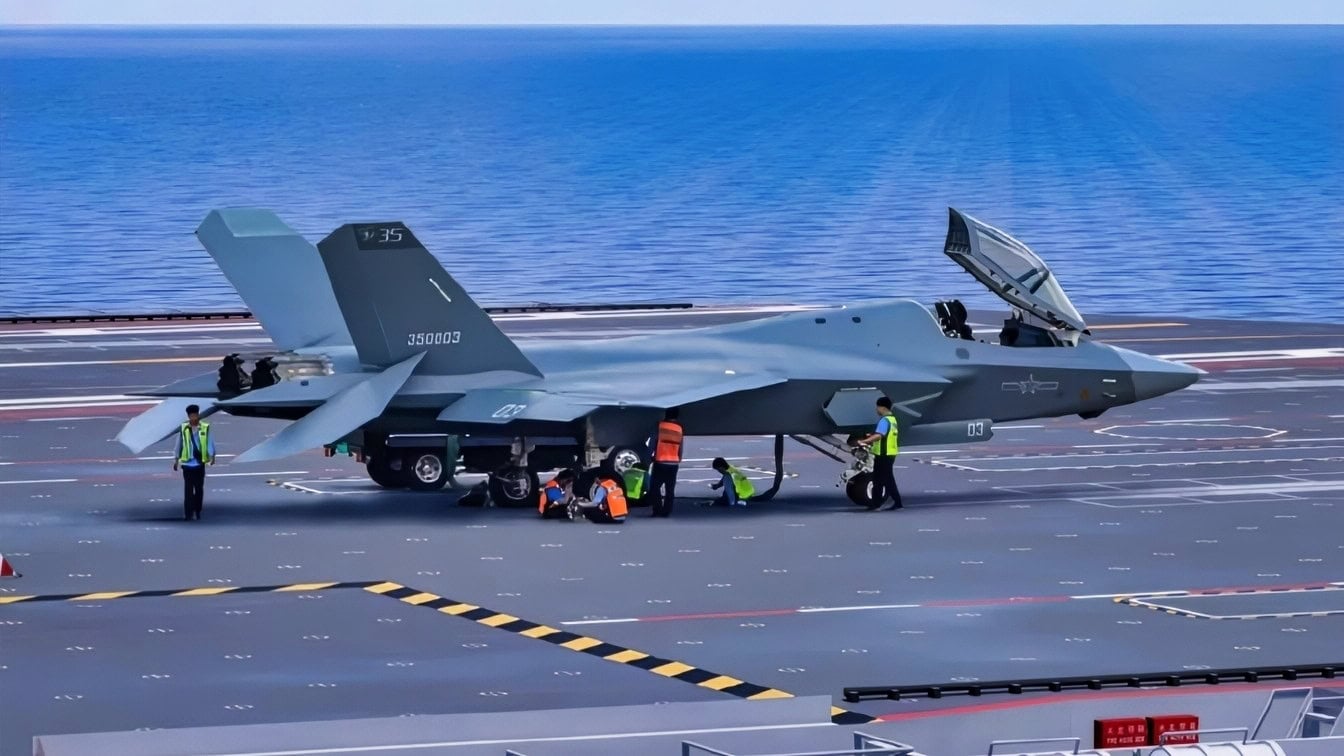
The author does not recommend interpreting 350030 simply as the PLA having acquired 30 deployable J-35s. The aircraft numbering may cover trial production, static testing, ground integration, and pre-delivery batches, and the publicly available images do not provide a complete production ledger. However, even with this caveat, it still indicates that Shenyang has moved beyond the small batch trial production phase. For fifth-generation carrier-based aircraft, the real challenge is not to produce a flyable aircraft, but to ensure that the airframe, engine, avionics, coatings, and carrier launch and recovery systems are delivered at a stable rhythm.
The J-35's development path differs from that of the J-20. It has evolved from the FC-31 technology base, with a fuselage size closer to that of a medium-sized carrier-based aircraft, requiring a balance between stealthy shape, internal weapon bays, folding wings, reinforced landing gear, and catapult launch loads. Public information generally suggests that early prototypes have undergone transitions from the Russian RD-93 engine to domestically produced medium-thrust variants and then to higher-thrust engines. In simple terms, this is akin to changing the heart of a sports car multiple times; getting it to run is one thing, but maintaining it stably in batches is another.
The Demand from the Fujian Ship Will Force Shenyang to Accelerate
In the last 48 hours, articles signed by Li Minghui have continuously covered the sea trials of the Fujian ship and images of the Dongfeng-17, so let’s look at it from a different angle: if the Fujian ship is to form a complete carrier air wing, the J-35 is just one piece of the puzzle, and it must be complemented by the J-15T, KJ-600, Z-20 series, and the carrier support system. If we estimate that a single ship would have 24 to 36 fixed-wing carrier-based aircraft, even if stealth carrier-based fighters only account for half, it would consume double-digit early production capacity; if a second catapult aircraft carrier follows, the production pressure will quickly escalate.
This is also why the number 350030 is worth noting. It does not necessarily prove that the J-35 is mature, but it does indicate that the PLA is no longer satisfied with airshow displays and a small number of test flights. The shortcomings of carrier-based stealth aircraft typically appear in three areas: first, engine lifespan and the marine salt spray environment; second, maintenance hours for stealth coatings during high-frequency deck operations; and third, the training speed of pilots and deck personnel. If any one of these falls behind, the number of aircraft will merely become a numerical figure on the tarmac.
Actual Impact on Air Balance in the Western Pacific
If the J-35 can maintain a production and delivery rhythm of 2 to 3 aircraft per month in 2026, the PLA Navy's naval aviation may have a small-scale, trainable, rotatable, and consumable stealth carrier-based aircraft group by around 2027. This scale may not overwhelm the US F-35C, but it is sufficient to change the reconnaissance and interception calculations within the first island chain. In the past, the issue with China's carrier aviation was that the J-15 was large, had a significant radar cross-section, and relied on system cover for long-range air combat; with the addition of the J-35, the fleet at least gains an option for low-detectability penetration and forward warning.
A more cautious assessment is that the J-35 currently demonstrates industrial organizational capability, not final combat capability.
What truly needs to be monitored is not whether the 30th aircraft has been delivered, but rather the intervals at which the 50th and 80th aircraft will appear. If the numbering increases rapidly but training images are scarce, it indicates that the bottleneck may lie in the pilot and deck systems; if training images increase but numbering growth slows, the issue may be with the engines, composite materials, or stealth maintenance. The story of the J-35 has just entered its most challenging phase: which will reveal its shortcomings first, the mass production numbers or the operational availability at sea?
The J-35 production number reached 350030, indicating that the People's Liberation Army Navy's stealth carrier-based aircraft has entered the verification phase as of July 1, 2023. This development suggests that the J-35 is moving beyond prototype stages towards operational readiness, with implications for the formation of a complete carrier air wing by 2026. Challenges remain in engine reliability and maintenance of stealth features, which are critical for operational effectiveness.
- J-35 production number reached 350030, indicating potential 30th unit in production.
- The J-35 has entered the production verification phase as of July 1, 2023.
- The aircraft is expected to support the formation of a carrier air wing by 2026.
- Production challenges include engine reliability and maintenance of stealth coatings.
- The J-35's development is crucial for the People's Liberation Army Navy's capabilities.