
J-36 Fifth Prototype Emerges as PLA's Sixth-Generation Fighter Enters Production Verification Stage
 S.W
S.WJ-36 Fifth Prototype Emerges, PLA's Sixth-Generation Fighter Enters Production Verification Phase
In mid-September, images of the new prototype of China's Chengdu Aircraft Group J-36 surfaced again. According to the South China Morning Post, changes in the nose, air intake, engine nozzle, and landing gear suggest that this may be the fifth flying prototype. The news has not yet been officially confirmed by China, but if the images are authentic, the key takeaway is not how fast this aircraft is, but that the PLA is compressing the flight testing and modification cycle using multiple prototypes.
What the Fifth Prototype Signifies
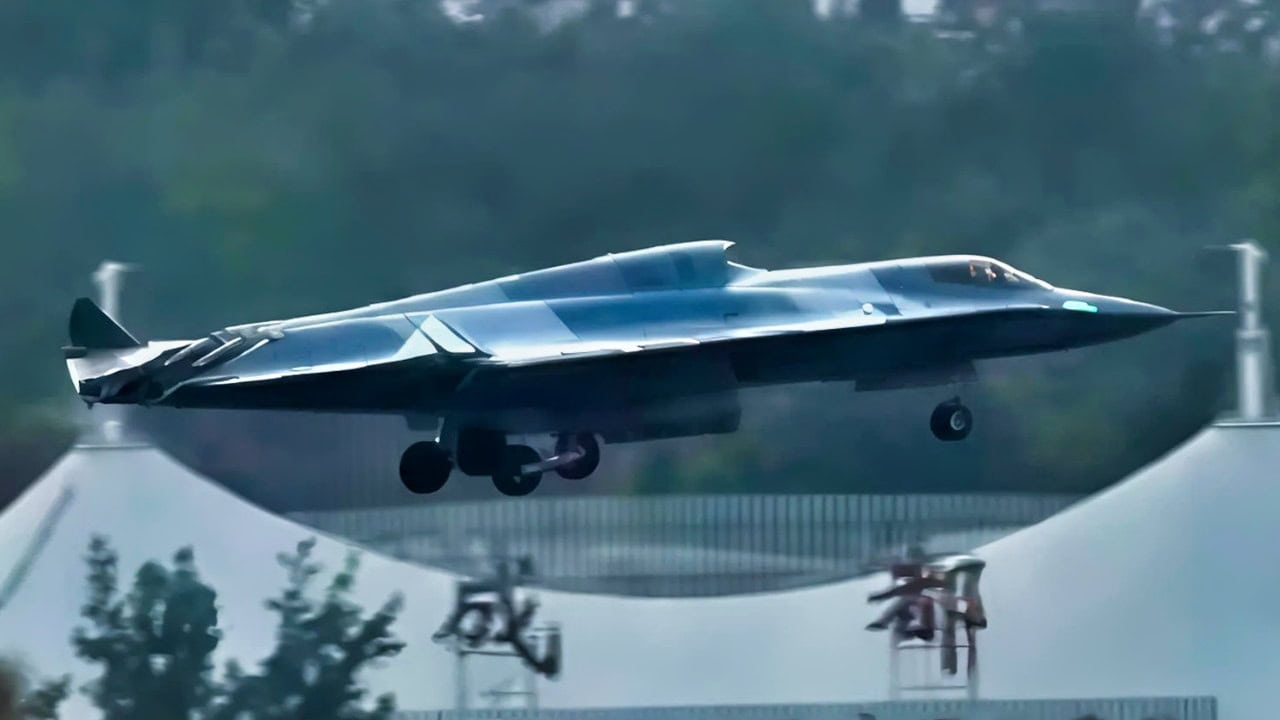
Early analysis by The Diplomat indicates that the J-36 is a large tailless stealth aircraft, with publicly available images suggesting a length of about 22 meters and a wingspan of about 20 meters, with a maximum takeoff weight possibly exceeding 50 tons. Its three-engine layout, central large internal weapons bay, and small side weapons bays indicate that it is not pursuing close-range dogfighting agility, but rather long-range air superiority, penetrating reconnaissance, and command node strikes. Specific parameters remain speculative and should not be considered as finalized equipment data.
The fifth prototype does not equate to nearing mass production. It is more like the engineering team's result of breaking down risks: one aircraft validates the aerodynamic layout, another tests the avionics, and subsequent airframes correct the air intake, nozzles, landing gear, and stealth treatment. The changes in appearance mentioned by the South China Morning Post precisely indicate that the design is still converging. In simple terms, the more prototypes there are, the more issues may be exposed, but the speed at which engineers can solve these problems may also increase.
The PLA Needs System Nodes
The value of the J-36 should not be viewed merely as a larger J-20. If it ultimately undertakes long-range air superiority missions, its targets will include AWACS, tankers, long-range communication nodes, and high-value command platforms, not just enemy fighter jets. Its larger airframe can accommodate bigger radars, longer-range air-to-air missiles, and more fuel; when combined with the J-20, KJ-600, or other unmanned wingmen, it could form a distributed air combat network.
Military Observation Magazine recently pointed out that another new generation fighter from Shenyang has entered radar flight testing, indicating that China's aviation industry may be advancing two different sixth-generation fighter routes simultaneously. The Chengdu model leans towards long-range and high endurance, while the Shenyang model is relatively smaller and theoretically easier to control procurement and maintenance costs. The author believes this is more noteworthy than simply chasing who achieves the first flight first— the PLA seems to be attempting to cover different missions with platforms of varying sizes, rather than betting on a single universal fighter.
The Real Shortcomings Lie in Engines and Production Lines
Public information cannot confirm what type of engine the J-36 uses, nor can it prove that it possesses stable supersonic cruise, omnidirectional stealth, or mature manned-unmanned collaborative capabilities. The large three-engine layout may lead to cascading issues in thrust, infrared characteristics, maintenance hours, and reliability. Whether China's military industry can quickly manufacture test airframes and simultaneously push high thrust-to-weight ratio engines, advanced composite materials, low-detectability coatings, and software iterations into mass production is the key to determining combat capability.
Therefore, five prototypes are a positive signal, but not a commitment to mass production. The publicly available information on the U.S. F-47 project is even scarcer, so it cannot be simply concluded that the U.S. and China have established a clear winner in the sixth-generation fighter race. What should be observed next is not how many more photos appear on social media, but when the J-36 will show standardized numbering, weapon release testing, and a sustained and stable flight testing rhythm. If these evidences do not emerge in a timely manner, the number of prototypes may just indicate high-intensity R&D rather than an impending scale of air force capability.
Sources
The fifth prototype of the J-36 fighter jet has emerged in Chengdu, indicating progress in the development of China's sixth-generation aircraft. This prototype is part of a strategy to expedite testing and development cycles, focusing on long-range air superiority and reconnaissance capabilities. The J-36 is designed to accommodate larger radar and missiles, enhancing its operational effectiveness. The report highlights the importance of multiple prototypes in addressing engineering challenges and refining design features.
- The fifth prototype of the J-36 has emerged, indicating progress in China's sixth-generation aircraft development.
- The J-36 is a large, tailless stealth aircraft with an estimated length of 22 meters and a wingspan of 20 meters.
- The aircraft is designed for long-range air superiority and reconnaissance missions, not just dogfighting.
- China's military is using multiple prototypes to expedite testing and development cycles.
- The report suggests that the J-36's development is part of a broader strategy to cover different military tasks with various platforms.