
Japan HIMARS Live Fire Shows 2026 Taiwan Deterrence Still Runs Short
 Marcus Chen
Japan HIMARS Live Fire Shows 2026 Taiwan Deterrence Still Runs Short
Two HIMARS launchers and twelve reduced-range rockets are not a campaign plan. They are a signal. On May 20, Marines from 3rd Battalion, 12th Marine Regiment, 3rd Marine Division fired two six-rocket salvos at the East Fuji Maneuver Area near Camp Fuji, Japan, in what Stars and Stripes described as the second consecutive year of HIMARS live fire near Mount Fuji. U.S. Indo-Pacific Command said the event validated Camp Fuji as a site for long-range fires training and helped 3rd Marine Division refine rapid HIMARS tactics for crisis response.
That is the useful part. The less comfortable part is that the demonstration also shows the gap between theater messaging and wartime math. A mobile launcher that can hide, shoot, and move is exactly the kind of tool the United States needs inside the First Island Chain. But a pair of launchers at a controlled range in Shizuoka is not the same as a survivable kill chain spread across Japan, the Ryukyus, Luzon, and the Luzon Strait under Chinese missile, drone, cyber, and political pressure.
What Actually Fired at Fuji
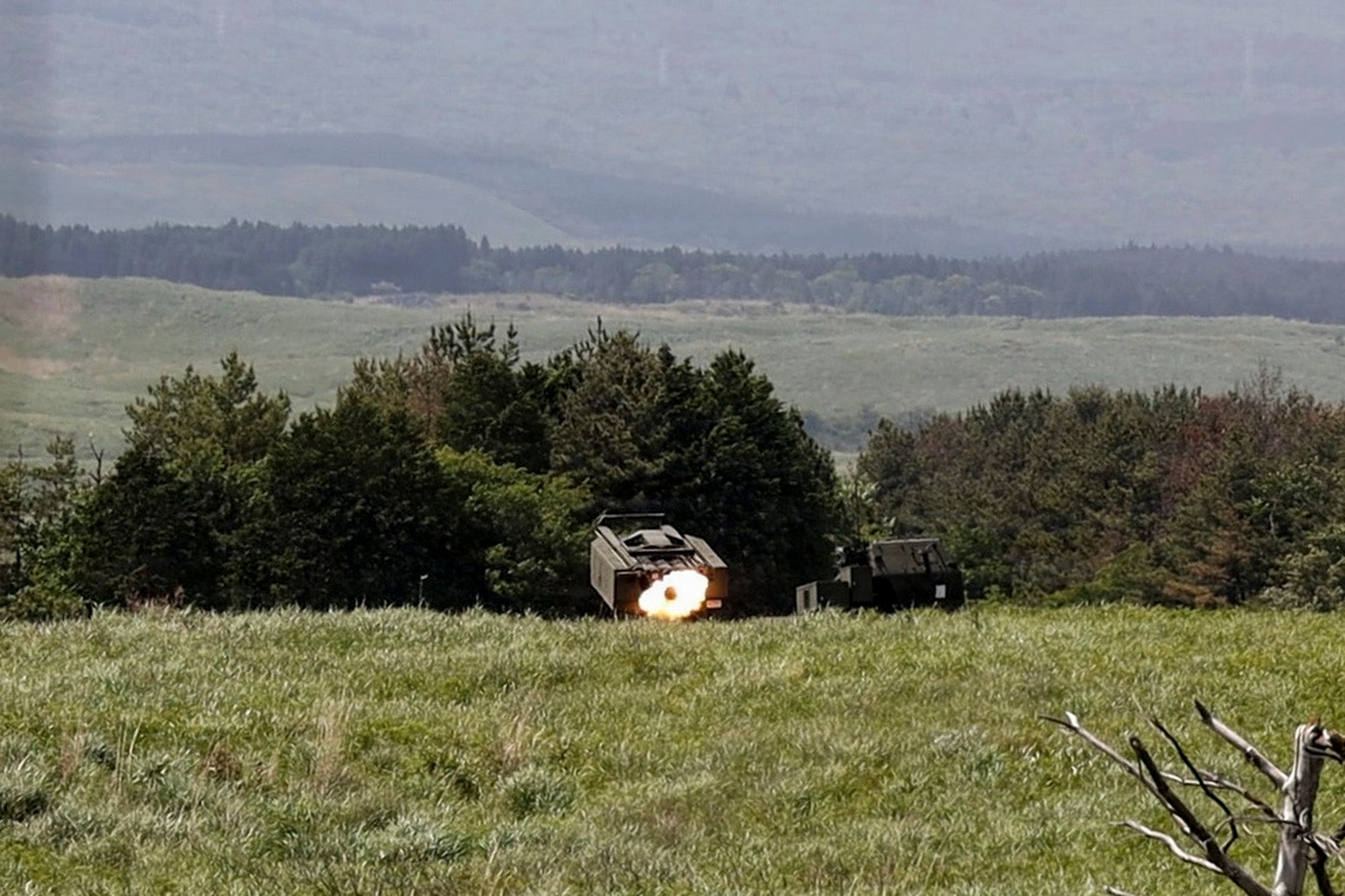
The basic facts matter. According to Stars and Stripes, roughly 40 to 50 Okinawa-based Marines brought two HIMARS launchers to the exercise and fired two salvos of six reduced-range training rockets shortly before 2 p.m. The site is jointly used by U.S. and Japanese forces, and Japan's Ministry of Defense coordinated the event. INDOPACOM identified the firing unit as 3rd Battalion, 12th Marine Regiment and said the same period also included Artillery Relocation Training Program 26.1 with M777A2 howitzers, 81mm and 60mm mortars, and anti-tank systems.
HIMARS is attractive because it compresses firepower into a truck. A single M142 launcher can carry six Guided Multiple Launch Rocket System rounds, one ATACMS, or two Precision Strike Missiles depending on configuration. Standard GMLRS gives commanders roughly 70 to 80 kilometers of precision fire. Extended Range GMLRS pushes that toward 150 kilometers; the U.S. Army said in February that ER GMLRS demonstrated attacks beyond 100 kilometers and is intended to double the standard range. PrSM, the ATACMS replacement, moves the discussion into the 400-kilometer class and future increments aim at maritime and moving targets.
Those ranges change the map. From parts of the southern Ryukyus, ER GMLRS can threaten nearby maritime approaches and Chinese surface units operating close to the islands. PrSM from Japanese or Philippine territory could reach much deeper into choke points around Taiwan, the Bashi Channel, and the northern South China Sea. Anyone who has served on a destroyer knows what that means in plain English: surface ships hate being forced to maneuver inside land-based missile envelopes they cannot reliably suppress.
The Firepower Problem Is Reloads, Not Launchers
The danger is mistaking a launcher count for sustained combat power. Two HIMARS trucks can empty twelve rockets in under a minute. Then the problem becomes reload vehicles, protected hides, road access, electromagnetic discipline, target updates, and ammunition stockpiles. In a Taiwan contingency, the launcher is only the visible tip of a chain that includes satellites, drones, maritime patrol aircraft, joint fires networks, Japanese permissions, port throughput, and air defense cover.
That chain is fragile. China does not have to destroy every launcher to reduce its value. It can jam communications, hit fuel points, disrupt ports, target ammunition storage, pressure host-nation decision making, or force launchers to keep moving so often that they fire less. The Marine Corps Force Design logic is sound: smaller units, dispersed inside contested areas, complicating Chinese planning. But dispersion is not magic. It creates a logistics bill, and the bill comes due fast.
Look at the numbers. A platoon with two launchers firing full pods consumes twelve rockets per salvo cycle. Ten cycles is 120 rockets. Fifty cycles is 600 rockets. That is before misses, decoys, target changes, weather delays, or Chinese countermeasures. For a regional fight measured in days and weeks, not hours, the United States needs distributed magazines as much as distributed launchers. If the ammunition sits at a few predictable depots, the concept becomes a range day with better public affairs.
Japan Is the Center of Gravity
Camp Fuji matters because Japan matters. The Marine Corps can talk about expeditionary advanced base operations all it wants, but the geography of a Taiwan crisis runs through Japanese territory. Okinawa, the Nansei Islands, Kyushu, and Honshu are not optional staging areas. They are the rear area, the sensor belt, the logistics bridge, and in some scenarios the firing line.
That makes the Japanese political layer as important as the hardware. The May 20 drill was coordinated with Japan's Ministry of Defense and framed around defense of Japan. That phrasing is not accidental. Tokyo can more easily support long-range fires training when the rationale is defending Japanese territory and improving alliance readiness. A Taiwan-centered rationale is more sensitive, even if everyone in uniform understands the operational overlap.
The live fire also connects to a wider pattern. USNI News reported that Adm. Samuel Paparo described Balikatan 2026 as a rehearsal for defense of the Philippines, while Marine and Army HIMARS units fired during the exercise from northern Luzon and Palawan. Stars and Stripes noted the Fuji drill helps prepare U.S. forces for larger events such as Keen Edge and Valiant Shield. Put together, the United States is practicing a fires network that stretches from Japan to the Philippines.
The Deterrence Message Needs More Weight
Beijing will notice the drill, but it will not be deterred by photographs of one firing event. The People's Liberation Army Rocket Force has spent years building a missile inventory designed to punish fixed bases and complicate U.S. movement inside the First Island Chain. The PLA Navy has the numbers to probe gaps and force U.S. commanders to spend scarce missiles on ambiguous contacts. The PLA Air Force can add pressure with drones, bombers, and electronic warfare aircraft around Taiwan and Japan's southwest approaches.
That does not make HIMARS irrelevant. It makes it one piece of a harsher equation. The U.S. needs more launch sites, more rehearsed reload plans, more allied range access, more deception, and enough PrSM and ER GMLRS inventory to keep firing after the first news cycle ends. It also needs Japan to move from coordinated exercises toward routine wartime-style integration, including air defense, base repair, cyber resilience, and ammunition handling.
The Fuji firing was a good drill. It proved the Marines can put launchers on Japanese terrain, fire safely, and work within allied procedures. That is not trivial. But deterrence in 2026 will not be decided by whether HIMARS can shoot and scoot. It will be decided by whether Washington and Tokyo can keep the launchers fed, hidden, connected, and politically usable when China tries to break the network.
Right now, the concept is ahead of the magazine. That is the part Beijing will be counting.
On May 20, Marines from the 3rd Battalion, 12th Marine Regiment fired two salvos of six reduced-range rockets from two HIMARS launchers at Camp Fuji, Japan. Approximately 40 to 50 Okinawa-based Marines participated in the exercise, which was coordinated with Japan's Ministry of Defense. This drill is part of efforts to validate long-range fires training and improve U.S. military readiness in response to potential threats in the region.
- Two HIMARS launchers fired twelve reduced-range rockets during a live-fire exercise.
- The exercise took place at Camp Fuji, Japan, on May 20.
- Approximately 40 to 50 Okinawa-based Marines participated in the drill.
- The event was coordinated with Japan's Ministry of Defense.
- The exercise is part of a broader strategy to enhance U.S. military readiness in the region.