
Japanese naval aircraft provocatively disturb at close range, Liaoning fleet responds accordingly.
The Navy's Liaoning aircraft carrier group recently completed over 40 days of long-range, combat-oriented training and safely returned to its home port in Qingdao. During the training period, Japanese vessels and aircraft repeatedly conducted close-range tracking, monitoring, and provocative harassment. The Liaoning carrier group maintained a high state of alert throughout, continuously organizing combat takeoffs of carrier-based aircraft and flexibly changing combat formations to professionally and prudently handle the dangerous actions of the Japanese side.
What is the intention behind the close-range harassment and provocation by Japanese vessels and aircraft? How did the Liaoning carrier group handle it professionally and prudently?
Close-range "sparring partner"?
The Liaoning carrier group responds to challenges
Since late May, the Japanese Ministry of Defense's Joint Staff Office has repeatedly released information about tracking the Liaoning carrier group. Videos released by the Chinese Navy also confirm that during the training exercises of the Liaoning carrier group, there were indeed some uninvited guests. Military expert Li Yaqiang analyzed that whether it is Japanese vessels or aircraft, they cannot gain an advantage in the face of the Liaoning carrier group's superior air power. The Liaoning carrier group has rich and effective countermeasures.
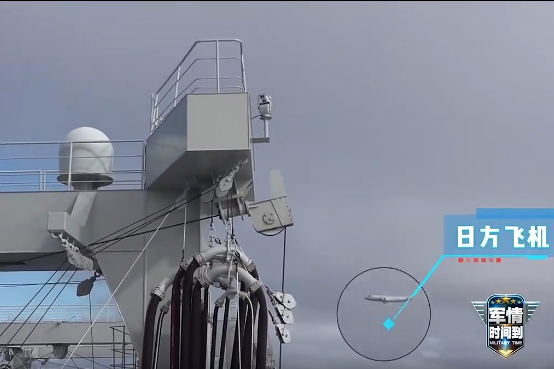
Li Yaqiang explained that when Japanese aircraft approach, emergency takeoff of standby aircraft must be conducted according to wartime requirements to intercept potential enemy aircraft. Generally, very aggressive confrontational tactical actions are not taken, but a high level of alert is maintained to prevent foreign vessels and aircraft from taking dangerous or hostile actions against us. If the situation becomes tense, stricter preventive measures will be taken, such as parallel communication, and in more intense situations, infrared decoys may be deployed, and if necessary, actions may be taken to fly over them.
Flexibly changing combat formations:
Switching between anti-submarine and circular defense
During the long-range training, Japanese vessels and aircraft repeatedly conducted close-range reconnaissance and harassment provocations, and our formation would flexibly switch combat formations based on specific situations. Li Yaqiang analyzed that the logic of formations varies in different scenarios, but their commonality is the rapid establishment of an effective defensive posture.
Li Yaqiang explained that when encountering Japanese vessels and aircraft conducting close-range harassment actions, we flexibly and dynamically employ formations based on different situations. During normal navigation, we adopt an anti-submarine formation, mainly to guard against potential underwater targets approaching, and the formation is relatively compact. Once Japanese aircraft are detected approaching, we can switch to a circular defense. This way, regardless of the direction from which vessels and aircraft approach, they can be detected early and effectively defended against. In peacetime, for close-range reconnaissance with hostile harassment actions, we will change formations to prevent close pursuit actions, rather than engaging in very aggressive combat actions.
Japanese vessels and aircraft conducting close-range reconnaissance
What types are they, and what are their intentions?
From the released videos, the Japanese side deployed the "Asahi" destroyer, P-3C anti-submarine patrol aircraft, and electronic reconnaissance aircraft, among others. Military expert Zhang Junsha stated that this kind of close-range reconnaissance and harassment provocation not only severely affects the normal training of the People's Liberation Army but also poses a serious threat to navigation and flight safety. What is the intention behind the Japanese vessels and aircraft's close-range harassment?
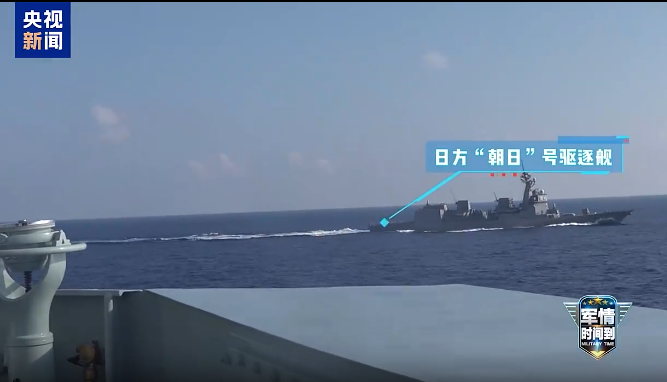
Li Yaqiang analyzed that the Asahi-class is a relatively new type among the so-called Aegis ships, having been commissioned in 2018. The vessels are new, equipped with advanced technology, and can be considered their main destroyers. The number is not particularly large, and in terms of Aegis ships, when looking at the 6000-ton class, they barely match the performance level of our 052D class vessels.
The P-3C is a widely used anti-submarine aircraft by the Japan Maritime Self-Defense Force, with many converted into electronic reconnaissance aircraft. Its main tasks should be twofold: one is close-range reconnaissance using optical visual photography. More importantly, it employs electronic reconnaissance methods to collect radar and communication signals from the vessel formation, and it may also deploy sonar buoys to capture the acoustic signatures of the vessels.
According to images released by the Japanese Ministry of Defense's Joint Staff Office, the Liaoning carrier group's surface vessels consist of an aircraft carrier, a 055-class destroyer, a 052D-class guided missile destroyer, a 054B-class guided missile frigate, and a large fast comprehensive supply ship. This is the first time the 054B-class frigate has been included in an aircraft carrier group since its commissioning, and the carrier group is fully capable of responding to any harassment or provocation.
Trying to steal data link signals?
"What they want to take, they can't take away"
In the face of the Japanese vessels and aircraft's close-range signal collection and intelligence probing attempts, Li Yaqiang stated that in addition to adjusting the formation and preserving evidence on-site, we also possess comprehensive signal control and prevention measures, establishing a solid confidentiality defense line at the electronic information level.
Li Yaqiang explained that we will take some preventive measures. For example, certain technical equipment is usually stopped from being used at this time to prevent them from obtaining advanced features of the technology. We can control the wartime frequencies of our attack radars, frequency hopping, and the frequencies used for wartime radio data links, preventing them from succeeding. Such technical measures are the most basic qualities for our military. In this sense, there is no need to worry too much; what they want to take, they can't take away.
The training of the Liaoning carrier group this time is a routine training organized by the Chinese Navy according to the annual plan, aimed at continuously improving mission capability, in accordance with relevant international laws and practices, and not targeting specific countries or objectives. Li Yaqiang stated that we always adhere to the principles of reason, benefit, and propriety in our handling, firmly grasping the legal and public opinion initiative while safeguarding the safety of our vessels and countering the reconnaissance and probing schemes of the other side. The handling of situations in peacetime is also a complex test for naval officers and soldiers. From the released footage, it can be seen that we now have increasingly rich and stringent experience norms in responding to such hostile harassment and close approaches, which can effectively ensure our safety while preventing the situation from escalating dramatically.
Supervised by丨Wu Zhehua Yang Sen
Reporters丨Yang Jun Tian Wang Jiyun
Video丨Cui Haitao
The Liaoning carrier group completed over 40 days of training and returned to Qingdao, while being closely monitored and provoked by Japanese naval vessels and aircraft. The group maintained high readiness, conducting combat air patrols and employing various defensive formations in response to Japanese provocations. Japanese assets included the Asahi-class destroyer and P-3C patrol aircraft, which engaged in close reconnaissance and harassment.
- The Liaoning carrier group completed over 40 days of training and returned safely to Qingdao.
- Japanese vessels and aircraft closely monitored and provoked the Liaoning group during exercises.
- The Liaoning group maintained a high state of readiness and conducted combat air patrols in response to provocations.
- Japanese assets included the Asahi-class destroyer and P-3C patrol aircraft.
- The Chinese Navy has effective countermeasures against Japanese reconnaissance and harassment actions.